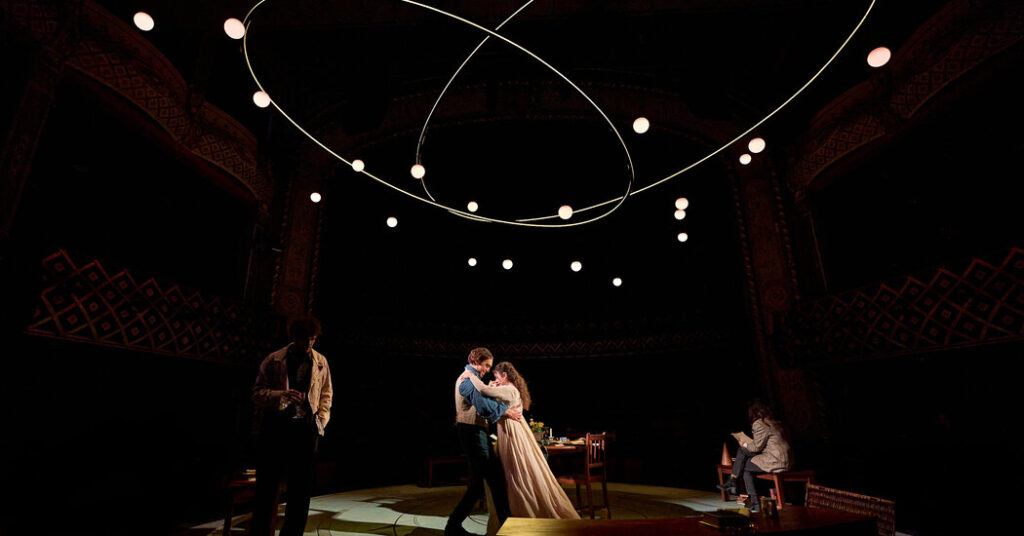
In the ethereal closing scene of Tom Stoppard’s “Arcadia,” two characters from each of the play’s twin narratives — one set in the early 19th century, the other in the late 20th — dance a tender waltz onstage. This evocative set piece, suggesting a synthesis of past and present in a single, eternal continuum, takes on added poignancy in a new revival that opened Wednesday at the Old Vic in London, just two months after the English playwright died at age 88.
Widely regarded as Stoppard’s masterpiece, “Arcadia,” which premiered in 1993, is nothing less than a dialectical inquiry into the meaning of life. The characters’ discourse covers a dizzying range of subjects — algebra, thermodynamics, botany, computer algorithms — but is underpinned by a series of simple binaries: the difference between classical and romantic temperaments; determinism versus free will; logic versus emotions; head versus heart.
These dichotomies are embodied onstage by two modern-day characters: the reserved, unsentimental author Hannah Jarvis (Leila Farzad) and the incontinently romantic scholar Bernard Nightingale (Prasanna Puwanarajah). They meet in the garden room of Sidley Park, a historic British estate where Hannah is researching a book. Bernard thinks he’s unearthed a juicy story about Lord Byron’s connection to the house, which he hopes will be his ticket to academic stardom. Although Hannah has little time for Byron, she reluctantly assists Bernard in his investigations.
While those two spar and sleuth, we are transported in alternate scenes to 1809, when Lady Croom (Fiona Button) is overseeing Sidley Park’s renovation in the then-fashionable romantic style and her precocious teenage daughter, Thomasina (Isis Hainsworth), is taking math lessons from her tutor, Septimus Hodge (Seamus Dillane). Ill-judged romantic attachments and adulterous shenanigans play out as the architectural landscape transforms from order into cultivated chaos. It seems to bear out Hannah’s curmudgeonly assertion that the romantic era brought about “the decline from thinking to feeling.”
Although the ideas are high-minded, the comedy is down-to-earth. Puwanarajah’s Bernard is a crowd-pleasing lampoon of self-regarding academics, by turns obnoxiously conceited and pathetically awkward. Thanks to the 19th-century scenes, we know that he’s misinterpreting the available evidence at every step, which gives his pursuit an almost slapstick quality. And Septimus’s brazen affair with the wife of a minor poet sets up some hilariously bawdy back-and-forth that recalls the “Carry On” movies of the 1970s.
The story culminates in tragedy, but until then it is badinage all the way; the two-and-a-half hour run time flies by in a flurry of puns, double entendres, acerbic put-downs and Wildean aperçus.
Rather than depicting the greenery of Sidley Park, Alex Earles’s understatedly stylish in-the-round set is thematically allusive. The action unfolds around a single desk at the center of a revolve stage patterned with concentric circles, above which hangs a constellation of illuminated orbs. It’s an abstract treatment, befitting a play heavy on abstraction.
That abstraction comes at a cost, though. Despite much loaded talk of “heat” in the dialogue, there is little in the way of palpable emotion. (Hainsworth’s Thomasina, played with a controlled blend of inquisitive restlessness and girlish vulnerability, is the exception.) Farzad’s Hannah gives little sense of rueful ambivalence — she comes off listlessly depressed rather than merely buttoned-up — and the male characters have their tongues in their cheeks throughout. All the characters express themselves in such a similar verbal style that the piece has the feel of a polyphonic sermon. That these shortcomings only slightly diminish our enjoyment is a testament to Stoppard’s wit.
Much has been written about the cleverness of Stoppard’s plays. He made light of it himself: In a TV interview on the eve of “Arcadia”’s 1995 Broadway premier, he remarked: “My intellectual plays, God bless them, have made no original contribution to intellectual thought.” Indeed, “Arcadia” is best enjoyed as a parlor game whose unnatural, debating-society rhythms are only tangentially related to the real world.
Stoppard’s verbal pingpong is its own aesthetic form, and in “Arcadia” it serves a specific end. The play is a homage to human curiosity, and the thrill of intellectual discovery. The process of knowledge acquisition, Stoppard suggests, is the very essence of life itself. As Septimus puts it: “When we have found all the mysteries and lost all the meaning, we will be alone, on an empty shore.”
“Arcadia” is the second London production of a Stoppard play since the playwright’s death, after the Hampstead Theater’s recent “Indian Ink.” That play, in which an academic retraces the life of an English poet who spent time in India during the British Raj, has a similar time-hopping structure, alternating between the 1930s and the 1980s. Now that Stoppard is gone, future theatergoers will come to resemble his hapless scholars, reaching back through the decades to ponder his mysteries and meanings.
Arcadia Through March 21 at the Old Vic in London; oldvictheatre.com.
The post Tom Stoppard Is Gone. In ‘Arcadia,’ His Wit Still Sparkles. appeared first on New York Times.