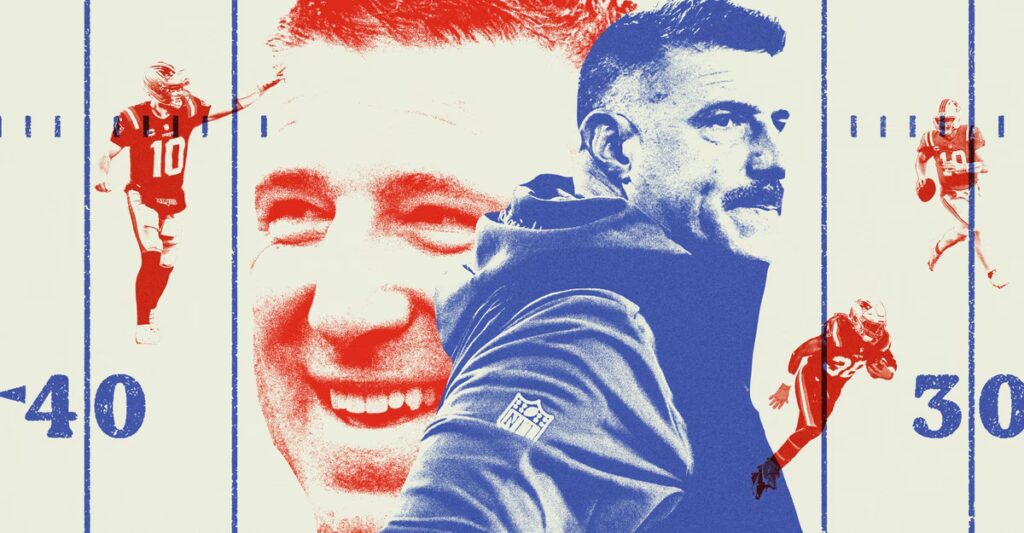
The New England Patriots coach Mike Vrabel leads from his ventricles—not from shallow-chested sentiment but from the pump action of his brawny heart, out of which blood occasionally makes its way to spurt from a split lip after a head bump from one of his players. During the team’s playoff run, the defensive tackle Milton Williams gave Vrabel a celebratory helmet to the mouth. “I forgot Vrabes ain’t got no helmet on,” Williams said, to which Vrabel, a former linebacking great, replied, “I’ve been hit harder than that.”
Anyone interested in leadership will want to take a close look at what Vrabel has done in one year of coaching the Patriots, and how he has done it. Last January, he took over a franchise that had been 4–13 in each of the past two seasons and, with a combination of hard know-how in football technique and light-handed locker-room authority, judo-flipped the team to 17–3 and a spot in the Super Bowl. A man who often seems ready to rush the field to make a tackle himself, he brings to his coaching a been-there-ness, and a drollery that treats football as the played game it is, not as the grimmest endeavor in the world.
Much of what Vrabel has done is counterintuitive. At the Patriots’ opening offseason workout in New England, he startled the players when one of the the first things he asked them to do was the “victory formation,” the kneel-down play to run out the clock when a game is won. It’s a routine action that doesn’t require much except snapping the ball, and it’s usually among the last things a team practices. Vrabel’s message: We intend to run this play a lot. He did not temper expectations. Most coaches who take over a 4–13 operation would buy themselves some time. Instead, Vrabel talked about winning the division and said, “I want to galvanize our football team. I want to galvanize this building.”
In the next months, he turned over more than half the roster, releasing a number of longtime veterans, including some members of the 2018 Super Bowl squad. Of his 53-man final roster, 30 were new players and none had been with the team more than five years. Usually, a coach with such a new collection of talent would feel urgency to install his playbook quickly. But before bothering with his system, Vrabel staged trust exercises, without any footballs in sight. One entailed setting up an obstacle course and making guys go through it blindfolded, led by a teammate from another position group. “I try to be intentional,” he said at a December press conference. The early team building, he added, was “critically important” to do “before we started dumping a bunch of plays on the guys.”
Historically, the NFL coaching profession has tended to be populated by militaristic leaders or mono-focused workaholic wonks with eyes scorched from analyzing game tape. But Vrabel wanted an outfit in which “nobody takes themselves too seriously,” he said during the playoffs. He operated as much by feel for the moment as by method, and didn’t waste time insisting upon professionalism; he simply treated players as professionals. According to Milton Williams, after the Patriots defeated the Denver Broncos in a semi-blizzard, 10–7, to win the AFC Championship, Vrabel said, “No curfew tonight. But the bus is leaving at eight in the morning, so if you ain’t on it, you ain’t playing in the Bowl.”
Such comparative easygoingness is redefining the qualities of a winning coach—at least for the Patriots. The previous man to take the team to the Super Bowl, the six-time champion Bill Belichick, was an arch headset strategist and autocrat known as “Captain Sominex” for his dark-lord voice and seeming emotional detachment. Belichick demanded excellence from his players and got it through relentless physical practice. Few dared to laugh in his presence. Vrabel asks his players for their best and says a sincere “thank you” for whatever he gets. One of his most distinctive gestures is to meet the team in the postgame tunnel for handshakes and shoulder slaps, win or lose. His players palpably love him for it. The Patriots wide receiver Stefon Diggs, who’s been to the playoffs seven previous times with the Minnesota Vikings and the Buffalo Bills, has called Vrabel “probably best coach I ever had.”
But when the Patriots play the Seattle Seahawks on Sunday, Vrabel’s philosophy will face a test—whether a team can play in the NFL without taking itself “too seriously” and still win it all.
Vrabel arrived at his style through his own personal experiences, including some lacerating ones. Drafted out of Ohio State in 1997 by the Pittsburgh Steelers, he became an undervalued backup who, in four years, never started a game. From 2001 to 2008, he rose to stardom and won three Super Bowls with the Patriots as an overachieving, desire-stoked defensive captain whose intelligence and loyal adherence to Belichick’s insistence on exacting execution made him seem indispensable—until he was traded by Belichick after he asked for too much money. Belichick delivered the news in a phone call, telling Vrabel tersely, “I traded you to Kansas City.”
Vrabel didn’t speak with Belichick for three years after that, though they would eventually reconcile at the end of his playing career, when Belichick encouraged his entry to coaching. Vrabel came away from his experience in New England feeling that Belichick had helped give him “a doctorate” in football, yet also seemingly with a clear sense of what he would do differently as a coach: rest players’ bodies and minds more, and appreciate the physicality that only a player can feel.
But as Vrabel discovered, coaching offers even less human loyalty than playing. He was hired as the head coach—and a hot prospect—of the Tennessee Titans in 2018 and made the playoffs in three out of five seasons, only to be fired by impatient ownership despite an overall winning record. He took a one-year contract as “coaching and personnel consultant” with the Cleveland Browns for 2024. Then the Patriots job opened. Belichick, too, had been fired; not even coaching a team to six Super Bowl victories can guarantee job security in the NFL. After the Patriots’ inexperienced next coach, Jerod Mayo, was also fired, Vrabel got the job because the team’s owner, Robert Kraft, knew and deeply admired him.
Still, Vrabel’s inaugural season with the Patriots didn’t begin as a pleasure trip. The team started 1–2, losing its first two games at home. The second-year quarterback Drake Maye threw an interception and fumbled in the opener against the Las Vegas Raiders. Against the Pittsburgh Steelers, Maye threw another interception, and the team lost four fumbles, including two by the running back Rhamondre Stevenson. The press hammered Stevenson, who had led the league in fumbles by a running back the previous season. Some commentators called for his benching.
What Vrabel did next alchemized his team: He stayed with Stevenson as a starter, and in his public comments cast the fumble problem as collective and fixable. His conviction was that although Stevenson needed work on securing the ball, he was one of the team’s most valuable and selfless blockers. His teammates knew this about him, but many observers missed it. Nobody on the team protected the quarterback the way Stevenson did, according to Vrabel, and he sprang crucial plays for others. Furthermore, Vrabel told the press, Stevenson’s fumbles were partly a function of other players not blocking well for him.
Vrabel’s answer was to “practice the crap out of it”—he and his coaching staff worked with Stevenson on keeping two arms wrapped around the ball. But he also encouraged the whole offense to defend Stevenson. “We also have to do a better job of protecting said person with the ball,” Vrabel said. Stevenson returned the loyalty. In Week 5, he kept his grip on the ball and tore through the line for two touchdown runs as the Patriots upset the heavily favored Buffalo Bills, on their way to a 3–2 record. Stevenson would not fumble again during the next 12 games. The new Patriots were suddenly a team to reckon with.
***
Vrabel uses his own player’s mentality to manage team challenges. Sometimes, that mentality can be hard-hitting. He doesn’t issue many rules, but when he does, they are firm decrees, and he can be caustic with violators. Regarding social media, he told players to speak for themselves but warned, “I wouldn’t try to go back and forth with somebody that’s got a lot of time on their hands.” He can be blunt to the point of insult, and his sheer physical size makes him intimidating to argue with. “He’s got a sarcasm that I haven’t really figured out 100 percent yet,” Maye said during the playoffs, “a little tough sarcasm where I want to laugh but you really don’t want to.”
Even so, Vrabel handles his players more gently than Belichick, who famously sent people home for being just a few minutes tardy in a snowstorm. Vrabel prefers to eye someone and assess whether he has a problem. “If somebody walks in the door at 7:45 and they just—there’s something on their face,” Vrabel said at his first press conference as head coach, “I would rather give that player 30 minutes or 45 minutes, however much time he needs to take care of the situation, than the seven hours he’s going to waste wearing it through the day.” Some football coaches (and bosses) motivate the people on their team by keeping them in a state of professional insecurity. Vrabel, however, has tended to emphasize what his players have done right. He has used his observational skill to make points not just about strategy but also about how small plays can become big gains through interconnectedness—that is, if every man “finishes” through the play, even if they feel like bystanders to the main action.
For instance: In one meeting, Vrabel showed the team a clip of a throw from Maye to Stevenson. Simple enough. But then Vrabel froze the tape and pointed out that two receivers had been open on the play, Kyle Williams along with Stevenson. Vrabel asked Williams something to the effect of: Did you want the ball? Were you upset you didn’t get the pass? Williams shrugged. Vrabel then restarted the tape and this time told the team to watch Williams. As the ball went to Stevenson, Williams turned, sprinted upfield, and leveled a defender with a block, springing Stevenson for a score. A short gain became a touchdown.
Vrabel wasn’t done. Next, he cued up tape of other receivers around the league not making those kinds of blocks for teammates. In sequence after sequence, the Patriots watched receivers who stopped running and jogged once the ball went to a different receiver on the other side of the field. Vrabel’s point was clear: The un-thrown blocks were opportunities lost, the difference between a six-yard gain and a game-breaker.
Vrabel searched for ways to make his study sessions amusing and unpredictable, especially at the end of a long practice week. On Fridays throughout the season, he would name that week’s game captains and show the team their highlights, but he would sew in some old high-school film of them as awkward teenagers, which made the guys capsize with laughter. “There’s some surprisingly bad high-school-football highlights,” Vrabel told reporters.
He assigned the hulking rookie offensive lineman Will Campbell to give a weekend update, and it became a running gag. Campbell would rise to his full 6-foot-6, 300-plus-pound mass and, in his bass-deep Louisiana accent, deliver uproariously profane accounts of how nor’easters and such might affect game conditions. By the end of the regular season, Campbell so loved Vrabel that he declared, “I don’t ever want to have to play for someone else.” He added, “This is the most fun I’ve had playing football since high school.”
Great football players almost never translate their onetime physical skills into sideline managerial ones. Early in his coaching career, asked if he had an established method such as the “Patriot Way” that Belichick had developed, Vrabel remarked, “I think to get a ‘way,’ you have to win. You have to be able to win championships before people start giving you ‘ways’ to do things.” If the Patriots defeat the Seattle Seahawks on Sunday, Vrabel will be just the fifth man in league history to win Super Bowls as both a player and a head coach. He will have proved that he’s not just a guy who had a hot season but a leader who deserves to enter the pantheon. And there will be a “Vrabel Way.”
The post The Coach Making Pro Football Fun appeared first on The Atlantic.