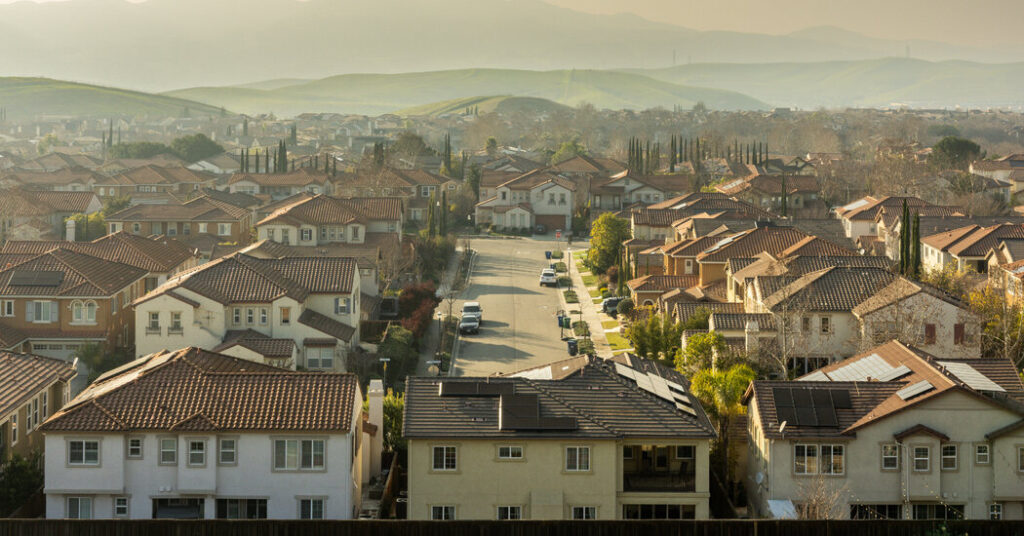
The ground has been restless in this California community 35 miles east of San Francisco. Since late last year, dozens of earthquakes have rumbled through San Ramon and its tidy neighborhoods and cul-de-sacs, disrupting the suburban calm.
They have been mostly quick, and relatively weak, rumbles occurring here and there, with a few hefty thumps in between. Until this week, they were all a magnitude of 4 or below — not powerful enough to cause any real damage, but frequent enough to make even longtime residents of this earthquake-prone region puzzle over what’s going on.
Monday brought the biggest jolt yet, and the most active day since the quakes began in November, when an earthquake with a 4.2 magnitude rattled nerves and windows. It was felt as far away as San Francisco.
“Everyone is really on edge here,” said Seema Sophia Aggarwal, who has lived in San Ramon for two and a half years. “The ground was bouncing and jerking from morning until night.”
Seismologists call waves of earthquakes like this swarms. They described the seismic activity as normal — and, crucially, said it was unlikely to be building up to a large, destructive Big One. But they don’t know when the shaking will stop, either.
There is no exact definition of an earthquake swarm, but it is generally applied to a series of earthquakes that doesn’t follow a pattern more typical to seismic events. Normally, a large earthquake is followed by aftershocks that become smaller and less frequent over time, usually in a predictable way. Earthquakes in a swarm, though, strike close in time in a concentrated area, and they are usually small and similar in magnitude to one another. They are less predictable.
Annemarie Baltay, a geophysicist with the United States Geological Survey, described it as a “continuous hum” of little quakes. A sequence can go on for days or for months, as this one has. This swarm began on Nov. 9 and has waxed and waned, with clusters of quakes followed by quiet periods.
Monday brought the most active burst yet. The day kicked off with a magnitude 3.8 earthquake at 6:27 a.m., followed by a half dozen smaller quakes. The 4.2 hit about 30 minutes later.
“I was rolling around in bed,” said Ravi Venkatesh, a San Ramon resident. “It was like being in choppy waters on a cruise ship or on a ferry, except more intense.”
The quakes continued, reaching at least 50 before Monday was over. They were the talk of the town, the conversation topic at school drop-offs and at the start of spin classes. Local online groups lit up with quake chatter every time the ground shuddered: “Here we go again.” “One more.” “They just aren’t stopping.”
Some people said they were feeling “quake drunk,” Mr. Venkatesh said.
Ambika Rajagopalan, who moved to San Ramon five years ago, said her 7-year-old daughter had slept with her Monday night, and she had considered staying with relatives in a nearby city to escape the shaking.
“Yesterday was too much,” Ms. Rajagopalan said on Tuesday.
The quakes have been centered in the southern part of the city, where Mark Armstrong, the mayor, happens to live. After one startling bump in January, he pulled up the U.S.G.S. website.
“The little dot marking the earthquake on the map was the house right behind me,” he said.
In reality, the quakes are occurring several miles under the ground — the deeper they are, the less likely they are to be felt at the surface — but shaking is felt much more intensely near the epicenters.
The number of quakes in a swarm can range from dozens to thousands. The majority are often too small to register as shaking at all. In this swarm, there have been about 150 earthquakes with a magnitude of 2.0 or above; 19 have been at 3.0 or above, the strength at which the people near the epicenter are likely to feel something. One of the most energetic swarms ever took place in Japan’s central mountain region from 1965 to 1967, and by the end, more than 700,000 earthquakes had been recorded.
Mr. Venkatesh said he sensed unease in his neighborhood, particularly among people who are new to California. In a group chat, he said, many people focused on being prepared, such as packing emergency bags, securing breakable items and installing automatic gas shut-off valves that can prevent fires in lines that might break in a large quake. A few people wondered whether they should move.
“Some people were really scared,” Mr. Venkatesh said. “I think people should focus on the scientific information.”
In the 1970s, seismologists installed a network of sensors in the San Ramon Valley that has revealed nearly a dozen swarms since then, all within a few miles of one another. This has been one of the most active, Dr. Baltay said.
Like other scientists, Richard Allen, the director of the Berkeley Seismology Lab, said that there was nothing unusual about the recent rumblings, but he acknowledged the anxiety many in the region had been feeling.
“There have been swarms like this before,” Dr. Allen said. “This is not unusual. But I fully understand how traumatizing it is when there are swarms like this, and you’re feeling it all throughout the day, and you’re being woken up at night. It is traumatizing.”
The recent activity may have heightened the fear of the Big One among some, but Dr. Baltay and others said the mechanism deep in the Earth that is causing the swarm differs from the one that causes most major quakes around the world. When a big jolt hits, and is followed by smaller aftershocks, that’s caused by the sudden release of stress on a major fault line, like the San Andreas or the Hayward, both of which course through the ground of the Bay Area.
Swarms occur for different reasons, and scientists believe the quakes in the San Ramon Valley are being set off by fluid that’s moving from deep inside the Earth’s belly into the crust. They think the crust between the many large fault systems in the region is fractured, like a broken sidewalk, with tiny cracks that are creating pathways for the fluid.
“It’s complicated,” Dr. Shelly said. “The fluids can trigger the earthquakes, and the earthquakes can help the fluids move.”
The good news for San Ramon residents, Dr. Baltay said, is that seismologists don’t think these small faults “are capable of hosting a major earthquake.”
“We’ll never say never, but we’ve never seen that a sequence like this has prompted a larger earthquake,” she said.
The major seismic hazard in San Ramon is not a swarm, but a large earthquake occurring on one of San Francisco Bay Area’s major faults. The U.S.G.S. has estimated that there is a 72 percent probability of at least one earthquake of magnitude 6.7 or greater striking somewhere in the region before 2043. Seismologists believe a large quake is most likely to occur on the Hayward fault, which rests between San Ramon and San Francisco, but at that strength, damage would be widespread across the region.
Mayor Armstrong said San Ramon was prepared for the Big One, with annual emergency training sessions and an operations plan for how to respond.
“All of this was already in motion, but this recent swarm has given our work to prepare a greater sense of relevance,” said Mr. Armstrong, who previously worked for the Federal Emergency Management Agency. “I’m not worried about the swarm, but we don’t take this lightly either.”
Amy Graff is a Times reporter covering weather, wildfires and earthquakes.
The post People in This San Francisco Suburb Would Like the Earth to Just Stop Shaking, Please appeared first on New York Times.