It was the final two minutes of a lopsided game in 2018 when a ferocious tackle left Buffalo Bills quarterback Derek Anderson lying face down on the turf. For a few seconds, he couldn’t move.
With fog in his brain and ringing in his ears, Mr. Anderson managed to stand up and walk back to the locker room. When his father came in to check on him, Mr. Anderson broke down into tears. He knew he’d played the last game of an N.F.L. career that had spanned 14 seasons. He had just suffered his seventh diagnosed concussion.
Over the years, doctors had offered shifting and largely ineffective advice on how to deal with the frequent head trauma. He’d once been sent to sit quietly in a dark room in the bowels of The Meadowlands, where he and another injured player took turns vomiting into a trash can. Other times, doctors had directed him to exercise, or sit in a hyperbaric chamber, or float in a sensory deprivation tank.
But Mr. Anderson found his mind in persistent turmoil, even years after he quit the game. When he wasn’t lashing out at strangers and family members, he was numbing his anxieties with alcohol or just lying in his bedroom, unable to shake his depression. Two years ago, he found himself alone in a hotel room with a gun, contemplating suicide.
In desperation, Mr. Anderson began looking for alternatives beyond conventional medicine. Last month, he traveled to a clinic in Denver, where he and another former N.F.L. star, the linebacker Brian Cushing, were undergoing a new treatment for chronic traumatic head injuries that is both traditional and experimental: psilocybin mushrooms.
For him, there was too much at stake not to try. “This brain isn’t working how I know it should work,” he said.
Mushrooms have been under heavy federal restrictions for decades, part of the government’s 1970s crackdown on L.S.D. and other hallucinogenic substances. But in recent years, as research began showing the potential for psilocybin to help those with addiction, depression or post-traumatic stress disorder, three states have opened the door to legalization, with regulated centers where people can consume mushrooms under the guidance of a licensed specialist. The Food and Drug Administration is considering whether to approve psilocybin nationally as a treatment for severe depression.
The Department of Veterans Affairs is also funding research into psychedelic therapy as some veterans have sought to use ibogaine, another psychedelic, to treat post-traumatic stress disorder and brain injuries.
Dr. Frederick Barrett, the director of the Johns Hopkins Center for Psychedelic and Consciousness Research, cautioned that there are risks to taking psychedelics, especially for those who consume them without supervision. He said that some people who have taken mushrooms in uncontrolled settings have experienced prolonged psychosis or detachment from reality.
“It’s not the kind of thing you want to do on your own,” Dr. Barrett said.
Still, he said, early research suggests that psychedelics can increase neuroplasticity, opening up periods of new learning and development that can serve as a jump start for some people struggling to overcome psychological issues. He said that while psychedelics are unlikely to repair the physical damage caused by brain injuries, they might help the brain adapt to work better within its new limitations.
“The thing that gets me excited about all of this is the idea, the possibility, that we have something that works better than treatment as usual,” Dr. Barrett said.
As they began their latest treatment session in January, Mr. Anderson and Mr. Cushing took some deep breaths and then poured mounds of dry mushrooms into their palms. They decided to take it slow.
“It’s like old popcorn,” Mr. Cushing said as he chewed.
“That’s not even close to the worst thing I’ve ever eaten,” Mr. Anderson added.
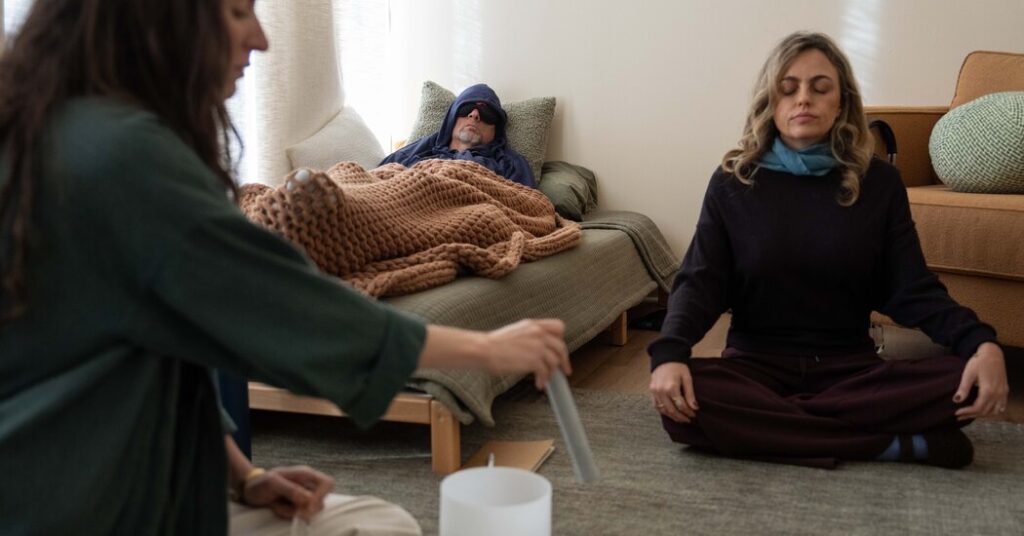
They settled themselves onto low-platform beds, donned eyeshades and waited for their journeys to begin.
A series of concussions
For both men, years of football’s violence had taken a toll on their heads.
After being hit during a college game in Arkansas, Mr. Cushing recalled, he had to make his way to the sidelines and ask a teammate where they were and whom they were playing.
“The next day, watching film, I was like, ‘I don’t remember that play at all. How did I know where to line up and make a tackle?’” he said.
But his unrestrained style of play, which led to injuries requiring 27 surgeries over his career, had become part of his brand and helped him become a first-round draft pick. In one famous instance, blood streamed down from his forehead to his chin after a face-to-face confrontation in which he was not wearing his helmet. He found himself compelled to maintain that level of aggression even in practice, downplaying any wooziness that might result.
“If you’re not, everyone’s questioning, ‘What’s wrong with you? Why are you being soft?’” Mr. Cushing said.
The long-term risks of head trauma have become increasingly apparent. The N.F.L. has increased penalties for dangerous hits, improved helmets and brought in observers who can intervene when players show signs of a concussion. Still, head injuries remain a constant threat, and players have battled a range of longer-term effects, including chronic traumatic encephalopathy, a neurodegenerative disease linked to head trauma that has been found in the brains of deceased athletes.
The research on psilocybin and brain injuries is still in its infancy. Last year, researchers at Northeastern University, trying to simulate the velocity of an N.F.L. collision, repeatedly struck the heads of rats and then provided them with psilocybin. They found that the compound helped restore the brain function that the rats had lost.
Mr. Anderson had also suffered a series of concussions during his career, with N.F.L. doctors at one point advising him that he would not be cleared to play if he suffered another.
The collision that knocked him out of the game in 2018 was not extreme in the world of N.F.L. tackles. But it came right after a previous play in which two defenders had taken him down in the backfield, his head striking the turf.
His ears would be ringing for the next six months.
Searching for help
It wasn’t until six years later, in 2024, when Mr. Anderson realized how deeply his mental health had deteriorated. He was constantly angry, lashing out at people in the grocery store or yelling at his family. He spent many days in bed, numbing his depression and anxiety with 10-14 alcoholic drinks a day. His wife kicked him out of the house.
A friend, with help from his wife, convinced him to seek help at a mental health and addiction treatment facility, where he stayed for 30 days.
He went through hours of testing and was told that he had suffered permanent damage to his brain that would limit his healthy years of life. He could only work to preserve what he had.
Mr. Cushing was hearing a similar message.
Separately, they both found Daniel Carcillo, a former National Hockey League player who had himself suffered many concussions and retired at the age of 30 after being diagnosed with early-onset dementia, along with a range of other psychological problems.
In 2019, Mr. Carcillo had tried psilocybin mushrooms. Brain scans before and after his treatment, he said, showed significant improvement in brain function. He found that his headaches and mood improved.
He started a business, Experience Onward, to guide people suffering similar problems through psilocybin sessions. He has since worked with some 200 former professional athletes and is preparing to begin a study with Johns Hopkins that would track former professional athletes and military veterans before and after their mushroom sessions.
What they all have in common, he said, is their experience with a wide range of treatments — antidepressants, stroke rehabilitation centers, vestibular therapy, hyperbaric chambers, stem cells, sensory deprivation tanks — that didn’t seem to work.
“It’s a pretty lonely road,” Mr. Carcillo said. “Concussion survivors can get hopeless pretty quickly.”
‘A reset of your mind’
Mr. Anderson and Mr. Cushing first tried psilocybin therapy about a year ago in private sessions, assisted by Mr. Carcillo, and reported a vast improvement in their mental stability. They described feeling more calm, having more impulse control and feeling more excitement about life.
Last month, the men went through a second treatment, this time together. After checking in at the facility in Denver, Mr. Anderson and Mr. Cushing put on slip-resistant socks and settled onto beds in a room with floor-to-ceiling drapes that filtered the sunlight beaming through the windows.
The facilitators had asked the men to prepare mantras that would keep them oriented during the session. “Forgive myself,” Mr. Anderson decided. “Let go,” said Mr. Cushing.
Shortly after the men swallowed the mushrooms, Kayli Howard, who specializes in psilocybin-assisted therapy, talked to the men about longstanding Indigenous beliefs about the power of mushrooms to heal.
“By taking these mushrooms, you are re-entering into the age-old tradition used in societies from time immemorial,” she told them.
As the men pulled coverings over their eyes, Ms. Howard laid out singing bowls, tapping and rubbing the instruments to fill the room with resonating sounds. Another facilitator, Carolina Correa, wafted a stick of burning palo santo wood, which is used in meditation practices as a cleansing incense.
The men drifted off. Mr. Cushing stayed rigid on his back, describing later how his mind had spun through a series of scenes, including one with his wife from years back, when they first met. Mr. Anderson, who spent much of his time curled into a fetal position, recalled seeing his daughter peek into view as if checking on him.
At one point, Mr. Anderson felt an urge to check on Mr. Cushing.
“Tell him I’m with him,” Mr. Anderson said through the facilitators.
“I’m with you too, buddy,” Mr. Cushing replied.
In the weeks since, Mr. Anderson said he has felt an improvement in his ability to gather his thoughts and convey them. He described a three-hour conversation with his wife that he felt he wouldn’t have been able to manage before.
Mr. Cushing said he has found himself waking up earlier, eager to take on tasks that he previously would have dreaded.
“It’s like a reset,” he said. “If I had to explain it to people that have never gone through it, it’s a reset of your mind, your intentions, your motivations.”
But both said there was more work to be done. Whatever they gained from the treatment, they wanted to make sure it did not slip away.
Audio produced by Tally Abecassis.
Mike Baker is a national investigative reporter for The Times, based in Seattle.
The post N.F.L. Careers Scarred Their Brains. Could Mushrooms Provide Relief? appeared first on New York Times.