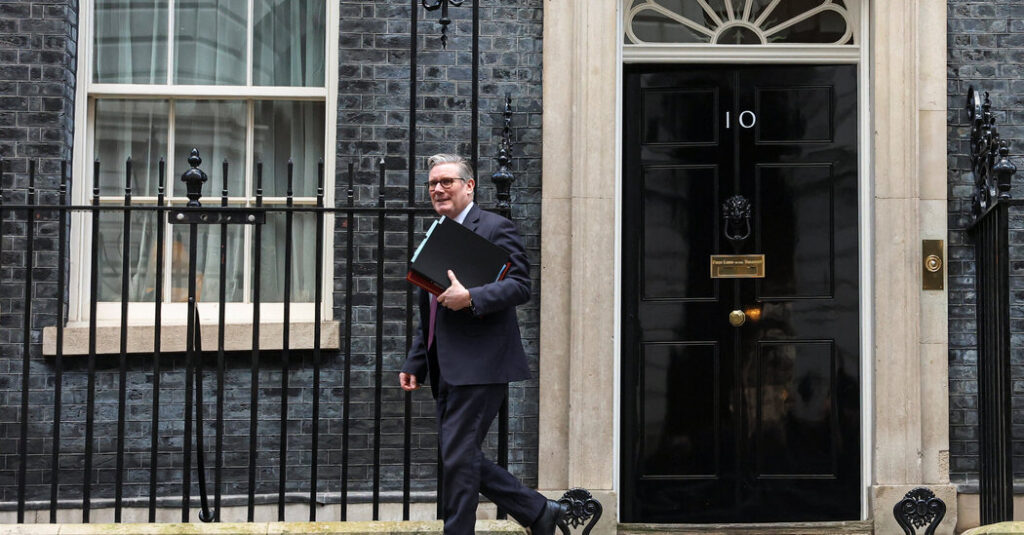
Prime Minister Keir Starmer of Britain on Thursday tried to dampen a wave of anger from lawmakers in his own party, and even some calls to step down, after new revelations about the friendship between his former ambassador to the United States and the convicted sex offender Jeffrey Epstein.
Before a preplanned speech on poverty in southern England, the prime minister accused the former ambassador, Peter Mandelson, of “deceit,” adding, “None of us knew the depth of, the darkness of that relationship.” He vowed to hold Mr. Mandelson accountable and apologized to Mr. Epstein’s victims.
“I want to say this,” he said. “I am sorry, sorry for what was done to you, sorry that so many people with power failed you. Sorry for having believed this man’s lies and appointed him. I’m sorry that even now you’re forced to watch this story unfold in public once again.”
Under intense questioning in Parliament on Wednesday, Mr. Starmer, the Labour Party leader, admitted that he had been aware of a relationship between Mr. Epstein and Mr. Mandelson when appointing Mr. Mandelson to the diplomatic post at the end of 2024. But Mr. Starmer accused Mr. Mandelson, a veteran Labour Party politician, of “a litany of deceit” about the extent of the friendship.
“He’s betrayed our country,” a visibly angry Mr. Starmer told the House of Commons.
The explanation has done little to subdue a surge of questions by Mr. Starmer’s critics about whether he failed to exercise good judgment in hiring Mr. Mandelson. Several members of Parliament from Mr. Starmer’s party came close to saying that he should consider stepping down.
“I think that he needs to think very hard about what is in the country’s best interest, what is in his party’s best interest,” Barry Gardiner, one of those lawmakers, told the BBC on Wednesday night.
When Mr. Gardiner was asked whether that was a “yes” on stepping down, he remained silent for several moments.
John McDonnell, another Labour member of Parliament, told the broadcaster ITV: “I think he should consider his track record. Is he performing the role responsibly? And I think the responsibility is on his shoulders to think whether he’s doing the right thing by staying on.”
Mr. Starmer, whose party swept into power 18 months ago, had already been struggling with record-low approval ratings amid a faltering economy and repeated flip-flops by his government. The prime minister’s Labour allies are fearful that the latest scandal could do even more to drag down the party’s fortunes in a special election scheduled for this month, and in elections in Wales and Scotland in the spring.
Among the huge number of files released last week by the U.S. Justice Department were ones detailing how Mr. Mandelson had leaked sensitive documents to Mr. Epstein, had appeared to accept money from the disgraced financier and had engaged in numerous, crude exchanges.
News headlines on Thursday morning were among the most brutal Mr. Starmer has faced since moving into No. 10 Downing Street.
“Labour MPs say Starmer’s days as PM are numbered,” The Guardian wrote. The Times of London headline read, “Starmer ‘in serious trouble’ over Mandelson’s Epstein links.” The Sun, a tabloid, called the swirling scandal Mr. Starmer’s “DAY OF RECKONING.”
The Mandelson-Epstein story shows no signs of abating.
In one of the newly released documents, written in 2009, just after Mr. Epstein was released from prison, Mr. Mandelson wrote, “How is freedom feeling?” Mr. Epstein replied, “She feels fresh, firm and creamy,” to which Mr. Mandelson wrote, “Naughty boy.”
Mr. Mandelson has said in the past that he regrets his association with Mr. Epstein but that he has never done anything against the law.
Mr. Starmer had already fired Mr. Mandelson in September when evidence first emerged that Mr. Mandelson and Mr. Epstein were close. But after Mr. Mandelson’s name appeared thousands of times in last week’s huge release of Epstein files, Mr. Starmer went further, under pressure from members of the opposition Tory Party and Labour lawmakers.
First, Mr. Mandelson was pushed to resign from the Labour Party. Then, Mr. Starmer forced Mr. Mandelson to give up his membership in the House of Lords. And on Tuesday, the prime minister referred Mr. Mandelson to the police for possible criminal prosecution for revealing government secrets.
On Wednesday, Mr. Starmer agreed to go yet further by saying that he would release previously private communications between members of his government during the time that Mr. Mandelson was named U.S. ambassador. Mr. Starmer’s allies said that the communications would show that Mr. Mandelson had lied to them when his appointment was being considered.
“Mandelson made out that relationship barely existed, that they hardly knew each other,” the British housing secretary, Steve Reed, told LBC Radio. “We need to look at the documents that will show the extent to which Peter Mandelson was lying.”
But that effort has stalled after the Metropolitan Police issued a statement urging the government not to release any communications that might interfere with the investigation that Mr. Starmer initiated this week.
“As with any investigation, securing and preserving any potential evidence is vital,” Commander Ella Marriott of the Metropolitan Police said in the statement. “We therefore asked them not to release certain documents at this time.”
In his speech on Thursday, Mr. Starmer said that he wanted to release more of the communications but that he would not do anything to imperil the investigation.
“I will not take any step, however politically tempting, however popular, that risks justice for victims, because this is not and must never become a political game,” he said.
Michael D. Shear is a senior Times correspondent covering British politics and culture, and diplomacy around the world.
The post Starmer Faces Storm of Criticism Over Ties Between Ex-Ambassador and Epstein appeared first on New York Times.