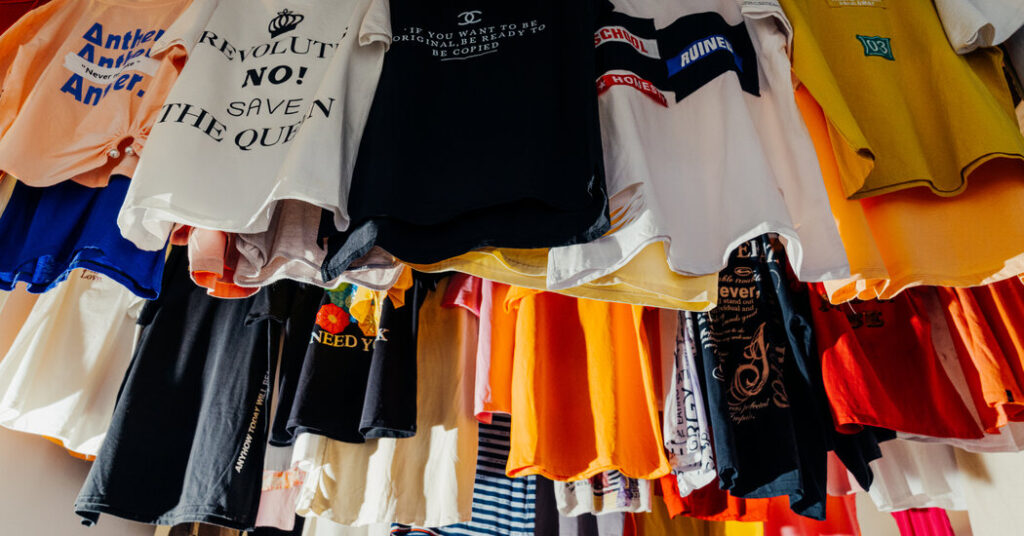
It’s worth remembering that every piece of clothing you own is at least partly handmade. The term “fast fashion” evokes an endless stream of cheap apparel churned out by machines, but humans feed those machines with fabric. Underpaid and dangerous labor, and wanton overproduction, continue to make today’s global garment industry possible.
“The Endless Garment: Atlantic Basin,” a group show of designer clothing, sculptures and videos at Pioneer Works in Red Hook, Brooklyn, adds human nuance to the textile trade, and to the story of globalization in general. Exploitation and waste are the exhibition’s distant backdrop, not its focus.
Organized by Jeppe Ugelvig, a curator and scholar of consumer culture, the show follows an earlier version in 2021 at X Museum in Beijing. The New York installment features nine artists, designers and collectives with ties to Southeast Asia, particularly Taiwan, and its diasporas in the United States.
Their aesthetics vary widely, from monochrome work wear to layered mash-ups of frantic patterns. These makers draw inspiration from the constant churn of fast fashion, and the confluence of cultures and styles that the internet provides.
The show takes it title from “The Endless Garment,” a continuing project by the New York artist duo Shanzhai Lyric (Ming Lin and Alex Tatarsky). Since 2015, they have collected mass-produced clothes bearing off-key and mistranslated English phrases, ranging from feisty (“Same Chic Different Day”) to tragic (“Don’t Forever”). The project reframes “shanzhai,” a word for the irreverent bootlegging of name-brand goods in China, sometimes using the same machines that produce the high-end versions. In Lin and Tatarsky’s project, “shanzhai” clothes aren’t mistakes or imitations but a culture in itself, consciously based on quirky “misunderstandings.”
Shuttling between cultures seems to soften the borders of authenticity. The fashion collective CFGNY (Concept Foreign Garments New York) presents a series of photographs in bulky cardboard frames, hung in a cardboard-lined room, recalling bales of flattened boxes. The models wearing their clothes pose in commercial portrait studios in Ho Chi Minh City, Vietnam, where customers can pick from a menu of backgrounds, props and makeup.
Each outfit is a pattern party. One pair of stovepipe pants has pink lamé on top, a dingy op-art design below the knee, and pockets in brown faux shearling. A pale, swirling sheath dress is fairly conventional, except for the plush Pikachu doll sewn into a womblike pouch of tulle on the front.
CFGNY has called its aesthetic “vaguely Asian.” The maximalist fabrics and clashing textures are anchored by relatively restrained cuts. They sometimes hire tailors in Southeast Asia that cater to tourists — a bespoke sort of fast fashion — who augment the artists’ designs with detailing meant to satisfy generic Western tastes. Such exchanges aren’t ersatz. They are their own contemporary style: CFGNY’s fashions incorporate, and transcend, Asian and Western tropes.
It’s important to underscore that the garment industry didn’t relocate to China in one big wave. Instead, it moves in trickles and eddies. Pioneer Works is near a port on the East River that, in the late 19th century, was a terminus of the Erie Canal; Red Hook’s warehouses once stored Southern-grown cotton on its way to Northern factories. Eventually, textile makers went to factories in the South, chasing lower wages.
This mercenary logic holds within Asia too. Across several works, including photo portraits and signage painstakingly rendered in pencil, the Taiwanese artist Huang Po-Chih traces the arc of his mother’s working life in Taiwan: first on a farm, then in a textile factory, then — when that industry was relocated to Shenzhen, China — back to the fields.
There’s certainly a hint of human misery here, as — to put it mildly — individual garment workers are buffeted by sea changes in their notoriously punishing profession. Huang’s work refers to his mother as a “blue elephant,” hands stained and ankles swollen from long hours sewing denim.
But there’s an elephant in the room, too: the abysmal working conditions in the industry. That omission seems deliberate. The stories these artists tell are not held up as evidence of greater systemic ills, but offered as personal examples of adaptation and wit. Survival, but with some joy.
And some melancholy. Two artworks by Serena Chang, an audio piece in the stairwell and a video playing in a wall-mounted sculpture, provide the show’s dusky soundtrack of crickets, frogs and humming machines. Stands of bamboo made from steel rods sheathed in hosiery from Chang’s family’s company, Sheerly Touch-Ya, cast elegiac shadows.
The show’s critique of labor is also gauzy. The wispy, frayed pieces by the label Use Value (the artist Chang Yuchen) draped over racks made of lumber push the limits of wearability. Many seem to be held together with just a few stitches of red thread. Notes on the racks break down the price of specific pieces, including the artist’s labor time — calculated as the cumulative average of her hourly wages from her employers.
Stereotypes of Asian economies often jump straight to sweatshops, but these artists try to thwart such assumptions. You expect clothes made in Asia to be cheap? CFGNY’s aren’t. You think textile companies are massive and faceless? Sometimes they’re a mom and pop shop. In this sense, it’s a political stance to make a show about fashion and the Asian diaspora that doesn’t foreground the textile trade’s abuses.
“The Endless Garment” alludes to the interminable hours of labor imbued in the modern garment industry by people who will never get all that they deserve. But despite that, it shows artists and designers finding meaningful, vibrant paths through the currents of global commerce.
Is it a moral failing not to take every opportunity to condemn human suffering? This ambivalent show seems to say: Yes, there is endless suffering, and we also live our lives.
The Endless Garment: Atlantic Basin
Through April 12, 2026. Pioneer Works, 159 Pioneer Street, Brooklyn; 718-596-3001, pioneerworks.org.
The post The Churn of Fast Fashion, Slowed Down appeared first on New York Times.