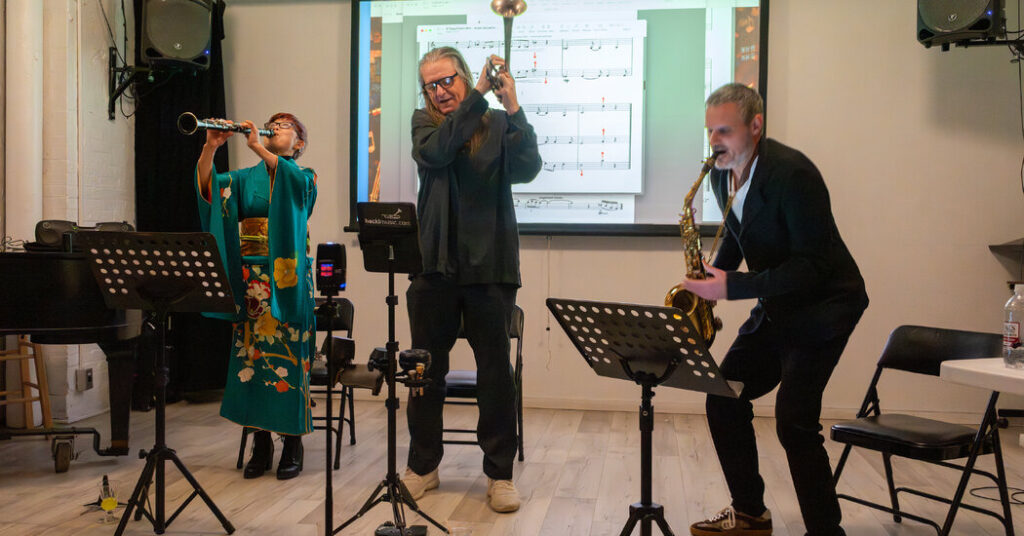
Midway into a performance by the Composers Concordance at Westbeth on Sunday, the composer Gene Pritsker let out a cry: “Is there a doctor in the house?”
The emergency was not medical but technical. Pritsker, a concert organizer, wanted to make sure the performers were legally drunk so the concert could proceed. Yet the musicians’ repeated rounds of wine, gin and Pernod failed to move the breathalyzer beyond 0.058 — short of the 0.08 percent blood alcohol level that New York State law considers evidence of intoxication. Not that anyone was going to be driving home. A blood test, someone suggested, might be more accurate.
The readings threatened to derail the experiment. Titled “DWI: Drinking With Instruments,” the evening presented two sets of the same thorny new music: the first time played sober, the second, drunk.
This lighthearted conceit touched on serious questions. In classical music, alcohol has often been used to alleviate performance anxiety. Conservatory-trained musicians are expected to execute written texts flawlessly while sounding convincingly fluid and expressive. Loosening inhibition can seem like a solution to both anxiety and excessive rigidity.
But alcohol is a blunt tool. Taken to excess, it dulls judgment, slows reaction time and interferes with fine motor control and breath coordination. The same muscles that make intoxicated people slur their speech are enlisted in playing wind and brass instruments. Increasingly musicians have turned to beta blockers, which dampen physical symptoms of stress without liquor’s cognitive and motor side effects.
To investigate how those side effects play out, the Composers Concordance devised a program of works deliberately designed to trip up the players: fastidiously notated flights of virtuosity; groove-based pieces that lean on jazz; a graphic score for a group improvisation. (A video projection showed the scores the performers were reading.)
The control group established by the opening set was impressive. The saxophonist Todd Rewoldt navigated the thicket of runs in Pritsker’s “Everything” with clean articulation and fiery sound. The trumpeter Franz Hackl rendered Seth Boustead’s “On the Rocks” with a warm, centered tone across its softly slurred arpeggios. The clarinetist Michiyo Suzuki, composing under the name Ginka Mizuki, gave a gracious performance of her “MA (Time-Space),” a work for live and recorded clarinets in which the soloist has to mold silences to the electronic tape without a click track to keep time.
Then came the drinking. To boost circulation and intoxication, all three performers reconvened for Mizuki’s “Tipsy Chairs (The Wasted Entertainer),” a collage of ragtime, nursery rhymes and absurd choreography that required the players to bob up and down from their chairs. Drinks were downed at alarming speed. That breathalyzer, though, refused to budge.
In the end, Rewoldt returned to the stage with only his glassy eyes to vouch for his drunkenness. Now the sextuple runs in “Everything” smudged together. In Charles Coleman’s “Move It,” he treated one rest marked with a fermata as an invitation to take a breather, cross-legged, on the floor.
Hackl’s repeat of “On the Rocks” fared worse in the instrument’s higher reaches. Arpeggios croaked, notes collided; one exclamation emerged as a cocktail of trumpet and spittle. Yet in his own jazz-inflected “Rhythm Diandle,” improvised riffs floated easily, rhythms snapping against the piano part with relaxed swing.
Suzuki appeared least affected, though she briefly lost coordination with the recorded track.
Afterward, I talked to the performers. Leaning in to hear, I breathed in sharp liquor fumes on their breath. Suzuki said she was surprised by how well she had maintained control of her clarinet. “But feeling the timing in the pauses got harder,” she said. “I just felt numb.”
Rewoldt, who had downed five double shots of gin, said his vision was the first casualty. “My eyes couldn’t focus on the music, critically,” he said. “I was relying completely on muscle memory.” As for tempo: “Everything was hitting me too fast.”
But Hackl said three glasses of wine and two of gin had only selectively hampered his music making. “Whatever has to be precise becomes more difficult,” he said. “But what’s based on rhythm, where you just lay back and feel, becomes easier.”
That distinction gets at something deeper. Classical performance demands intense cognitive focus alongside fine motor control. But it also depends on instinct so that timing can breathe and phrases take on emotional life. Where the composer insists on control, a tipsy performer risks sabotaging the work. Where the performer is granted more agency, loosening inhibition can free a flicker of Dionysian inspiration.
Robert Voisey’s “Knots,” a graphic score of looping lines for three instrumentalists, put that idea to the test. Hackl said he found it easier the second time around. A few drinks make it easier to free yourself from a notated score and so “defy what you were brought up with in academia.” he said.
Rewoldt, however, had the opposite experience. It was easier, he said, to pay attention to the stopwatch timing the players while sober. “But drunk, I didn’t really care,” he added, swaying slightly. “I was just like, as long as it felt correct, and everyone agreed on it, then we’d be OK.”
The post And One for Mahler … Experiments in Drunk Music Making appeared first on New York Times.