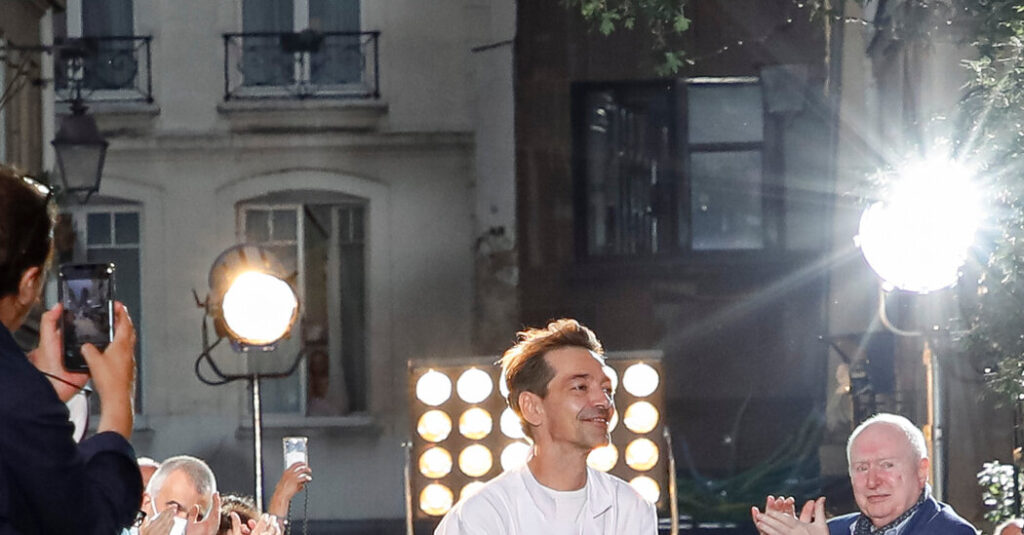
For the first time in Versace’s 48-year history, its creative vision has been placed in the hands of someone born outside of Italy. Today, Pieter Mulier, a Belgian fashion designer who for the past five years has been the creative director of Alaïa, was named chief creative officer at Versace.
In a news release, Versace’s executive chairman Lorenzo Bertelli wrote that he believed Mr. Mulier “can truly unlock Versace’s full potential.” He will assume the job on July 1.
It doesn’t require a red-string conspiracy theorist to visualize how the appointment came to be. In early December, Prada Group closed on its deal to acquire Versace for $1.4 billion. Days later, Dario Vitale, an Italian designer who had assumed Versace’s creative direction from Donatella Versace just eight months earlier, was abruptly forced out.
Immediately, Mr. Mulier’s name began to swirl as Mr. Vitale’s successor. Those rumors grew louder when it was announced in late January that Mr. Mulier would be stepping down from Alaïa. His final collection for the house will be presented in March.
“Over the past five years, Pieter and the exceptional team he led have shaped Alaïa’s creative renewal,” Alaïa’s chief executive, Myriam Serrano, wrote in a release, which did not name a successor for Mr. Mulier.
When you factor in friendships, he is an obvious choice for Versace: Mr. Mulier, 46, spent much of his career until his time at Alaïa working alongside Raf Simons, a fellow Belgian designer who since 2020 has been co-creative director of Prada.
A graduate of the Institut Saint-Luc in Brussels, where he studied architecture, Mr. Mulier had been Mr. Simons’s right hand at both Christian Dior and Calvin Klein. (Fashion is a shallow sandbox: Matthieu Blazy, Mr. Mulier’s former partner, who likewise worked with Mr. Simons at Calvin Klein, is today Chanel’s artistic director.)
Thus Mr. Mulier’s appointment at Versace on the surface looks like one friend bringing a longtime creative compatriot back into his corporate fold. This, though, gives short shrift to Mr. Mulier’s independent reputation.
At Alaïa, Mr. Mulier’s designs could demonstrate both assured theatrics and prosaic elegance. He served up aubergine cocoon coats, clingy off-the-shoulder dresses and lustrous, belted leather jackets with a 1980s verve. A show at the Guggenheim in 2024 demonstrated the breadth of his tastes: Models wore clinical white minidresses, like “Star Trek” doctors; denim pants as wide as curtains; ruched skirts; and dresses that recalled Yves Klein forms.
Not all his ideas landed: An Alaïa show last year featured models with their hands restrained under tubular dresses, a concept that some interpreted as Mr. Mulier’s unnecessarily restricting the women he was supposed to make glamorous.
Yet, overall, Mr. Mulier’s Alaïa earned raves. When he joined, he had large shoes to fill. Azzedine Alaïa, the Tunisian couturier who started the company and died in 2017, was held up as a designer with a preternatural understanding of how to imbue women with elegance and assuredness.
But Mr. Mulier lifted Alaïa, owned by the luxury conglomerate Richemont, from an idiosyncratic jewel box to a competitive fashion business, drawing new retailers and Rihanna to his shows. His mesh ballet flats, essentially a wisp of cheesecloth affixed to a gossamer sole, were an oft-copied trend. In late 2024, the company was selling tens of thousands of pairs annually, the designer said in an interview that year with The New York Times, providing a firm foundation for a business that Mr. Mulier said had grown in sales volume by about 10 times since he started.
At Versace, Mr. Mulier will again have large shoes to fill, but under a far different context. Mr. Vitale’s lone Versace runway show had been the pleasant shock of Milan Fashion Week in September. A veteran of Miu Miu, where he worked under Miuccia Prada, Mr. Vitale was a relative unknown when he took the job at Versace.
His debut collection was provocative and winsome, jammed with lurid “Dick Tracy” colors, shirts slashed to reveal peekaboo cutouts, Deco checked prints (a seeming nod to Gianni Versace’s love of Miami), oddball proportions and trousers that were purposefully bunched at the crotch. Young celebrities like Addison Rae, Olivia Dean and Lorde were soon wearing Mr. Vitale’s Versace creations, and eager retailers were raring to see shoppers respond to the new Versace look.
Whatever sparked the collection, it was swiftly snuffed out. Some in the industry now believe that Mr. Vitale took the job knowing that his former bosses were going to fire him. That may be so, but regardless, it is natural that Versace’s new owners at Prada Group would want to put their own imprint on the brand. For that, they certainly didn’t look far outside their social circle.
Jacob Gallagher is a Times reporter covering fashion and style.
The post Versace Didn’t Look Far for Its Next Designer appeared first on New York Times.