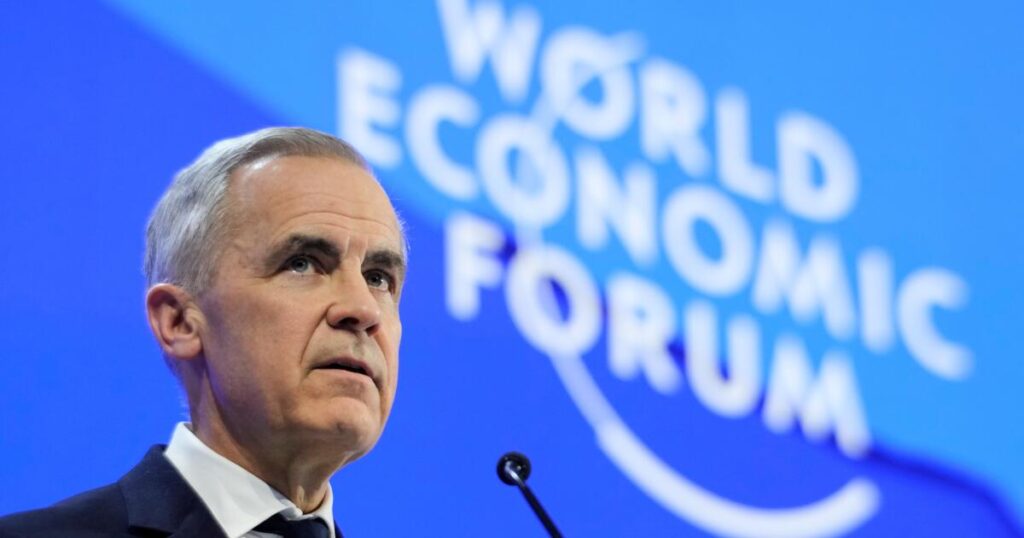
What a difference a single year makes. The once-dominant push to radically reshape society in hopes of averting climate catastrophe has collapsed. Look at Davos, the talkfest long dominated by climate advocacy. That consensus has been all but abandoned by its once strongest proponents.
Emblematic of the shift: European Commission President Ursula von der Leyen didn’t mention the climate transition even once in her 2026 Davos, Switzerland, talk after putting it front and center in preceding years.
But it’s not just the Europeans. Canadian Prime Minister Mark Carney once called for “a global net zero commitment” to solve climate change, which he saw as “an existential threat.” Now Carney admits that the “architecture of collective problem-solving” long supported by World Economic Forum elites — and including United Nations-organized climate change summits — has been “diminished.” At home, he’s pledging to make Canada into an “energy superpower.”
In the U.S., Democratic politicians have stopped leading with climate change as a central issue, shifting focus to affordability, low energy prices and immediate economic relief instead. New York City Mayor Zohran Mamdani, the democratic socialist winner of last November’s election, campaigned on rising grocery bills and housing costs, and barely discussed climate change.
This global shift is not all down to the election of President Trump. Voters have become sick and tired of constant climate alarmism, meaning many climate advocacy voices like environmentalist and author Bill McKibben have had to dial back their rhetoric. Shouting about doomsday is failing to deliver political gains.
Other issues have become much more important to voters, and people are reading and watching climate change news less across the global north. The media itself has less to say: According to a Washington Post analysis, 2025 saw the fewest media mentions of climate change since it started keeping track in March 2022.
A Searchlight Institute poll highlighted that voters in battleground states are prioritizing pocketbook concerns over abstract environmental threats, with political strategists advising against talking about “climate change” altogether because “when leaders say the words ‘climate change,’ voters get bad vibes.”
This course correction means that the media and leftwing politicians are catching up with the public, who say climate change ranks low even compared with other environmental concerns. A Pew Research Center global survey from August found that many high-income countries have seen a mass reduction in concerns around climate change as a major threat.
This recalibration even extends to advocacy groups and observers, who have retreated from confrontational doomerism.
This retreat is good for sensible policy, because the failed alarmist approach relied on a series of persistent misrepresentations. Take the claim that extreme weather events, because of climate change, have dramatically made us worse off. This is simply untrue.
Deaths from climate-related disasters including storms, floods, droughts and fires have declined sharply over the past century, with the last decade seeing some of the lowest numbers on record, despite global population quadrupling. In the 1920s, the global death toll was near half a million per year on average — last year it was less than ten thousand, a reduction of more than 97%.
This progress results from better warnings, stronger infrastructure, improved disaster response and overall societal wealth that enables such protections. Adaptation through innovation has proved far more effective than fear-driven restrictions.
Another big fib is the idea that China is rapidly going green. The reality is that China is massively reliant on fossil fuels just like everyone else. Half a century ago, China got 40% of its energy from renewables — when it relied on burning wood and dung because its people were poor. As Chinese people have since become massively wealthier, fossil fuels peaked at producing 92% of the country’s energy in 2011 — and that figure has only ebbed slightly, to 87% in 2023, the last year for which there are data.
Ambitious commitments made at successive climate summits that would redirect enormous financial flows toward green projects in poor countries have proved illusory. Rich countries continuously failed to honor their $100-billion per-year climate finance promiseand — to make matters worse — largely repackaged development aid that could otherwise have helped fight hunger and diseases
Activists and politicians demanded urgent, economy-wide transformations, insisting that only massive shifts could avert climate disaster. They mobilized calls for trillions to flow from taxpayers and conventional industries into renewables. Those grand visions have faltered, and private capital has been all but withdrawn amid high risks and uncertain returns. What was presented as an inevitable tidal wave of sustainable finance now appears more like a passing blip.
Europe provides the starkest warning of idealism clashing with reality. Germany’s vaunted energy transition has been a textbook case of climate scares driving poor but immensely costly decisions. Now, Chancellor Friedrich Merz confesses that Germany has achieved “the most expensive energy transition in the entire world.”
A large part of the cost comes from prematurely shutting down nuclear plants that were reliable, low-carbon and already fully paid for. Instead, German policymakers increased reliance on coal and gas drove up emissions and saw electricity prices skyrocket. Merz now admits “it was a serious strategic mistake to exit nuclear energy.”
The transition from exaggeration to muted realism among the leaders at Davos is at least some progress. This reflects recognition that exaggerated fear tactics have led to public disconnection, bad policies and political backlash. Now we need to focus on what works. For now, we should deliver cheap, secure energy to boost prosperity while we innovate for a greener future.
Bjorn Lomborg is president of the Copenhagen Consensus, visiting fellow at Stanford’s Hoover Institution and author of “False Alarm” and “Best Things First.”
The post Why the global retreat from climate alarmism is a good thing appeared first on Los Angeles Times.