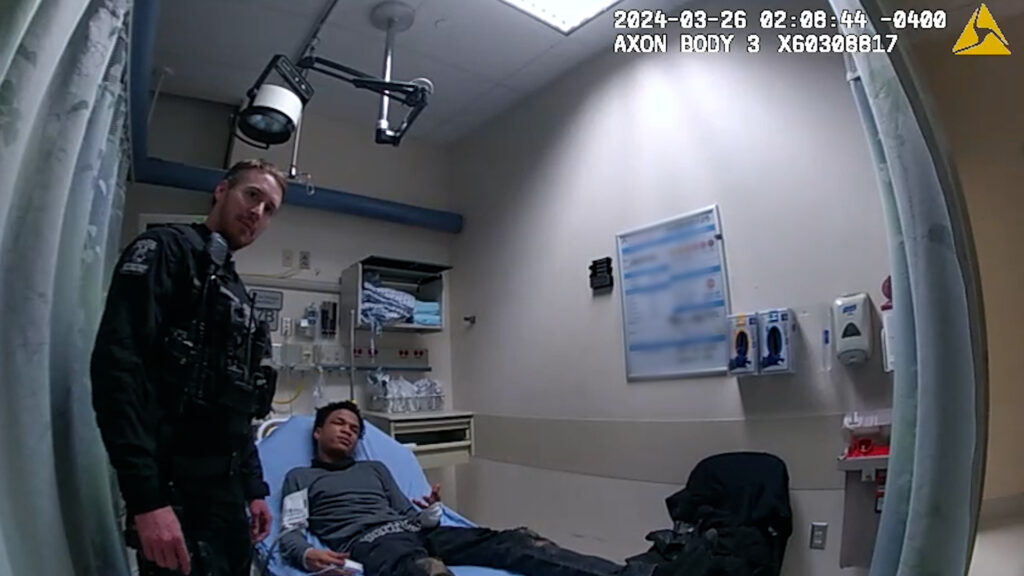
The patient had just arrived at the hospital with nine fingers. The three cops standing in front of him were confident they had the other one.
“I heard you’re missing something,” Officer Andrew Richardson said.
“Pinkie,” the man responded, lying on his back and holding up his bandaged left hand.
A half-hour earlier, and nine miles away, the officers had made a startling discovery: a little finger in the grass. They bagged it up — first in paper, then in plastic — as colleagues called local hospitals in search of a recent arrival who fit a specific description. And so here they were, speaking with 21-year-old Nasir Wilkinson in the middle of the night at Shady Grove Adventist Hospital in Rockville, Maryland.
One of the officers held up the bag.
“So, that is your finger?” another cop asked.
Wilkinson’s answer would come at the start of a case laced with horror and mercy, vengeance and justice. Before it was over, a stabbing victim near death would make a remarkable recovery. A judge would grant the attacker a lenient sentence. And the man’s actions afterward would land him back to her courtroom.
“It wasn’t the hardest case I’ve investigated, but it was certainly the most unique,” Sgt. John Borowski said last week.
‘Just don’t stab him’
Before he picked up the knife, Wilkinson had been a star wrestler who won matches around the country. A diagnosis of Type I diabetes at age 14 hardly slowed him down as he attended two Maryland prep schools: St. Paul’s School for Boys outside Baltimore and Bullis outside Washington.
By 2022, he’d become a trusted salesman at a gun shop in Maryland. He also cared for his grandmother, making her breakfast and taking her to the doctor and physical therapist.
Early the morning of March 26, 2024, though, he was enraged at his girlfriend’s ex-boyfriend. Armed with a knife and with his girlfriend in the passenger seat, he drove to the man’s neighborhood and parked.
“Just don’t stab him,” the woman said, according to a recorded interview with detectives.
The Washington Post reviewed more than 10 hours of police body-camera footage; additional detective interviews with the victim and Wilkinson; court documents; and recorded court hearings. All dialogue is based on those sources.
Wilkinson got out, and moments later came running back. “My pinkie’s gone!” he said, before driving to the hospital.
Meanwhile, a 19-year-old lay on his back, moaning in pain. He called 911.
“I just got stabbed,” he said, struggling to speak. “I’m about to die.”
A half-dozen officers from the Montgomery County Police Department sped into the neighborhood, drew their guns and fanned out. They heard moans and ran toward them, then were led the rest of the way by the victim flashing the light on his phone.
“Put your hands out!” an officer shouted. “We’re coming to help you!”
Three of them donned rubber gloves and started treating the man. “Can you tell us anything?” Officer Dominic Acosta asked, receiving only a stare in response.
Another officer spotted something on the ground and bent over. He shined his flashlight over to the victim. Ten fingers.
“There’s someone else’s finger cut off here,” he said.
The victim’s wounds to his torso were gruesome.
“Jesus Christ,” another cop muttered, catching the victim’s attention. As he raised his head several inches and looked down, terror stretched across his face.
“I’m dead,” he said quietly.
“You’re not dead, buddy,” said Officer Richard Buck, reaching to hold his hand.
Nearby, a sergeant reported a big find.
“Go down to Shady Grove. Our suspect is down there checking in,” he said. “Take the finger with you.”
Twenty minutes later, from his hospital bed, Wilkinson acknowledged it was his.
“So you want them to try and put it back on?” Officer Frank Corn asked.
“Yeah,” Wilkinson replied.
His girlfriend was waiting at the hospital, and she told investigators about him confronting her ex. Borowski obtained a warrant charging Wilkinson with attempted first-degree murder.
An ambush from behind
The 19-year-old victim had survived the attack. Taken to a different hospital, he underwent emergency surgery to open his abdominal cavity and ensure there was no organ damage. Eight days later, detectives paid him a visit.
“The first 10 times I told the story, I cried,” he told them.
The Post typically does not identify the survivors of violent crimes without their consent. The victim declined a request for an interview. His account of the attack, recorded by the detectives, started with an ambush from behind.
“I looked down and there’s a knife in me,” he said. “I pulled the knife out and we were wrestling over the knife.”
The attacker ran off and he recalled reaching down: “I feel something squishy. Then I just go down to the ground.”
The victim told the investigators his attacker wore a ski mask but had the recognizable voice of a man he knew as “Naz.” He’d also shouted out his ex-girlfriend’s first initial: “This is for K!” The victim volunteered that he had struck the woman in the face during an argument eight months earlier, which may have motivated the attack.
He said he could hear the officers talking about what they found. “I remember looking at my fingers,” he said.
Much worse, he said, was seeing his intestines emerging from the stab wounds. Hearing the officers tell him he wasn’t dying, however well intended, left him feeling doomed.
“It was like a movie,” he told detectives. “You know how people are like, ‘You’re not dead, you’re not dead.’ And the guy dies.”
‘Nasir became my rock’
Wilkinson also healed. He, his pinkie and an officer had been transported by ambulance to a hand-specialty hospital in Baltimore where doctors reattached it.
As his trial approached, both sides had leverage: Assistant State’s Attorney Peter Larson had the pinkie, the ex-girlfriend’s statements and a victim willing to testify.
Wilkinson’s attorney, Walter Neighbors, had Maryland sentencing guidelines, which gave great deference to his client’s previously spotless criminal record.
The two sides reached an agreement: Wilkinson would plead guilty to one count of attempted first-degree murder, and prosecutors would seek no more than 16 years in prison.
Circuit Court Judge Marybeth Ayres would decide the sentence. She’d been a prosecutor in Queens, Baltimore and finally Montgomery County, where she’d secured a string of life sentences in murder cases. Defense attorneys had feared that background, even as they noticed something else: She strived to be fair.
Ahead of Wilkinson’s sentencing hearing, 24 letters of support came to Ayres — from family, friends, coaches and co-workers describing a life defined by discipline and decency.
“Nasir was raised by a village of people who all have seen the respect and love that he has given to all of us,” his great-aunt wrote.
His supporters packed the courtroom for the hearing. Fifteen spoke, including his parents and 85-year-old grandmother, Carolyn Jacobs.
“Nasir became my rock,” she told the judge. “I’m asking you, your honor, to please look at all the good in him.”
Larson, the prosecutor, said the kind words were hardly lost on him. “I struggle hearing all of that, hearing what the defendant came from and the support that he has, in trying to reconcile that with what he did.”
He played audio recordings of the 911 calls, grainy video from a doorbell camera that recorded terrifying yells from the victim, and police body-camera footage that showed the victim’s injuries. Larson said Wilkinson deserved to serve all 16 years.
Wilkinson apologized to the victim before addressing the judge: “I can guarantee you that you or no other judge will see me standing in front of them again.”
After nearly two hours, Ayres took a quick break and came back to the bench.
She described the viciousness of the attack: “I can’t imagine the fear someone would have as they lay on the ground seeing their organs outside of their body.”
The judge said she couldn’t recall seeing so much support for a person about to be sentenced. She believed that as a group, they would deter him from re-offending. And she lauded Wilkinson for acknowledging and showing responsibility for what he’d done.
“I do believe that you have great potential, and I do believe in redemption,” Ayres said. “And I have confidence that when you told me you are never coming back, you are serious.”
She handed down eight years.
#KillALLRats
Four months later, while Wilkinson was incarcerated inside a Maryland prison, his left hand had healed enough that he could write. He picked up a pen and paper.
“To The Snitch,” he began, addressing the man he tried to kill. “Let me make this clear. I AM GOING TO KILL YOU! And I don’t give a f— about the consequences.”
Wilkinson stood to benefit from Maryland’s prison laws: With possible parole and credits available for good behavior, taking classes and participating in programs, he could be out by 2029. “I’ll see you again soon,” he wrote closing the letter with “#KillALLRats.”
Two days after the victim read the letter, his mother received one.
“I’m NOT Done With Him!” it stated. “I hope that y’all didn’t think that apology I gave to his snitch a– was real or sincere because it WASN’T. I didn’t mean it one bit.”
“I also got something for you,” the letter continued, “his sister, grandfather that’s on dialysis and anybody else that’s blood connected to him. What makes it so easy is that I know where y’all lay your heads at. LOL!”
In place of a signature, the author drew a devil’s head.
The recipients called Larson. Investigators lifted fingerprints from the letters, collected DNA off one of the envelope flaps, and enlisted a handwriting expert. Everything matched.
‘I had faith in you’
Ayres’s optimistic tone, so evident the last time Wilkinson was brought before her, was gone.
“I had faith in you,” she said, calling her earlier sentence the most lenient she’d ever imposed. “I was so lenient. And I was so wrong.”
Over 45 minutes, Ayres had heard more details about the letters and the overwhelming evidence of witness retaliation, a new crime to which Wilkinson pleaded guilty. The judge also heard from the victim’s mother, who spoke of the panic the letters brought to her house, especially to her parents.
“They’re terrified every time they walk out the door,” she said.
Wilkinson’s explanation: Undiagnosed bipolar disorder and depression propelled him to write the letters. Now — under proper medication and clear thinking — he knew how wrong they were. But to Ayres, two things seemed more clear: Wilkinson thought he’d get away with writing the letters because he thought the victims wouldn’t report them, and Wilkinson actually meant what he wrote.
Ayres wondered aloud her own role in Wilkinson writing. “I asked myself, ‘Did I embolden you with my lenient sentence?”
She called his letter to the victim the worst witness retaliation letter she’d ever read. She spoke about how much the victim already had suffered.
And she imposed more prison time: 27 years.
The post He lost a pinkie trying to kill a man. From prison, he made things worse. appeared first on Washington Post.