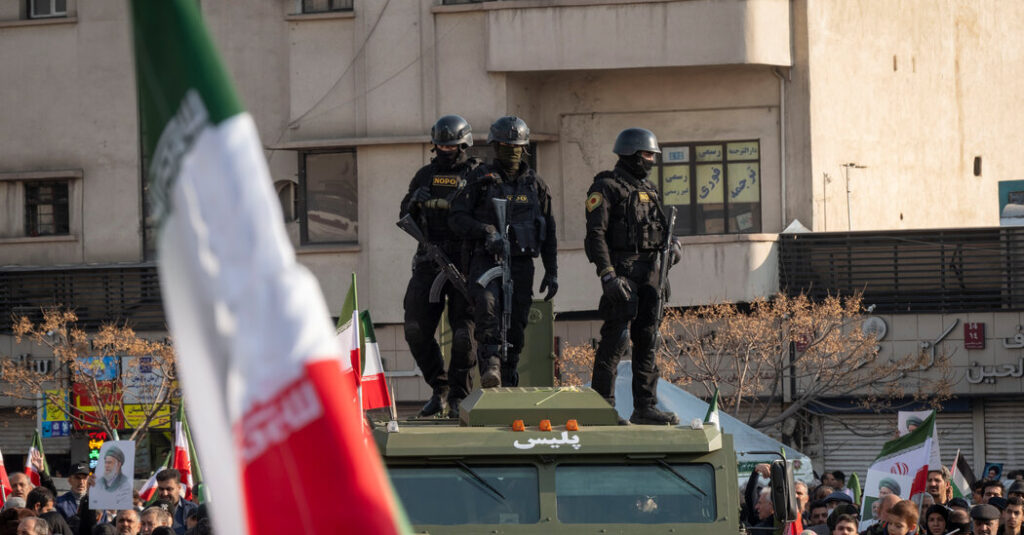
The protests are largely over in Iran, crushed by the heavy hand of the government, but the retribution is just beginning.
Doctors who treated injured protesters have been swept up in mass arrests, beloved businesses have been seized and shuttered, and critical media has been silenced — all to stamp out the possibility of further unrest.
Even families holding funerals for loved ones killed during the crackdown have been ordered not to cry in public.
Several rights groups estimate that up to 40,000 people have been detained since protests began, many on charges of being “rioters” or “terrorists.” Many have made televised confessions that rights groups say are likely forced.
Activists say the scope and scale of the repression tactics are perhaps the most sweeping in the Islamic Republic’s history.
“It’s collective punishment,” said Mahmood Amiry-Moghaddam, the director of Iran Human Rights, an Oslo-based organization. “They want to traumatize a whole generation, so they won’t rise up again.”
The severity of the crackdown reflects how much Iran’s clerical leaders feel they have their backs to the wall, analysts say.
In addition to an ever-deepening economic crisis, which set off protests in late December that snowballed into a nationwide movement, the government also has to reckon with the possibility of a U.S. attack.
“The government is signaling that it is prepared to do whatever it takes to remain in power,” said Omid Memarian, a senior Iran analyst at DAWN, a Washington-based organization focused on the Middle East.
Since quelling the protests, the Iranian government has publicly acknowledged the death of around 3,000 people in the crackdown, though rights groups estimate the final toll will be far higher.
Weeks after those killings, protesters are still being rounded up — and so are the medics who cared for them.
The New York Times spoke to three doctors in Iran who shared the names of at least 11 colleagues arrested in the past week — among them doctors, nurses, and dentists. They said their colleagues had been detained for treating protesters in the secrecy of their own homes. The whereabouts of one doctor remains unknown.
Like all of those interviewed inside Iran for this story, the doctors requested anonymity out of fear of retribution. Two of them said they had been repeatedly summoned for questioning by officials seeking more information about those who helped protesters.
Even household names in Iran have not been spared arrest, among them Mohammed Saedinia, the grey-mustachioed owner of a national cafe chain.
Mr. Saedinia’s coffee shops offered Iranians a taste of a world closed off to them by clerical rulers and punishing international sanctions, serving international crazes like cruffins and cold brew. But on Jan. 8, the Saedinia cafes joined businesses around the country that showed support for the demonstrations by going on strike.
Days after the deadly crackdown, the authorities sealed the doors of Saedinia cafes across the country, and left a notice that they would remain closed for two months, according to one employee. Mr. Saedinia; his son, Sadegh — who ran the cafes — and a store manager were arrested, the employee said.
A spokesman for Iran’s judiciary, Ashgar Jahangir, confirmed Mr. Saedinia’s arrest on Tuesday, saying that the cafe owner had “supported the rioters,” and that, if convicted, his assets would be used to pay for damages caused during the unrest.
The closure of Mr. Saedinia’s business was symbolic for many Iranians, who see the state’s targeting of cultural symbols as a bid to demoralize its opponents.
When Iran’s prosecutor general, Mohammad Movahedi-Azad, ordered the judiciary to identify and seize the assets of famous people who supported the protests, he said it was “to take action against terrorists and their backers in a way that teaches a lesson.”
In mid-January, prosecutors in Tehran told state media that they had opened cases against 15 athletes and actors, as well as 10 other people who signed a statement from Iran’s largest filmmakers’ guild declaring that they “stand with the oppressed people of Iran.”
An Iranian government spokesman did not respond to a request for comment about the crackdown measures.
The Iranian authorities are silencing even those voices that consider themselves reformists, not opponents of the system, like the newspaper Ham Mihan. It was shut down on Jan. 19.
Ham Mihan was one of the few publications inside Iran to cover the protests and the heavy injuries and deaths. A subsequent opinion piece by the paper’s editor, Mohammed Javad Rouh, said that Iran’s current leadership, like the shah before his ousting in 1979, had become indecisive and unable to find a way out of compounding crises.
“This is why people feel they have no future,” Mr. Rouh said in an interview. “They see that, in practice, there is no functioning state in Iran.”
Mr. Rouh said Ham Mihan was the first news outlet to be shut down since 2016, and that the paper has not been given a court date to contest.
The repression touches even the bereaved, with the authorities regularly monitoring and banning funerals of those slain during the protests.
One Iranian, Abbas, said that he and his relatives were repeatedly summoned as they organized a ceremony for three family members shot to death during protests in a city north of Tehran. The authorities forced them to sign pledges of silence, he said.
“They made us sign commitments not to cry, not to leave the door of the house that hosts the memorial ceremony open,” said Abbas, who did not want his relationship to the family publicized.
While the government appears to have largely suppressed the protests, Mr. Memarian, the think tank analyst, warned of “a dam that could suddenly crack.”
“It may harden public resolve, making the government more vulnerable if protests continue, rather than less,” he said.
Some Iranians are daring to voice defiance.
Last week, 17 prominent civil society leaders, filmmakers, lawyers and rights activists released a new statement blaming Iran’s supreme leader for a crackdown they called an “organized state crime against humanity.” Several of the signatories were arrested, among them Mehdi Mahmoudian, a screenwriter for the movie “It Was Just an Accident,” which has been nominated for two Oscars this year.
On Tuesday, students at 31 medical, nursing, and dental schools across the country boycotted their exams or held sit-ins to protest the deaths of fellow students in the crackdown and the continuing arrests of medics.
Mourners, too, have found their a way to fight back — with celebration, instead of tears.
In recent days, videos posted on social media have shown mourners playing music and throwing confetti, more in keeping with a wedding ceremony than a funeral. In one video verified by The Times, family members can be seen dancing as they sing along to a local folk song.
“The heart was no longer tight with longing,” they sing. “Suddenly it went mad. It became war.”
Monika Cvorak and Arijeta Lajka contributed reporting.
The post ‘It’s Collective Punishment’: Iran Exacts Heavy Price on Protest Supporters appeared first on New York Times.