Gildo Siorpaes became a bobsledder by accident and then rode the sport all the way to an Olympic podium at the 1964 Winter Games in Innsbruck, Austria.
But six decades later, a bobsledding track has gone up in his hometown for the upcoming Winter Games in northern Italy, and it is the bane of his old age.
Mr. Siorpaes, 88, the brakeman for the bronze medal-winning Italian bobsled team in Innsbruck and a former coach of the Italian women’s ski team, vehemently opposes all the Olympic infrastructure being built in and around his hometown, Cortina d’Ampezzo, which will also host Alpine skiing, luge and curling.
“It’s ruining everything,” Mr. Siorpaes said, sitting in a three story wood-and-white-plaster house that he built with his brothers in Mortisa, a hamlet just outside Cortina. “This was a village with a perfect view,” he said, gesturing outside his living room window to a view of unfinished construction. “It was paradise.”
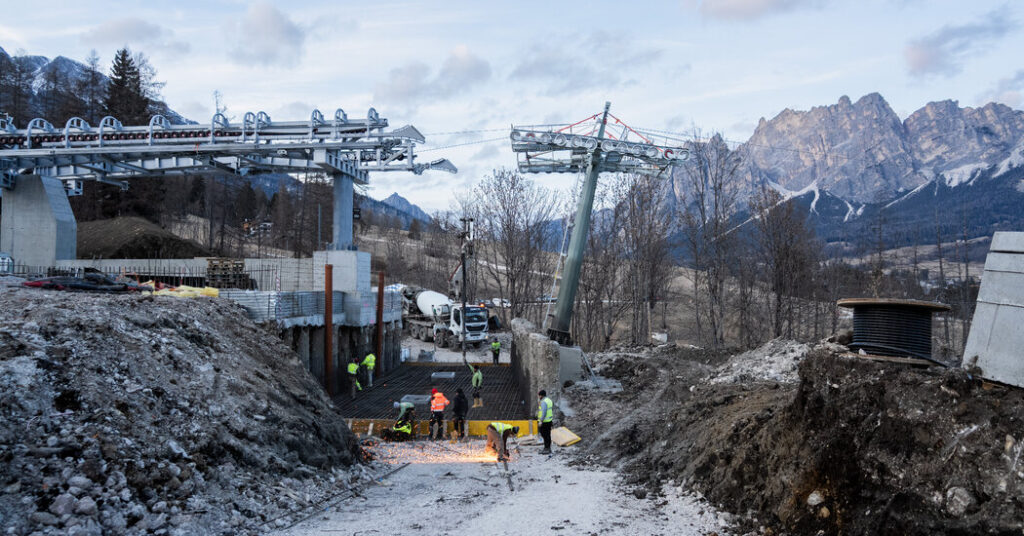
In the buildup to the Games, roads in and out of Cortina, a town of just 5,000 full-time residents, were closed off for construction, diverting and snarling traffic. Workers clogged the streets and erected an Olympics digital clock and statue in a closed-off town square. Backhoes and construction cranes dotted the landscape, and the normally postcard-perfect town was garlanded in bright orange netting.
The last-minute work led to gripes from just about everyone. Locals grumbled about Olympic organizers, developers and politicians; ski lodges grumbled about lost business during the Games — and Olympic officials grumbled about residents.
“The Cortinesi are a big pain,” Andrea Varnier, chief executive of the Milan-Cortina organizing committee, said during a test event at the Santa Giulia Arena last month. “They complain, they protest, they can’t stand change to their routine.”
In fact, residents seem divided between those, like Mr. Siorpaes, who view the Olympic construction with hostility, and those who acknowledge the need for — and even welcome — the upgrades to infrastructure.
Reflecting one attitude heard around town, Michele Da Pozzo, 50, described all the construction for the Games as “a waste and an invasion” as he loitered on a road with friends observing the work.
Others, like Carmen Rosoleni, 70, a former member of the national women’s ski team who was coached by Mr. Siorpaes, were more conciliatory. “Cortina needed, let’s say, this face-lift,” she said on her way out of a local pizzeria.
As well as the bobsled track and a cable car to take people up the mountain, the Olympic development in Cortina includes roads, parking lots as well as renovations of apartment buildings and a town piazza, benefits that will last long after the Games are over.
The number of these infrastructure projects far outstrips the number of sporting venues, according to Fabio Saldini, special commissioner for Olympic works at Simico, the state-owned company overseeing infrastructure projects.
Mr. Saldini said that about $3.6 billion was being spent on “legacy projects” across the three regions hosting events, including about $600 million for sports facilities.
Questions about the long-term benefits of the Games have long plagued Olympic host cities. The fear of being saddled with white elephants or onerous maintenance costs has made it increasingly challenging for the International Olympic Committee to attract new hosts.
Cortina’s mayor, Gianluca Lorenzi, said he was confident that improvements causing headaches now will pay off later. “We mustn’t look at the immediate situation but at what Cortina’s future will be,” he said during an interview in his office where he displayed an Olympic branded Coca-Cola bottle and replicas of the Olympic and Paralympic torches. “Because we are redesigning and rebuilding Cortina for the next 30 years of its tourism.”
Some local business owners are more concerned about the prospect of lost short-term profits. Gianluca Lancedelli, 61, a third-generation owner of a mountain lodge at a resort that will host downhill ski events, said Olympic organizers had forced him to close during the Games.
That, he said, could slash his annual income by about 60 percent. “Everyone says that they are doing it for our future,” Mr. Lancedelli said. “But how can we be sure? The future is uncertain.”
In Cortina, one of the biggest long-term concerns centers on the safety and upkeep of the new cable car.
Giorgio Giacchetti, president of the Veneto region’s association of professional geologists, expressed alarm about building the cable car so quickly in an area subject to landslides. Marco Barla, a geotechnical engineer from the Polytechnic University of Turin who consulted on the project for Simico, said that he had studied the site extensively and was confident it could operate safely for 50 years provided that regular adjustments were made.
Mayor Lorenzi said that the town would take over the maintenance but did not provide details about how it would be managed or who would pay the costs.
Though Mr. Siorpaes opposes the construction, he spent much of his post-Olympic career building local infrastructure, including ski lifts and hydroelectric plants to provide water for snow-making.
His antipathy toward the bobsled track echoes his long-held ambivalence for the sport. He had made the team to compete for Italy at Innsbruck as an Alpine skier. But following a disagreement with a coach, he was recruited to the bobsled team after one of the captains observed him pushing sleds on the slopes during cross-training.
On the medal podium, “It wasn’t as exciting for me, as emotional for me, as it was for those who were born bobsledders,” Mr. Siorpaes recalled.
For all his grumpiness, Mr. Siorpaes is beloved in Cortina, even by those who disagree with him.
“Gildo is a very respected person, a great man for Cortina,” said Franco Sovilla, 68, who sells Mr. Siorpaes a newspaper every morning. “He has his ideas,” said Mr. Sovilla, who supports the Olympic construction. “We don’t share them.”
Ms. Sovilla’s wife, Nicoletta Fontana, added: “They’re the ideas, respectable ideas, of someone of a certain age.”
Motoko Rich is the Times bureau chief in Rome, where she covers Italy, the Vatican and Greece.
The post As Olympics Arrive, Everyone in This Town Is Annoyed About Something appeared first on New York Times.