One of the most ominous signs that Jersey City, N.J., was in fiscal disarray came more than a month before the city’s mayor, Steven Fulop, left office and stepped into a prestigious new role leading the Partnership for New York City, a business advocacy group.
Moody’s, a credit-rating agency, warned in December that the remedies needed to restore the state’s second-largest city to sound financial footing were “becoming increasingly drastic.”
“A realistic path to substantial recovery remains unclear,” Moody’s wrote as it downgraded Jersey City’s bond rating for the second time in three years.
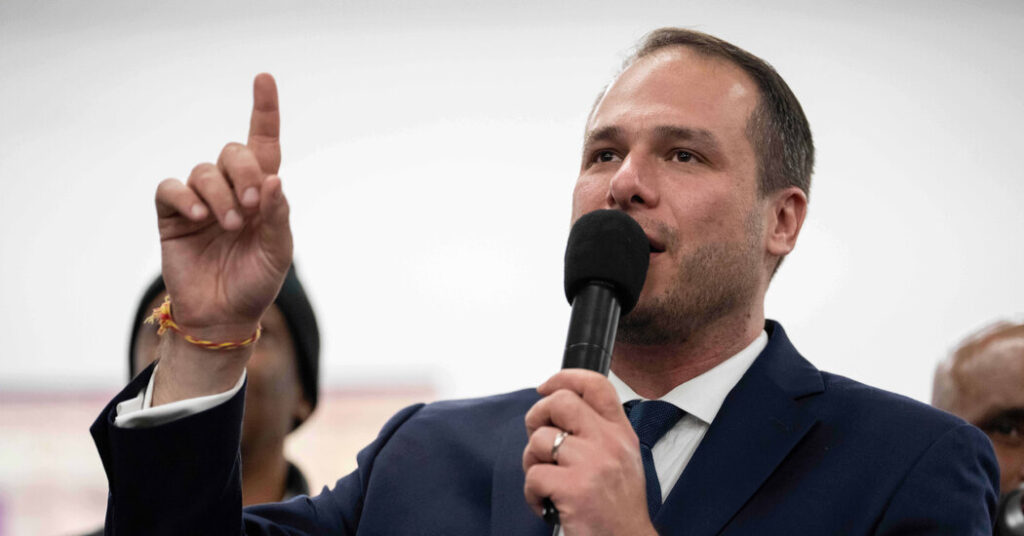
But few were prepared for a report released Wednesday by the city’s new mayor, James Solomon, that outlined the full scope and severity of the problem now gripping the city, a community of 300,000 residents across the Hudson River from Lower Manhattan.
According to the analysis, which was done in consultation with the Institute for State and Local Governance at the City University of New York, Jersey City is facing a deficit of $255 million — nearly 30 percent of its annual budget. That gap is more than the city spends each year on police and fire services.
Mr. Solomon, in an interview, placed blame for the budget shortfall on Mr. Fulop, who campaigned unsuccessfully for governor before deciding not to run for re-election in Jersey City.
“He relied on tricks and gimmicks to avoid having to make tough decisions when he was running for governor,” said Mr. Solomon, who as a Jersey City councilman was critical of the city’s spending plan and voted against the budget every year he was on the Council.
The report itself said Mr. Fulop, who led Jersey City for 12 years, had built an “unsustainable financial house of cards.”
“And as he abandons Jersey City for New York,” the report stated, “that house of cards is now collapsing.”
Mr. Fulop, who last month took over as chief executive and president of the Partnership for New York City, said he disagreed with the fiscal analysis and that Mr. Solomon had supported at least some of the policies he is now criticizing.
“Had I chosen to run for re-election, we would have introduced another budget with no tax increase for Jersey City residents,” Mr. Fulop said.
“It’s also worth noting that James served on the City Council for eight years with full budget responsibilities,” he said, adding, “This is James playing politics.”
Mr. Solomon called that claim “laughable.”
Mr. Fulop, 48, landed the coveted New York job soon after losing a Democratic primary for governor of New Jersey to Mikie Sherrill. Ms. Sherrill went on to beat the Republican candidate, Jack Ciattarelli, by 14 points, and was sworn in last month.
During his campaign for governor, Mr. Fulop often boasted about the rapid commercial and residential growth in Jersey City, where affluent commuters have moved into skyscrapers that line the city’s Hudson River waterfront. Minutes from New York City, with access to New Jersey’s major highways, Jersey City successfully lured many large corporations over the past several decades.
But the budget gap is also likely to be a defining element of Mr. Fulop’s legacy, as Jersey City officials now look to state leaders for help. Mr. Solomon said he had briefed Ms. Sherrill on the crisis, and as he announced the report on Wednesday he was flanked by many of the state lawmakers who represent Jersey City.
A spokesman for Ms. Sherrill had no immediate comment.
Mr. Solomon, 41, said that he and his team had been reviewing the city’s finances closely since December, when he won a runoff race for mayor against Jim McGreevey, a former New Jersey governor.
Given his time on the City Council, Mr. Solomon said he had been aware that the city faced a sizable deficit. But he said he was stunned to learn its true scope, which he said had been masked by one-time stopgap measures, borrowing and an imprudent use of federal pandemic aid to subsidize a tax cut.
For example, Mr. Solomon said the analysis found that the city had routinely underestimated its costs for employee health insurance. As a result, the city had $52 million in unpaid health bills over the past two years, leading to millions of dollars in late fees.
He said he planned to meet with community groups and constituents to lay out the city’s financial crisis and to use their input to craft a five-year budget strategy. In the short term, he said, city officials will “absolutely need to work with the state” on a solution.
Gerald McCann, a former Jersey City mayor who left office in scandal, said he had for years been warning city leaders, including Mr. Fulop and Mr. Solomon, that the city was improperly spending money reserved for capital improvements to cover its basic costs, while also granting large tax abatements to encourage economic development.
“I put it all in writing,” said Mr. McCann, an accountant by trade who between 2017 and 2023 worked on and off as the city’s internal auditor. “They ignored me.”
“Now, all of a sudden, it is what I said it was,” he added.
Mr. Solomon, who represented downtown Jersey City from 2018 through 2025, regularly challenged spending decisions approved by a majority of the City Council that was loyal to Mr. Fulop.
“When the situation is this dire, you always think: Were there more questions you could have asked?” he said.
He said the city had already taken several steps to address the funding gap, including working with union leaders to enlist a new health care insurer for public employees that offers more in-network coverage, resulting in cost savings.
Last month, legislation backed by Mr. Solomon became law in Trenton, giving the city more tools to collect a tax that companies are supposed to pay for each employee who does not live in Jersey City.
Raj Mukherji, a state senator who represents Jersey City and sponsored the legislation, said the new law would give the city access to data already collected by the state to ensure that the tax, which funds the city’s public schools, is paid.
“It will provide more reliable and predictable revenue and a lower property tax burden for the people of Jersey City,” Mr. Mukherji said.
Tracey Tully is a reporter for The Times who covers New Jersey, where she has lived for more than 20 years.
The post Jersey City Faces a Stunning Budget Deficit, Report Shows appeared first on New York Times.