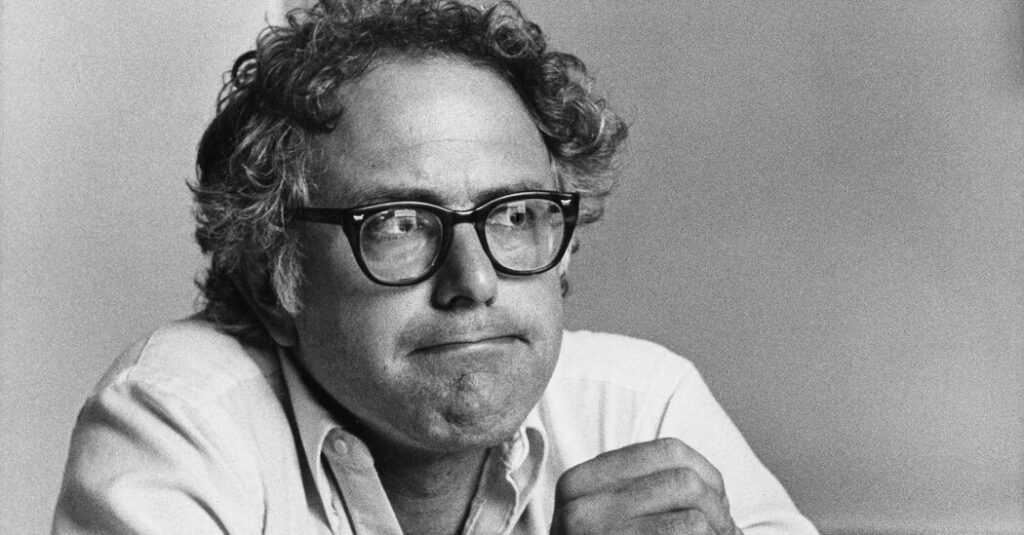
BERNIE FOR BURLINGTON: The Rise of the People’s Politician and the Transformation of One American Place, by Dan Chiasson
I always read the acknowledgments page of a book I’m reviewing. They’re usually bland, pro forma affairs. Sometimes, though, they give an inadvertent glimpse into the authorial soul.
Dan Chiasson concludes his new book, “Bernie for Burlington,” a history of the eight years during the 1980s that Bernie Sanders spent running the state’s biggest city, with a shout-out to his subject: “And thank you, Bernie Sanders — for Burlington.” I think that’s the heart of what bothered me about this impressive but frustrating book.
Senator Sanders, according to Chiasson, is “arguably the most influential leftist politician in the modern history of the nation,” “a national figure of historic impact” who “leveled Burlington’s old hierarchies, networks and institutions,” turning the city into a “wacky, D.I.Y. civic experiment.” This “seasoned manipulator of the sometimes-hostile media,” who “overcame the fears of the establishment with one smart, nonpolitical initiative after another,” transformed Burlington into “a one-of-a-kind, historic inquiry into the possibilities for human happiness in an American city.”
Today an English professor at Wellesley College, Chiasson was born and raised in Burlington in a working-class Catholic family during the years of the four-term Sanders mayoralty. His affection for that place and time is obvious and often artfully rendered, as when he writes about the city’s first Xerox machine, where “metalheads ran off posters for their bands” and a local math professor printed a widely read anti-Sanders newsletter.
Chiasson is a witty, gifted poet and a sometime poetry critic for The New Yorker, the author of five collections. His poetic voice is jazzy and self-effacing, quietly assured.
We miss those qualities here. Sanders is legendary for the loyalty he inspires in adherents. But, unfortunately, the Independent senator benefits from Chiasson’s affection more than his book does. By collapsing the distance between himself and his subject, Chiasson turns history into a sales pitch.
He hasn’t chosen an easy subject. To his supporters’ delight and his critics’ frustration, Sanders has been focused on the same issues for decades, without concern for shifting attitudes or polls. And he’s not cuddly: As his advisers put it in a 1982 memorandum, “You are not nice to people.”
Sanders was one of many “idealistic pilgrims” from larger cities who saw Vermont as an affordable place to put countercultural politics into practice. He first went there in 1968, spent his first years as an “itinerant carpenter and freelance writer, deeply influenced by the rogue psychoanalyst Wilhelm Reich.” (Sanders even penned some creepy erotica.)
“Bernie for Burlington” is at its best when it ignores both Bernie and Burlington. Writing about Vermont as a whole, Chiasson is encumbered neither by ideological affinities nor by hometown pride. He describes a state whose character is composed of “progressivism, thrift and orneriness.”
Trump Administration: Live Updates
Updated
- Homan says D.H.S. is pulling 700 officers out of Minneapolis.
- Ukraine talks resume, despite an intense Russian bombardment of Ukraine’s power grid.
- Trump throws a possible deal with Harvard into chaos.
Vermonters were traditionally resistant to government initiatives, and hostility was not limited to Washington. Chiasson chillingly describes “Rural Vermont,” a eugenics study from 1931 that “speaks of the deteriorating of Yankee blood and the problem of towns being overtaken by immigrants who were ‘failures elsewhere.’” A story of quaint inns, ski resorts and quirky antique shops, this is not.
Between 1945 and the mid-1960s, the number of farms in Vermont fell sharply. The college-educated newcomers, inspired by back-to-the-land guides, provided a necessary blood transfusion, even if their experiments were often quixotic.
Sanders ran for public office as a candidate of the radical Liberty Union Party, four times between 1972 and 1976, losing two U.S. Senate races and two bids for the governor’s mansion. He had become, Chiasson acknowledges, a “perennial candidate.”
In Chiasson’s telling, an adviser named Richard Sugarman persuaded Sanders to leave behind the “performative politics” of the 1960s. By 1977, Chiasson writes, “the hippies were now in their 30s, with families to raise and mortgages to pay.” Sanders announced he was leaving Liberty Union later that year, charging that the party had not been aggressive enough in fighting “banks and corporations.”
It’s a testament to Chiasson’s research that I often found myself highlighting people and places I wanted to explore further. But the accumulation of detail also makes for an infuriating reading experience. A book that is about the time Sanders spent as mayor of Burlington takes 257 pages to get to his first mayoral run.
The Sanders candidacy was powered by “a new wave of Vermont transplants” who were liberal but not especially interested in forming communes. “Their music was Madonna, Patti Smith and Talking Heads,” Chiasson writes, their clothes bright and chic. And for these new arrivals, “part of the Burlington experience was voting for Sanders.”
In the four terms that followed, Sanders would turn a “dowdy, backward, deeply Catholic” city into “the place to see socialism in action,” Chiasson argues. Yet he appears to undermine his own argument by conceding that, in some respects, Sanders turned into “a classic ribbon-cutting mayor.” He also calls the proud democratic socialist an “innovative capitalist.”
An honest assessment of Sanders’s mayoralty would grant that he expanded parkland along the shores of Lake Champlain, made important strides in creating affordable housing and practiced a grass-roots politics that took the concerns of young people seriously. At the same time, he engaged in the kind of gestures Sugarman had advised against, such as his controversial 1985 trip to visit the Sandinista rebels in Nicaragua.
In 1988, Sanders went to the U.S.S.R. While there, he attempted to make Yaroslavl, an ancient settlement north of Moscow, Burlington’s sister city. Chiasson sarcastically excoriates a New York Times Moscow correspondent, Anton Troianovski, for reporting deeply, during the 2020 Democratic presidential primary, on Sanders’s efforts while mayor to foster closer ties with the Soviet Union. It’s an unseemly attack that accuses Troianovski of trying to “red-bait” Sanders, while failing to acknowledge the very real risks to high-profile American journalists in Putin’s Russia.
Sanders and his wife, Jane, did not participate in this book, though it is not clear how much they would have had to add. Chiasson writes about traveling to Vermont in 2024 to meet Sanders at a picnic, where Chiasson told Sanders about growing up in his Burlington. The response from Sanders: “Oh, boy.”
It must have been an anticlimactic encounter, though maybe also an apt one. The stubborn Sanders has cleared the way for younger, more charismatic democratic socialists, including Alexandria Ocasio-Cortez and Zohran Mamdani. But Chiasson does little to dispel the charge, frequently voiced by Sanders critics, that he has few robust legislative accomplishments.
I have no doubt that Chiasson has written the authoritative history of the Sanders tenure in Burlington. Whether this somewhat confounding labor of love was necessary, whether it tells us something important or new, is more difficult for me to say.
BERNIE FOR BURLINGTON: The Rise of the People’s Politician: and the Transformation of One American Place | By Dan Chiasson | Knopf | 569 pp. | $35
The post A Bernie Bro Writes a Fawning Biography of His Hero appeared first on New York Times.