To the Editor:
Re “How National Park Service Is Taking a Crowbar to U.S. History” (news article, Jan. 28):
I object strongly to directives instructing national parks to remove materials deemed by the Trump administration to “disparage Americans” or promote “corrosive ideology.” Our national parks are not merely scenic backdrops; they are classrooms, archives and mirrors of our shared history.
We do not grow as a nation by forgetting. We learn by remembering — by confronting the reality of slavery and understanding how hard-won progress emerged from that injustice. We learn by acknowledging how women and immigrants once labored in textile mills and factories, often under brutal conditions, to build the prosperity we now enjoy. These stories are not corrosive; they are instructive.
Likewise, explaining that tall trees could help store carbon dioxide and slow global warming is not political advocacy; it is basic, well-established science. Providing this information is educational and beneficial to visitors who want to understand the natural world they are standing in.
To sanitize history or science because it makes some uncomfortable is to undermine the very mission of our national parks. These public lands belong to all of us, and they should tell the full, honest story of our past and our present.
Martha Weinar Cherry Hill, N.J.
To the Editor:
I am trying to imagine a National Park Service video celebrating Lowell, Mass., a historic hub of American industrial production, without the workers. Empty factory floors?
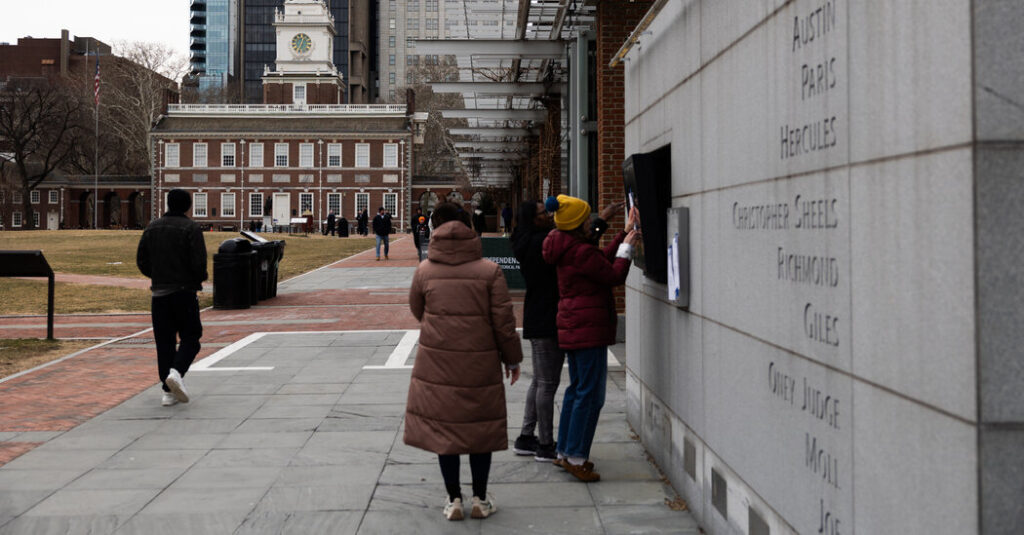
And I wonder how visitors will learn about daily life in President George Washington’s household in Philadelphia now that plaques and videos have been taken down. (You report that a federal judge has ordered the Park Service not to make further changes to the President’s House Site as she considers a lawsuit filed by the City of Philadelphia.)
When the National Park Service erases the historic roles of typical Americans — in these cases, women, immigrants and enslaved people — it disparages their millions of American descendants.
At the same time, the blank walls, plaques and video screens are a warning to all of us that something is amiss.
Joan Cadden Davis, Calif. The writer is a professor emerita of history at the University of California, Davis.
Farewell and Thank You, David Brooks
To the Editor:
Re “Time to Say Goodbye,” by David Brooks (column, Feb. 1):
Mr. Brooks’s final column should be required reading for all Americans. He has managed to articulate, in the most uplifting way, what is missing in our society at this point in history.
The qualities he speaks to — generosity, connectedness, integrity, honor, working for the common good — are a return to the way most people lived their lives. We can and must get back to that.
Such a shift in consciousness and behavior can only begin with each one of us making that shift in ourselves.
Thank you, David, for your brilliant writings and for pointing the way for all of us, together, to create a better future.
Joanna Ryder Hermosa Beach, Calif.
To the Editor:
I was genuinely saddened to see David Brooks’s goodbye column. His departure makes me sad not because I generally agree with him — quite the contrary, and this column was no exception. Instead, one of the few things that he and I might agree on is the importance of hearing and trying to understand the person opposite you in any dialogue, especially if you markedly disagree on fundamental points.
However, the assumed common values, faith and meaning that he refers to have, in my opinion, this fatal flaw: They are of the same substance that has driven this country to the state of decline he bemoans.
It is impossible for me, as a Black, queer, nonbinary, disabled, female-bodied older person, to find the beliefs and history of the dominant Western European culture that have caused people like me such harm to be a viable foundation on which to build the thriving, audacious and virtuous society we all dream of.
Fare thee well, Mr. Brooks.
Magenta Freeman Chapel Hill, N.C.
The post Erasing American History, the Trump Way appeared first on New York Times.