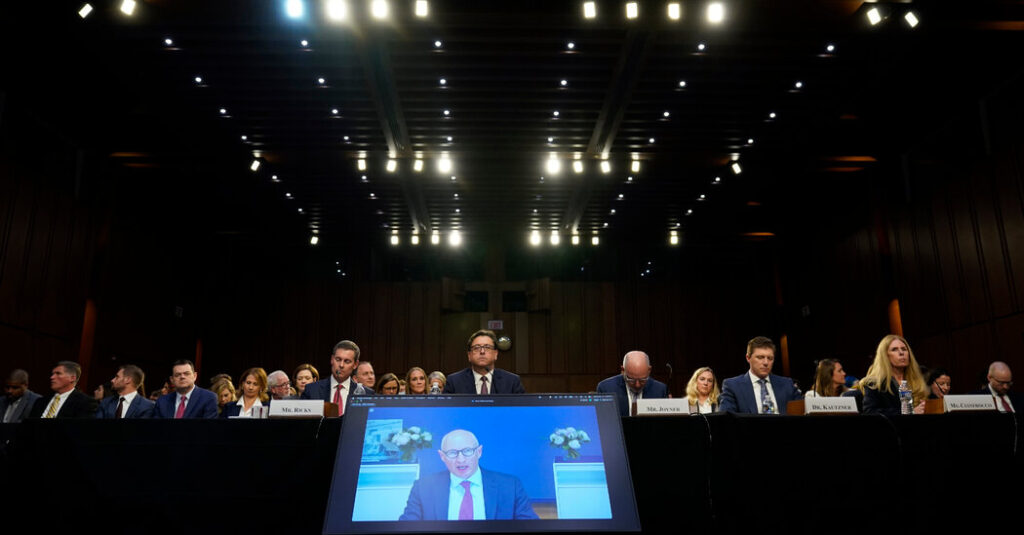
The spending package passed by Congress on Tuesday includes an effort to drive down drug prices, by imposing new restrictions on some of the most controversial practices of the giant companies that oversee prescription benefits.
The legislation represents a significant political defeat for the companies, known as pharmacy benefit managers, or P.B.M.s, which for years had largely escaped public attention, regulation and oversight. And it represents a win for drugmakers, which have long lobbied to deflect blame for high drug prices toward the P.B.M.s.
In signing the overall package on Tuesday afternoon, President Trump singled out his efforts to reduce drug prices.
While the new restrictions on P.B.M.s received widespread support, it is unclear how much they will benefit the government, employers and patients. There are complex reasons for high drug prices, and the legislation still preserves many core elements of the benefit managers’ opaque business model that contributes to high drug prices.
The three largest benefit managers — CVS Health’s Caremark, Cigna’s Express Scripts and UnitedHealth’s Optum Rx — collectively oversee some 80 percent of all prescriptions in the United States. Employers and government programs hire P.B.M.s to negotiate with drug companies, pay pharmacies and help decide which drugs patients can get at what price. Patients see the work of a benefit manager when they encounter denials for coverage of prescriptions or are forced to switch medications.
Over the years, benefit managers and their conglomerate parent companies, which also own major insurers, consolidated more power over different parts of the American health care system.
This legislation is the latest sign of the pressure building against the benefit managers’ longstanding practices. Many Americans are angry about the interference with their medicines, and some disillusioned employers have fired the big three P.B.M.s and moved their business to start-ups pitching a more transparent and friendly alternative.
When choosing which drugs are available to patients, benefit managers make more money by favoring high-priced medications, a dynamic that critics say drives up drug prices. The changes — which have been debated in Congress for the past few years — seek to eliminate those incentives.
“We’re finally going to see some relief on P.B.M.s and the egregious practices that they have,” said Representative Buddy Carter, Republican of Georgia, a pharmacist and a central architect of the P.B.M. legislation.
Benefit managers defended their business practices, saying they lower drug prices for their clients and patients.
Their trade group, the Pharmaceutical Care Management Association, fiercely opposed the legislation. The group has increased its spending on lobbying as pressure has mounted over the past few years.
“This will put upward pressure on drug costs,” said Brendan Buck, a spokesman for the group. “Patients and employers have not been helped here, but certainly the large drugmakers have.”
A spokesman for Caremark, David Whitrap, said his company was focused on lowering prescription drug costs. Optum Rx and Express Scripts declined to comment.
If the legislation works as intended, Americans could eventually see lower out-of-pocket costs for some of their medications and benefit from slower growth in their insurance premiums. Employers and government programs, which shoulder the bulk of drug costs in the United States and are struggling to pay for them, could also see savings.
“We think this moves the needle in a big way because it reorients the business model,” said James Gelfand, chief executive of the ERISA Industry Committee, a group of large employers that provide health benefits to workers. The group is named after the Employee Retirement Income Security Act, a law that governs employee benefits.
.
But others are more skeptical. The P.B.M. industry “demonstrates tremendous resilience in the face of policy reform,” said Antonio Ciaccia, a consultant hired by states and other clients that are scrutinizing their deals with benefit managers.
Trump Administration: Live Updates
Updated
- Ukraine talks resume, despite an intense Russian bombardment of Ukraine’s power grid.
- Trump throws a possible deal with Harvard into chaos.
- A judge appears likely to curtail Hegseth’s power to penalize Mark Kelly for his ‘illegal orders’ video.
The new restrictions stand to generate relatively modest savings for the government. The nonpartisan Congressional Budget Office estimated that the different provisions of the bill affecting P.B.M.s would save the federal government about $2 billion over a decade. Most of the savings would come from transparency requirements that could help employers save more money on drugs, allowing them to spend more money hiring new workers or giving out raises that the federal government could then tax.
By comparison, the program allowing Medicare to directly negotiate some drug prices with drugmakers is projected to save the government about $100 billion over a decade.
One of the critical changes in the legislation would apply for drugs covered under Medicare. Starting in 2028, P.B.M.s will no longer be paid based on a percentage of a drug’s sticker price. Instead, they will be paid flat fees, a move to try to discourage the benefit managers from pushing high-priced drugs when cheaper alternatives are available.
Proponents of the bill hope that will drive use of lower-cost biosimilars, akin to generics, for drugs produced through complex biological processes. That could bring down costs of treating autoimmune conditions like arthritis, should more patients take cheaper versions of blockbuster drugs like Humira and Stelara.
Other parts of the legislation apply to the private market, an enormous business where P.B.M.s oversee prescriptions for workers covered by employers. P.B.M.s will face new requirements to disclose details about how the employers’ money is being used.
Another provision requires benefit managers to pass back all “rebates” — certain payments they extract from drugmakers — to the employers that hire them. The biggest P.B.M.s say they are already doing that nearly all the time, but employers have complained that P.B.M.s sometimes secretly keep a share of the money.
The legislation “gives employers visibility into where the money is going,” said Elizabeth Mitchell, chief executive of the Purchaser Business Group on Health, which represents employers.
Lawmakers have also moved to protect independent drugstores, which say the largest P.B.M.s are driving them out of business by paying them too little and not including them in the networks their customers can use.
Small pharmacies have had little clout because the giant benefit managers have so much control of the market. The legislation provides funding to Medicare to investigate complaints by pharmacies of unfair treatment.
P.B.M. officials warn the bill will backfire, arguing that the changes will remove their financial incentives to negotiate the best deals for their clients and result in higher prices for employers, taxpayers and patients. The legislation takes away important flexibility for their clients, they said, to determine the shape of their own deals with their benefit managers.
P.B.M.s say they are already voluntarily taking steps to respond to what their employer clients want.
Last fall, for example, Express Scripts announced that it was introducing a new offering to insurers and employers that would be rolled out over the next few years. The benefit manager would get paid a set amount for its work, instead of taking a share of payments from drugmakers.
When Express Scripts negotiates discounts from drugmakers under the new program, patients will see the benefit at the pharmacy counter, which is typically not the case today. For instance, a patient with a high-deductible plan who previously had to pay the full cost of a $100 prescription would pay only $70 if Express Scripts negotiated a 30 percent discount. Under the typical practice, that $30 savings went to the employer, with the benefit manager also sometimes taking a cut.
The company said the move would reduce its earnings by $500 to $600 million, though it was not clear when that projected hit to profits would happen.
“Our shift is what we think the market is demanding,” Adam Kautzner, president of Express Scripts, said on Cigna’s podcast late last year.
For years, Congress had debated legislation to rein in P.B.M.s, but that went nowhere. It had been included in a spending bill in late 2024, but was scuttled when Elon Musk, the world’s richest man, who at the time was helping shape Mr. Trump’s agenda, objected to the overall legislative package as too sprawling.
Mr. Trump doesn’t talk much about P.B.M.s, even as he has pushed for lower drug prices, but his administration has been putting pressure on benefit managers on a range of fronts.
Last week, federal officials published a proposed rule that would require P.B.M.s to disclose more information to employers about how much they get paid and how they handle their clients’ money. Officials estimated that it would save hundreds of millions of dollars annually for employers and workers.
Under the Biden administration, the Federal Trade Commission sued the three largest benefit managers for inflating insulin prices. The Trump administration is now overseeing that case, and legal filings indicate that at least one of the companies, Express Scripts, could be close to reaching a settlement with the agency. Express Scripts declined to comment.
Reed Abelson covers the business of health care, focusing on how financial incentives are affecting the delivery of care, from the costs to consumers to the profits to providers.
The post Congress Reins In Drug Middlemen in Effort to Lower Prescription Prices appeared first on New York Times.