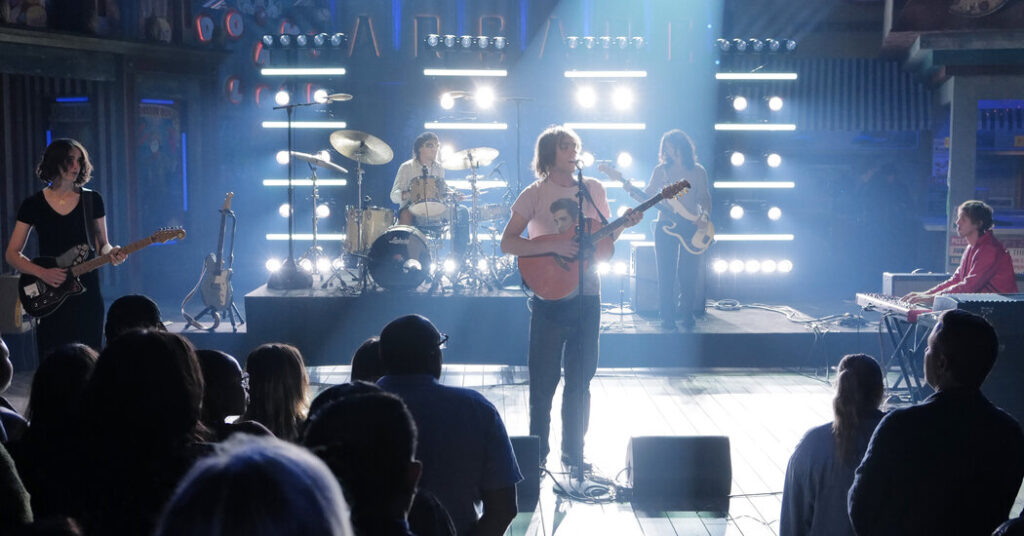
What kind of music do you listen to? Hip-hop? Pop? K-pop? Country? Reggaeton? An eclectic mix of styles and genres?
How about rock?
Are you a fan of bands like the Beatles, the Rolling Stones, Queen, AC/DC, U2, Nirvana, Red Hot Chili Peppers and Green Day? How about more current bands and performers like Måneskin, Hayley Williams and Geese? Do you like any particular rock sound, such as classic rock, grunge, new wave, heavy metal or indie?
Or, as far as you’re concerned, is rock music dead?
In “Who Says Rock Is Dead?” Jon Pareles argues that as artificial intelligence infiltrates music, the genre’s handmade imperfections are more crucial than ever:
The 21st century has not been kind to rock. Pop, hip-hop, R&B, country and Latin music have all pushed the genre out of the commercial and cultural mainstream. In retrospect, rock’s last grand heyday was in the 1990s, when grunge, nu-metal and pop-punk were all happily — well, more like furiously — blasting away.
But rock was already being stripped for parts. Country was latching onto arena rock’s most crowd-pleasing sounds, hip-hop was borrowing drumbeats and riffs, and pop performers learned to treat electric guitars as fashion statements and attitude signals, if only for the length of a song. While some surviving classic-rock acts still sell out arenas today, most 21st-century rockers are well aware that their chosen idiom is likely to remain a niche choice. One indicator: In recent years, the Grammy Awards haven’t handed out the best rock album trophy during prime time.
But rock has stubbornly stuck around, and in 2025 rock bands still raised a ruckus. They have a vast available vocabulary: psychedelia to punk, rockabilly to shoegaze, yacht rock to emo, prog-rock to industrial. And it’s not as if a band has to choose just one. In an era of streaming that offers every timeline all at once, the most striking rock bands have been demolishing pigeonholes.
The limited expectations for 21st-century rock may just have turned out to be freeing. For songwriters, musicians and — with luck — enough fans to support them, rock is far from played out. Consider just a few examples from bands that have been forging their music in time-tested rock style: gigging, making multiple albums, gigging some more.
The New York City band Geese stirred up wildly disparate praise and scorn in 2025. Its third full-length album, “Getting Killed,” flaunts Cameron Winter’s wayward vocals, songs that hopscotch through decades and lyrics that pivot from heartfelt insights to absurdist doggerel and back. Is Geese a rightful critic’s darling, a spoiled put-on, neither, both or more? Winter’s stage presence drew enough notice to merit a parody on “Saturday Night Live.”
Turnstile, a 15-year-old band from Baltimore that emerged from hardcore but was never constrained by it, released “Never Enough,” a sleek, electronics-buttressed outpouring of songs about connection, longing and loss. Another band with a punk and hardcore foundation, the Armed, charged off in the opposite direction; it ferociously cranked up the frenzy and distortion, screaming and stomping its way through the songs on its aptly titled album “The Future Is Here and Everything Needs to Be Destroyed.”
Mr. Pareles continues, contending that many of the same technological and cultural factors that have led to rock’s decline are reasons for its recent resurgence:
Now that every computer is a potential instrument, library and recording studio, it has never been easier to create music alone or via shifting virtual collaborations. Artificial intelligence promises to reduce human input even more; for some listeners in 2025, the hollow mediocrity of the A.I.-generated band Velvet Sundown was palatable enough. But rock’s persistence in the face of machine-tooled music is a welcome sign of humanist obstinacy.
For all the attractions of computerized convenience and digital precision, there’s still traction in the longtime archetype of the rock band as a gang of unruly outsiders. A working band is a contentious team that makes its own rules, unites incongruous personalities, works beyond (or revels in) limitations, aims for improbable synergies and makes a lot of noise along the way. There’s friction, but there’s also purpose; there’s instinct along with calculation. Rock promises the physical sensation and lived-in experience of hands on instruments and voices being pushed, of callused fingers and breathless effort. And there’s passion, even when it’s wrongheaded or contrary to convention.
A rock band is also a bulky physical presence: a roomful of people, instruments, amplifiers and mics, not to mention the pedals and cables and stands. It’s not necessarily streamlined or digitally optimized. Anything might fritz out or feed back — and might make a sound no one expected and everybody loves. Machines can sample those unforeseen sounds — hip-hop regularly turns noises into hooks — but rock makes them happen in real time.
Students, read the entire article and then tell us:
-
Does rock music still matter? Do you or your generation care about the genre anymore — the way young people growing up in the ’60s, the ’70s, the ’80s and the ’90s did?
-
Are you a fan of rock music — past or present? If so, which are your favorite bands and songs, and why?
-
If you aren’t a big fan, what kind of music do you like? Are there genres or styles you like best? Some you avoid at all costs? Or do your music tastes defy genres and labels?
-
What’s your reaction to the article? Does Mr. Pareles make a convincing case that rock is still alive and kicking? Have you heard of any bands he discusses, like Geese and Turnstile, before? If not, are you curious to take a listen now?
-
Mr. Pareles writes that rock is a battle between “order and chaos” and that its persistence is a “welcome sign of humanist obstinacy” against machines. Do you value “friction” and “imperfections” in music? Or do you prefer the “computer-tuned voices” and “metronomic beats” of digitally optimized tracks?
-
What do you see as the future of rock? If rock stays “on the fringes” rather than being the most popular genre, does that make it more or less appealing to you?
Students 13 and older in the United States and Britain, and 16 and older elsewhere, are invited to comment. All comments are moderated by the Learning Network staff, but please keep in mind that once your comment is accepted, it will be made public and may appear in print.
Find more Student Opinion questions here. Teachers, check out this guide to learn how you can incorporate these prompts into your classroom.
Jeremy Engle is an editor of The Learning Network who worked in teaching for more than 20 years before joining The Times.
The post Does Rock Music Still Matter? appeared first on New York Times.