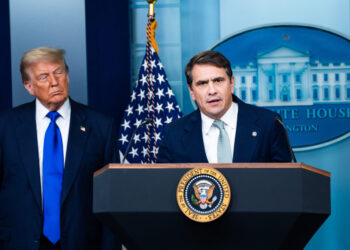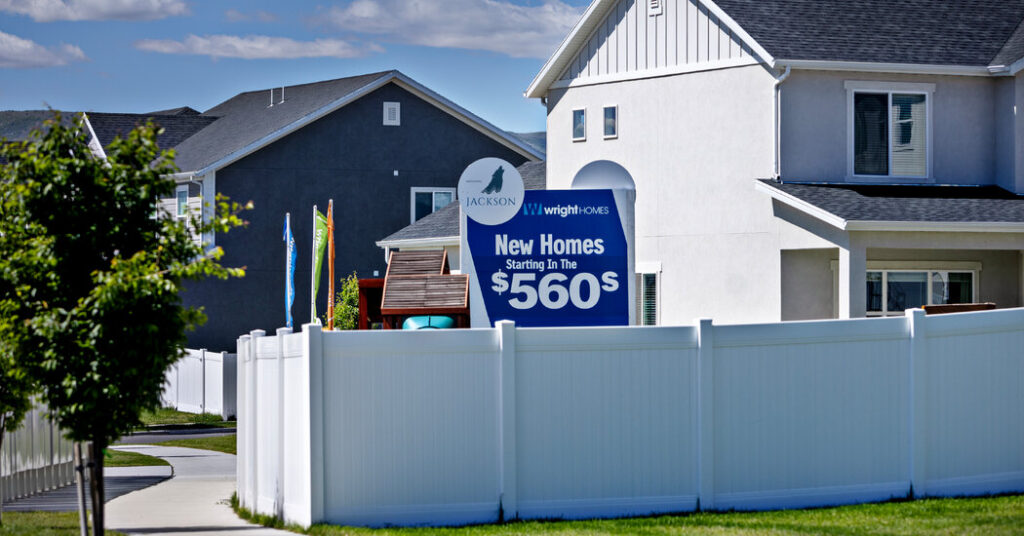
President Trump has promised to address the housing affordability crisis, a top concern for voters. At a cabinet meeting last week he did so directly, but not in the way frustrated home buyers might have expected.
“I don’t want to drive housing prices down,” he said. “I want to drive housing prices up for people that own their homes.”
The desire to protect the investments of existing homeowners while making ownership more attainable for first-time buyers is a conundrum that has flummoxed policymakers for decades. In a country where owning a home remains both a national aspiration and the greatest source of personal wealth, there is no way to lower costs for buyers without hitting the pocketbooks of owners.
Economists across the ideological spectrum have diagnosed the United States with an acute housing shortage that has raised home prices and rents. The remedy, they argue, is to focus on policies that increase the supply of housing, which should tame rising prices by bringing supply in line with demand.
If the president were talking about almost any other good, this approach would seem uncontroversial — he regularly argues that expanded oil drilling can calm energy prices. But with housing, that basic calculation is not so simple.
In the years since the Covid-19 pandemic, home prices have risen about 50 percent. That increase is driving the frustration with the cost of living, especially among young people. In a recent New York Times/Siena poll, more than half of voters under 30 named housing as the thing they worried most about being able to afford. But because two-thirds of American households own their homes, that run-up in prices has simultaneously created trillions in wealth for their parents.
“Every time you make it more and more and more affordable for somebody to buy a house cheaply, you’re actually hurting the value of those houses,” the president said during a speech at the World Economic Forum in Davos, Switzerland, last month. “And I don’t want to do anything that’s going to hurt the value of people that own a house, who for the first time in their lives are walking around the streets of whatever city they’re in, very proud that their house is worth $500,000, $600,000, $700,000.”
Housing is an unusual good. It is on one hand a basic necessity — shelter — and on the other a financial asset. That split has made it the double-edged sword of economic policy.
In his second term, Mr. Trump has advanced a number of ideas for making housing more attainable, if not actually more affordable. In November, for instance, he floated an idea for 50-year mortgage, a move that could lower monthly mortgage bills but would add hundreds of thousands of dollars to the total cost of a typical home. His advisers have talked about allowing home buyers to tap their retirement accounts for down payments. At his cabinet meeting, he pointed to lower interest rates — a recurring theme — as the primary solution to increasing homeownership.
The common thread in these ideas is that they are “demand-side” policies that aim to make mortgages cheaper or easier to get while doing little to address the underlying housing shortage, which economists estimate at between four million and seven million units. The president is far from alone. As Judge Glock, a senior fellow at the Manhattan Institute, a conservative think tank, put it, “So far most of what Trump has proposed has been in line with 100 years of the federal government allowing people to layer on more debt.”
Life, Liberty and the Pursuit of Property Value
From its founding to today, the United States has lionized property ownership as core to societal stability. But until the Great Depression, the federal government played a minimal role in helping people purchase homes. Home buyers typically got mortgages through cooperatives called building and loan associations that required large down payments and had to be paid off over a decade or so.
After the downturn, as banks began collapsing, the federal government stepped in with a series of measures — including the creation of the Federal Housing Administration — to shore up the housing market and prevent homeowners from going into foreclosure. This helped expand the pool of buyers by lowering down payments and, over time, ushering in products like the 30-year fixed rate mortgage.
Over the next several decades, the federal role in housing continued to expand through options like Veterans Affairs loans and the backing of financing institutions like Freddie Mac. The goal, as during the Depression, was to expand the ranks of homeowners by pushing lenders to extend credit to a larger pool of buyers than a purely private market would risk.
Home price stability was central to that policy of widening ownership, but rapid price appreciation was not. That began to change in the 1970s, when a spike in inflation turned owner-occupied homes into “growth stocks,” according to William A. Fischel, an economist at Dartmouth.
As owners began to think of their homes as an instrument for rapid wealth building, restrictions on growth — such as environmental laws and zoning policies that choked off new development — proliferated around the country and boosted home values. In effect, this put federal and local housing policies in conflict.
While the federal government tried to expand housing demand by subsidizing the cost of mortgages, local governments tried to limit supply by making housing harder to build. The predictable result was faster home price growth.
Mr. Fischel coined the term “homevoters” to describe the new wave of constituents focused on their property values. Today, many people simply call these NIMBY (for “Not in my backyard”) tactics.
This shift created a housing shortage that has been building gradually over decades but was most acute in a handful of high-priced markets such as California. It was the aftermath of the Great Recession that made the housing shortage a national crisis.
In the years after that financial collapse, lenders pulled back and local homebuilders went out of business. Housing construction plunged more than 70 percent from 2005 to 2009 and, almost two decades later, has yet to come near the pace of building before the Great Recession.
When interest rates plunged during the pandemic, demand rose and home prices only exploded further. A concern among economists is that if interest rates fall without a healthy increase in supply, home prices will simply rise and erase the benefit of lower mortgage rates.
“If you have strong economic growth and homebuilding stays at the same level, lower interest rates are just going to push home prices higher,” said Edward J. Pinto, co-director of the American Enterprise Institute’s Housing Center.
The ‘Homevoters’ Coalition
Housing politics are almost impossible to map on the traditional Democratic-versus-Republican divides. A better way of thinking about housing tensions is that they pit incumbents versus newcomers, stability versus change.
David Schleicher, a professor at Yale Law School who writes about land use and property, pointed to California, where “homevoters” from both parties have rebelled against growth and change. Liberals have pushed for laws to expand environmental protections; conservatives have revolted against property tax increases.
“There are left things and there are right things, but they’re the same thing,” he said.
What’s new is that bipartisan NIMBYism seems to be shifting to a bipartisan YIMBYism (“Yes in my backyard”) — an agreement that the country needs to build more housing, more quickly. Over the past few years, cities and states have passed a host of measures to make housing more plentiful, like allowing backyard units and rolling back limits on multifamily housing construction. The explicit aim is to make housing more affordable.
Much like the “homevoter” revolution of a half-century ago, this movement has taken hold in conservative states like Montana and liberal states like California. In Congress, there are currently several measures to increase the housing supply that have bipartisan support.
Whereas state and local leaders used to think it was politically ruinous to cross local homeowners, now they routinely run on anti-NIMBY platforms and their desire to lower home prices.
Sky-high property values create their own kind of instability. Parents who find their retirement accounts flush with home equity might not feel good about it when their grandchildren can’t afford to live nearby. Businesses have a hard time finding employees in places where the rents are high, while luxury condominiums go up in neighborhoods grappling with homelessness.
“The problem wasn’t bad enough for voters to be seeking solutions until pretty recently,” said Jason Elliott, a political consultant in California who was a senior adviser to Gov. Gavin Newsom from 2019 to 2024. “Now the social costs are too apparent to ignore.”
Conor Dougherty covers housing and development, focusing on the rising costs of homeownership. He is based in Los Angeles.
The post Voters Say Housing Prices Are Too High. Trump Wants Them Higher. appeared first on New York Times.