Nicholas Eberstadt is the Wendt chair in political economy at the American Enterprise Institute. This column is adapted from the preface to his November essay collection “America’s Human Arithmetic.”
The 250th anniversary of the American experiment would be reason enough for a reckoning. But the force of historical events brings its own special reasons to a focus on America at this moment, too.
All eyes are on America today. There is an uncertainty and a sense of unease about the American project, both at home and abroad.
Domestically, confidence in our political and civil institutions has undergone a serious and prolonged decline. Confidence in America internationally is eroding precipitously as well. Foreign governments and global markets are coming to regard the United States as an unreliable actor — even as an epicenter of international instability.
The American unpredictability that newly unnerves overseas friends and shakes markets emanates from internal U.S. sentiment — from Americans’ dissatisfactions about their own country, including its role in the world. That discontent is prompting Americans to reconsider their long-standing commitment to the existing international system — to the Pax Americana of security treaties and arrangements for finance and trade that have done so much to bring freedom and prosperity to humanity for three generations.
There is an exquisite and agonizing irony to this moment: The acute and unsettling U.S. restlessness that is turning the world stage into an American drama happened to spill over at the very point when the United States had emerged, through victory in the Cold War, as the globe’s single and undisputed superpower — with greater reach and influence than the Romans, the Mongols, or any other ambitious predecessor.
Likewise, the doubt and uncertainty now reverberating within the United States, perhaps still largely inchoate but increasingly channeled into populist impulse, is besetting a society of breathtaking affluence. No country in history has been as successful at generating riches — U.S. private net worth amounts to more than $180 trillion — as the United States today.
Why is the richest and most powerful country in history so consumed today with doubts and discontent? America’s human arithmetic may provide important clues.
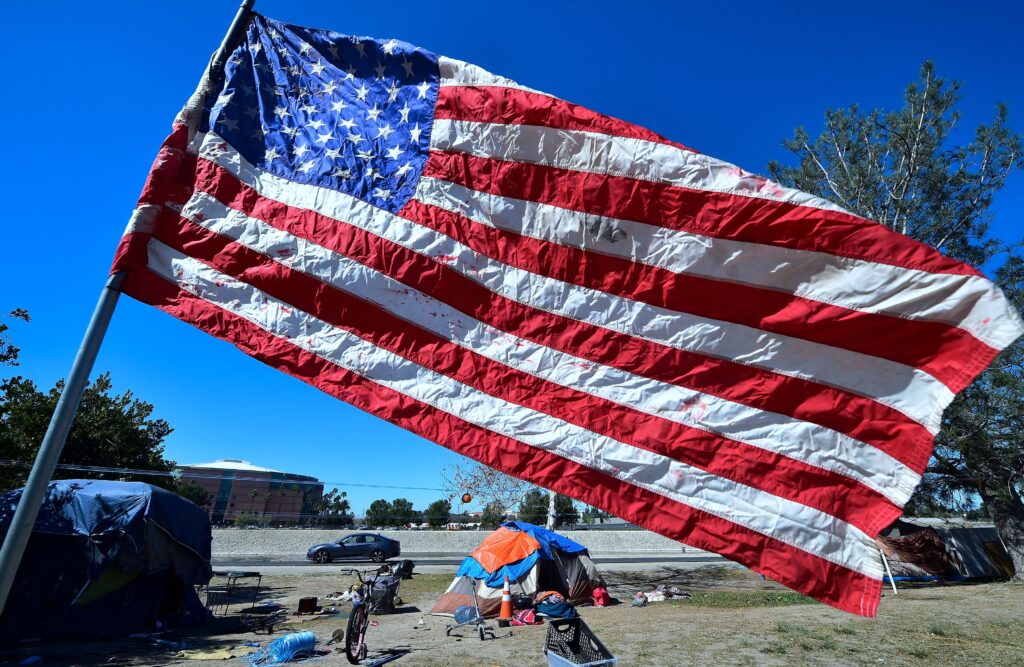
It is possible to be both prosperous and pauperized; to enjoy affluence and suffer from savagery.
America’s material living standards have advanced tremendously in a relatively short time. Signal social progress has also been achieved in recent generations — most notably, the overturn, and thorough repudiation, of legalized racial discrimination, a stain on our country that continued for a century after our bloody war to end slavery.
But the unexpected results of our new spending power, and the unintended consequences of our government policies for social betterment, have exacted a startling toll — a painful bill, impressed into the lives of many Americans. Call it the New Misery.
Our forebears from the Great Depression could scarcely have imagined that a future America — awash with so much plenty, benefiting from so much education, possessing so many revolutionary new scientific breakthroughs and technological innovations — would have so much more welfare dependence, family breakdown and crime than they did. Possibly more loneliness and despair, too.
An earlier generation of Americans might have been more aware of the role of human agency in this state of affairs than we seem to be today. Moderns instead tend to speak of all these ills in a language full of phrases like “social forces” and “structural trends.”
This brutally materialist habit of thought may be correct as far as it goes, since modernization and development are always accompanied by socioeconomic transformation (often by disruption and upheaval). But a discourse that reduces our circumstances to mere social probability schedules also dehumanizes us, neglecting the power to shape those same schedules through personal choice. Indeed: The country we inhabit was built by a people whose improbable choices reflected their exceptional grit and faith; their enterprise and wild, cockeyed optimism. The United States as we know it would not exist but for this distinctive, and world-changing, aggregation of personal choices.
Some aspects of the New Misery have been strangely overlooked by today’s social commentary, academic research and policy planning. We cannot have an accounting, much less an understanding, of America’s human arithmetic if we fail to observe major problems facing large numbers of Americans. Yet somehow these problems keep on hiding in plain sight.
Consider just one of them: The long-term collapse of work for men in postwar America.
Despite seemingly favorable unemployment numbers, especially for men in the prime of life, the awful truth is that the employment rate for men of prime working age (those 25 to 54) has on average been lower in the first quarter of the 21st century than it was at the end of the Great Depression.
The idea that grown men would not be looking for jobs when they lacked them would have been inconceivable to a Depression-era sensibility. Yet over the past two generations, the fastest growing component of America’s prime-age male population has been men who are neither working nor looking for work.
Due to this exodus from the labor force, roughly 7 million men between the ages of 25 and 54 are now un-workers: over 1 in 10. For every prime-age man who is actually unemployed — i.e. jobless but looking — there are three who are jobless and not looking. Such men characteristically are detached, dependent and defeated. Almost half say they use pain medication every day. A large proportion are former felons. Too many live lives of lost potential and court deaths of despair.
The damage from this one problem — from America’s men without work — radiates outward. Their unnatural condition makes for slower economic growth; wider income and wealth gaps; increased welfare dependency; reduced social mobility; more fragile families; and a weaker civil society.
The failure of our nation’s describers and deciders to address, much less redress, the New Misery is an important contemporary problem in its own right. It deserves deeper consideration than it has received.
Although we live at the vaunted advent of an age of “big data,” and notwithstanding the legions of intellectuals, analysts and public servants charged with monitoring and promoting the public weal, the American population bears scars and wounds that our detectors and improvers could not bring themselves to see for decades on end. These include, but are hardly limited to, our army of men without work, our epidemic of deaths of despair and the tens of millions of convicts now in our midst.
This would be occasion for satire were it not so tragic. It speaks to the strange distance that has opened between our “improvers” and “improves” and underscores an unseemly empathy gap in our country — not least on the part of those in positions of intellectual and political authority. It is also related to the decline of truth in the public square — a spectacle that many in the academy, the media, and the government have not only tolerated but abetted.
Is it really so difficult to understand why trust in our civil and political institutions has fallen so far in recent decades?
America has endured a prolonged spate of unusually poor political leadership since the end of the Cold War — almost 35 years now and counting. U.S. international leadership, I submit, has been increasingly myopic.
The world is a dangerous place. Peace and prosperity do not take care of themselves. Too many raised in our historically anomalous “post-Cold War era” have been tempted to think otherwise — to take for granted the global fruits from our necessarily conditional Pax Americana.
Our political leadership has likewise succumbed to previously unfamiliar temptations domestically, including a perverse new codependency with American voters. As the federal government evolved into a machine for administering and dispensing entitlement payments to the general population, the elected representatives in Washington in charge of these transfer payments became complicit in compromising the quality of citizenship in America.
In the interest of maximizing transfers to the voting public, the principle of fiscal balance was first repeatedly violated. Eventually, all pretense of budget discipline was abandoned. Now we are at the stage where Congress and the president routinely approve 13 figure budget deficits — even during peacetime economic expansions. In effect, these vast amounts of public debt are being contracted to finance current entitlements.
Another way of saying the same thing is that our country’s children, and Americans as yet unborn, are being obligated tomorrow to pay for “mandatory” consumption by senior citizens today. This way of conducting the nation’s business is unethical, indefensible and unsustainable. Yet mortgaging the American future seems to be politically unobjectionable, at least for now.
America today is a great nation at risk. But arguably the most important threats to our country, both at home and abroad, come from our own hand. Our unsettled superpower may be exceptional in this regard, as in so many others. Fortunately, it means we find ourselves at a point not only of peril, but conversely also of immense promise.
America already possesses the basic formula for eliciting bounty for all at home. So, too, the domestic legal and constitutional foundations for an unending experiment in political liberty. Internationally, for its part, our Pax Americana has done more to protect individual rights and foment the escape from poverty than any other set of arrangements ever attempted.
Our fundamentals are sound. We need the faith to let them work. A bit of that wild, cockeyed American optimism wouldn’t hurt, either.
The post Life, liberty and the pursuit of misery appeared first on Washington Post.