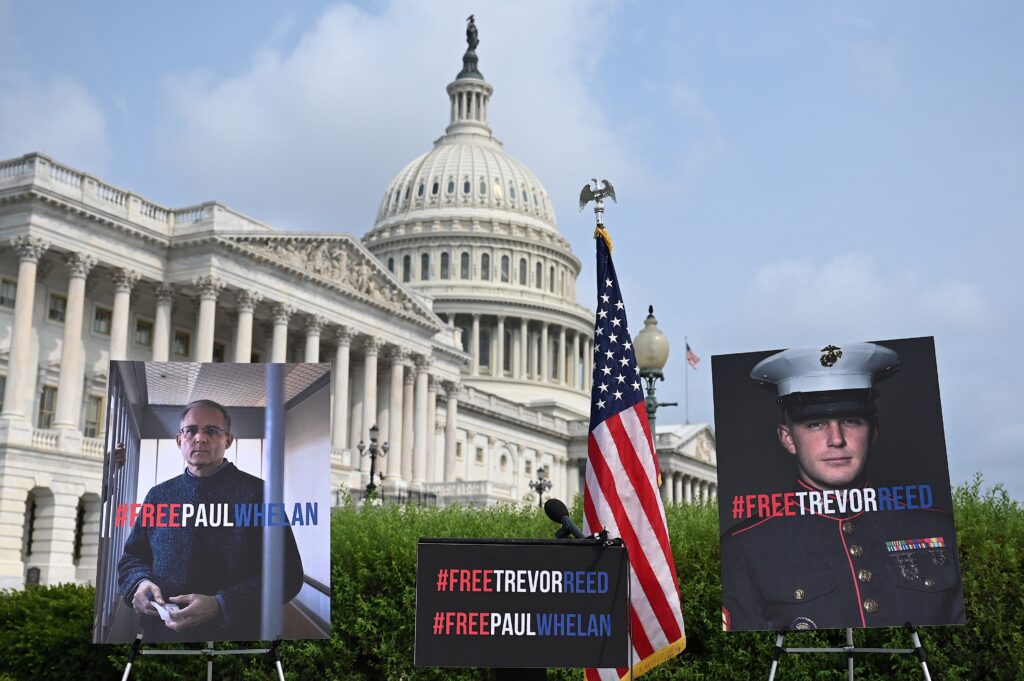
Pedro Pizano is director of the John McCain Freedom for Political Prisoners Initiative. Sarah Moriarty is a fellow in New America’s Future Security program and one of the seven children of Robert “Bob” Levinson, the longest held hostage in American history.
In September 2025, the Trump administration signed an executive order aimed at deterring foreign governments from wrongfully detaining Americans abroad, giving Washington the authority to designate and impose consequences on regimes that arrest Americans for political leverage. In December, through the National Defense Authorization Act, Congress codified this executive order into law with broad bipartisan support.
According to Adam Boehler, the U.S. special hostage response envoy, the Trump administration has brought home 160 hostages, both Americans and allies, from captivity this term. These new powers can help extend that momentum — if the government makes use of them.
Authoritarian regimes across the world have made state hostage-taking a routine tactic. Innocent Americans are arrested to extract concessions from the U.S. government, to offer authoritarian governments a point of leverage or to incentivize prisoner swaps. In 2024 alone, the Foley Foundation reported on at least 54 wrongful detentions or hostage cases involving U.S. citizens — more than one American taken hostage every week. Detaining civilians for political gain is a form of coercion and a violation of international law, yet the practice persists around the world.
The U.S. now has the authority to designate an entire government a State Sponsor of Wrongful Detention (SSWD). The executive branch, under a single instrument, can impose sanctions, visa restrictions, financial penalties and coordinated interagency actions. Consequences could include restrictions on geographic travel, on assistance provided to the nation’s government under the Foreign Assistance Act of 1961 and on the export of certain goods to the country under the Arms Export Control Act and the Export Control Reform Act of 2018. Critically, the State Department can also quickly reverse these consequences or retract the SSWD designation should a foreign government release their hostages and change their behavior.
Experts have long advocated for this approach: If taking Americans hostage triggers swift and meaningful penalties, foreign governments and non-state actors are likely to reduce or entirely stop the practice.
The McCain Institute’s Freedom for Political Prisoners Initiative and its advisers have called for a stronger emphasis on deterrence within the existing hostage recovery infrastructure. The Center for Strategic and International Studies’ bipartisan Commission on Hostage Taking and Wrongful Detention warned that effective deterrence requires changing the cost-benefit calculation for foreign leaders. The Independent International Panel on Arbitrary Detention in State-to-State Relations has urged countries to treat arbitrary detention as a human rights violation that demands coordinated consequences.
But the promise of this new tool will go unrealized if the authority remains unused. The Trump administration should swiftly issue new SSWD designations. Russia, Iran and Afghanistan are all repeat offenders who need to feel the consequences of their policies. Designating Iran in particular must be a priority, as several new American hostages are reportedly being held there in the wake of the recent protests. These initial designations would also send an important wider message to other potential SSWDs: reverse course or pay a similar, or even greater, price.
After the designations are in place, the Trump administration should dole out punishments in ways that have maximum impact. For example, an official travel ban to Afghanistan or Iran under the designation may give all international travelers pause where general awareness campaigns have not yet worked and ultimately impact these countries’ growing tourism revenue streams.
Finally, the U.S. government should work even more closely with former detainees/hostages and their families through formal engagements, similar to the U.S. Advisory Council on Human Trafficking. Former detainees’ experiences make clear what is at stake. Many describe years of uncertainty, isolation and fear that their government has forgotten or abandoned them. Their stories, and the stories of those who did not come home, highlight how much suffering could have been avoided if meaningful deterrence existed earlier.
Americans traveling, working or reporting abroad deserve a proactive response to hostage-taking. They deserve a policy that makes their safety nonnegotiable. The SSWD designation is a significant step toward that goal. Whether it realizes its potential depends entirely on if Washington decides to make it count.
The post The U.S. finally has a tool to deter hostage-taking appeared first on Washington Post.