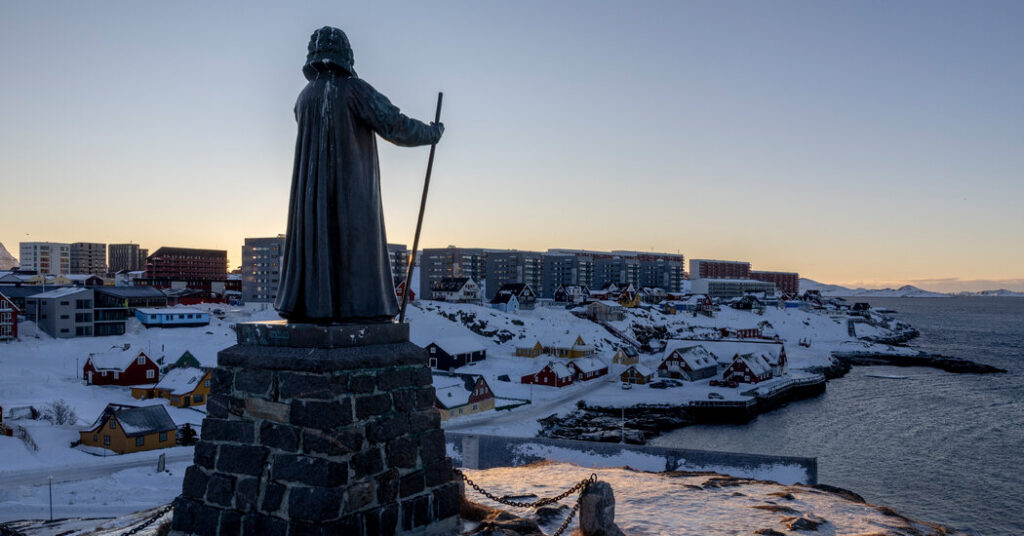
President Trump’s recent fixation with Greenland has brought attention to a little-known snag. Over a century ago, the United States had all but promised to keep its hands off the island.
In 1917, it agreed to respect Denmark’s control of Greenland, then a Danish colony, in return for a deal to buy the Danish West Indies, a group of islands in the Caribbean.
Legal experts say the deal still binds the U.S. government. That is unlikely to constrain Mr. Trump. He has pulled out of multiple treaties and made clear that he feels limited only by his own morality, not by international law. He has backed down, for now, from a previous threat to seize the territory.
Still, as Danes and Greenlanders worry about Mr. Trump’s next steps, the 1917 agreement helps shed light on an era of superpower territorial expansionism that he seems intent on reviving.
What was the 1917 deal?
The deal to purchase three islands in the Caribbean — then the Danish West Indies, now in the U.S. Virgin Islands — was ratified by the American government in January 1917.
The islands, which lie off Puerto Rico’s eastern coast, had been coveted by the United States for at least half a century, mostly for commercial and military reasons.
The U.S. paid $25 million in gold for the islands, one of the final expansions of U.S. territory after a 19th century dominated by the “manifest destiny” idea of growth. In the 1800s, the United States grew by more than 70 million people and 29 states, as the government acquired most states west of Kentucky and south of South Carolina.
“That was the last time that you could do something like that,” Astrid Nonbo Andersen, a historian at the Danish Institute for International Studies, said of the 1917 purchase, before World War I ushered in new concepts of nation and self-determination.
Previous U.S. attempts to buy those Caribbean islands had fallen through. But in 1916, the United States — which had not yet entered World War I — worried that Germany might invade Denmark, allowing Germany to station troops and a military fleet in the Caribbean, Dr. Andersen said.
Gunvor Simonsen, a historian at the University of Copenhagen who studies the Caribbean, said Denmark was not keen to sell at first. But the Danes were also aware, she said, that “if they don’t agree to sell, maybe the U.S. will simply occupy the islands.”
What did the Caribbean islands have to do with Greenland?
Both were under Denmark’s control. Both had long been desired by American leaders.
“The interest in Greenland was tightly indexed to the interest in the Danish West Indies,” said Mark M. Smith, a historian at the University of South Carolina who is studying U.S. interest in the islands.
Ultimately, the United States wanted the Caribbean islands more, historians said.
A deep harbor in a major commercial Caribbean shipping lane would have likely been seen as more valuable than an icebound expanse in the Arctic.
The strategic calculus has since shifted with new technologies and melting ice caps, but it made sense at the time, experts said.
The Danes used that as leverage to get the Americans to back off from Greenland as part of the Caribbean deal, Dr. Simonsen said.
It worked.
“The United States of America will not object to the Danish Government extending their political and economic interests to the whole of Greenland,” Robert Lansing, then the Secretary of State, pledged — in writing — in 1916.
Is the 1917 deal still binding?
Yes, experts said.
“We recognized it, so we kind of can’t take that back,” said Julian Arato, a professor of law at the University of Michigan.
That is true even though Greenland is now a semiautonomous part of the Danish kingdom, and not a colony, said Rachael Lorna Johnstone, the director of the polar law program at the University of Akureyri in Iceland.
“It is not possible, over a century later without any contradictory practice, to withdraw the declaration,” Dr. Johnstone, who also teaches at the University of Greenland, wrote in an email.
Whether Mr. Trump believes in honoring treaties is a different matter entirely.
“I don’t need international law,” he told The New York Times last month. Asked whether his administration had to follow such law, he said that it “depends” on one’s definition.
Professor Arato said that there was no obvious place for Denmark or Greenland to sue if U.S. troops invaded, because the United States does not automatically accept the jurisdiction of the International Court of Justice, the United Nations’ highest judicial body.
“The law would be crucial in figuring out the aftermath,” he said. “But it doesn’t mean the law would stop the disaster.”
Amelia Nierenberg is a Times reporter covering international news from London.
The post A Century Ago, the U.S. Accepted Danish Control of Greenland. Here’s How. appeared first on New York Times.