Private credit, an industry focused on lending to risky companies, has been one of the fastest-growing sectors on Wall Street, raking in trillions of dollars of investments and minting a slew of billionaires.
But the tide has started to turn.
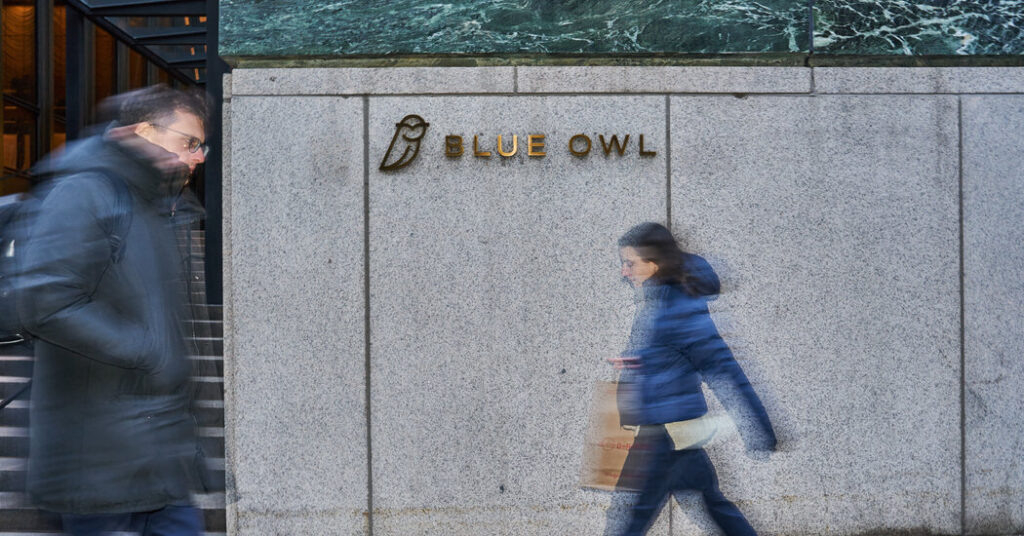
Blue Owl Capital, the largest private credit firm, has seen its stock fall more than 50 percent over the past year — including a 10 percent drop on Tuesday — and investors have been pulling money from funds that the firm manages. Apollo Global Management and BlackRock, two other large players, have also rattled investors with write-downs on large loans to several troubled e-commerce companies.
Concerns about risks in the industry have been rising for months after a smattering of loan losses have raised questions about the financial stability of private credit borrowers.
But a trigger for Tuesday’s turmoil was a sudden fear that software companies, which borrow heavily from private credit firms, could be upended by artificial intelligence.
Software firms have received roughly 20 percent of loans made by private credit funds, and analysts at Barclays and UBS warned this week about the risks of increased losses on the loans. Publicly traded software firms have lost roughly one-fifth of their value this year, and the prices of loans that trade have also dropped, the analysts noted.
“This industry has never gone through a down cycle, so it makes a lot of sense that investors are especially jittery,” said Jared Ellias, a professor at Harvard Law School who recently co-wrote a paper on the growth of private credit titled “The Credit Markets Go Dark.”
The prospect of further write-downs on these private loans has raised fears of large losses rippling through Wall Street and constricting a source of roughly $3 trillion worth of capital in the economy.
In recent years, private credit stepped into a lending void left by traditional investment banks that had to deal with greater regulatory restrictions on their lending. It became an especially attractive investment when interest rates were extremely low because private credit firms were lending at higher rates, meaning higher returns for investors.
But the trade-off is that since both the borrowers and the lenders in most cases are private, investors are given relatively little visibility into the financial health of the companies borrowing from private credit firms.
The Barclays analysts noted on Monday that it was “nearly impossible” to know how much risk there was in the software companies because those companies were private. The private credit lenders themselves update their own valuations of these companies only on a quarterly basis.
Private credit firms have sought to reassure investors that their credit quality is sound.
Craig Packer, co-president of Blue Owl, said in an interview Tuesday that he was baffled by the sell-off. “It seems really overblown relative to what we’re experiencing,” he said.
One issue for these firms is how they have funded their growth. Blue Owl has raked in nearly $300 billion from investors since its founding in 2016 — a pace of growth nearly unmatched on Wall Street.
Some of that money came from long-term investors, including pension and endowments that are used to locking up their money with private investments for five to 10 years and waiting out any short-term setbacks.
But a large portion of Blue Owl’s funding comes from investors in the publicly traded investment funds that Blue Owl manages, called business development companies, or B.D.C.s.
As some companies have shown signs of strain, many investors have been selling.
In September, a pair of relatively unknown companies — a midsize auto parts retailer, First Brands, and an auto lender and used-car retailer, Tricolor Holdings — unexpectedly declared bankruptcy, dealing losses to their lenders, which included private credit lenders. Executives at both companies were involved in fraud, prosecutors say.
Even though Blue Owl was not a lender to either company, the company’s share price dropped steeply after those bankruptcies, as investors worried about whether private credit firms had done their diligence on the companies they were lending to.
The sell-off has accelerated at the start of this year. Last week, Blue Owl revealed that investors that account for roughly 15 percent of the money in one of its technology-focused credit funds had asked for it back, after the firm raised a previous cap on redemptions of 5 percent. Blue Owl has said its other funds have had significantly fewer redemptions.
“Investors are very on edge about the next negative headline,” said Ben Budish, an analyst at Barclays who covers Blue Owl. “They worry that they’ve made irresponsible loans,” he said about the industry as a whole.
Still, the extreme sell-off has surprised Mr. Budish and other analysts who believe that the economy remains strong and that defaults will not spread beyond just a few companies or sectors like software.
Of 16 Wall Street analysts covering Blue Owl’s stock, 13 rate the company a buy.
“It doesn’t seem like credit performance is deteriorating,” said Mr. Budish, who has the equivalent of a buy rating on Blue Owl.
Michael Hitchcock, chief executive of the South Carolina Retirement System Investment Commission, has been an investor in Blue Owl since its early days. He said the pension fund planned to continue investing in private credit and would most likely only increase its investment in Blue Owl.
“Like any market, there’s going to be ups and downs,” he said.
It’s not necessarily the scale of the losses that is spooking some investors, but rather that some losses are coming as a surprise.
BlackRock recently told investors that it had cut the value of one of its private credit loan books, which had exposure to struggling Amazon resellers and a home improvement company that filed for bankruptcy, by 20 percent. Just a month earlier, BlackRock had valued that group of companies at roughly $1.8 billion.
Last month, Bloomberg reported that Apollo had been forced to write off a portion of a $170 million loan it extended to Perch, a company that bought and aggregated sales for Amazon resellers. In a statement, Apollo said the loan “was immaterial to our performance — on an annualized basis.” Apollo’s share price is down about 24 percent over the past year.
The stock sell-off could also hurt the industry’s ability to keep growing rapidly.
Blue Owl has used its stock to go on a buying spree of investment firms in related industries. In 2024, the company spent roughly $1 billion to buy IPI Partners, a data center investor; $450 million for Atalaya, a firm that specializes in consumer loans and other specialty types of finance; and $750 million for Kuvare Asset Management, an insurance and annuity provider.
Because Blue Owl used its own stock for a portion of these deals, its existing investors get a smaller piece of the overall pie. Investors and Wall Street analysts have also expressed concerns that these acquisitions won’t generate enough growth to make them worth Blue Owl’s while.
With its stock falling from a record high of $26.68 on Jan. 24, 2025, to $12.11 at the close of Tuesday’s trading, Blue Owl could have less capacity for future acquisitions.
But Blue Owl’s executives say there are other avenues for growth, including data centers, which are key to fueling the artificial intelligence boom.
Over the past few months, Blue Owl has announced more than $50 billion in data center deals. It has pitched itself as one of a small number of firms with the money to lease the land and build out the infrastructure that firms like Meta, Alphabet and Microsoft are looking to rent.
Blue Owl said its contracts and the promise of 15 to 20 years of lease payments from the most cash-rich companies in the world were airtight. But there are increasing concerns that the large technology firms are taking on more space than they’ll need.
The executives in charge of Blue Owl continued to preach the value of private credit.
“We’ve lived through short-lived periods of time where the stocks in the industry get knocked down, and over time, they tend to be buying opportunities,” Mr. Packer said.
Maureen Farrell writes about Wall Street for The Times, focusing on private equity, hedge funds and billionaires and how they influence the world of investing.
The post Once the Hottest Bet on Wall St., Private Credit Has Started to Crack appeared first on New York Times.