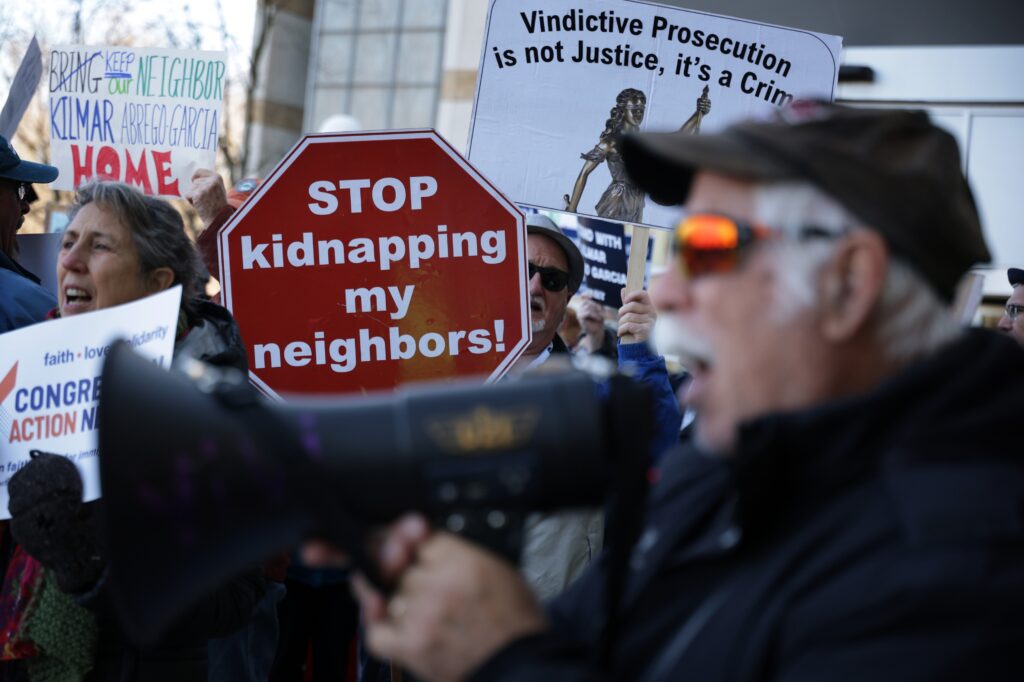
Maryland is poised to bar local law enforcement agencies from formally facilitating federal immigration arrests, joining several other states who have sought to use their local authority to curtail the Trump administration’s ramped-up enforcement effort.
At least eight other states have already either prohibited or set restrictions against local police and sheriff’s offices entering into what are known as 287(g) partnerships, which enable those agencies to help U.S. Immigration and Customs Enforcement take into custody people they say are in the country illegally. New Mexico, New York, Hawaii and Virginia are considering similar bans during their 2026 state legislative sessions.
In Maryland, the proposed ban that this week passed both chambers of the Democratic-led General Assembly, would force nine sheriff’s offices to immediately sever their ICE agreements — including in Frederick County, where the sheriff’s department joined the 287(g) program in 2008, making it one of the nation’s longest active participants.
Gov. Wes Moore (D) has not said whether he would sign the legislation. But leaders in both the House of Delegates and the state Senate, plus immigrant advocates, say they have no reason to believe the governor will not join them in making a stand against the Trump administration with this and other immigration-related bills.
“Maryland taking action right now is very powerful. It’s going to set the tone for other states to fight this,” said Cathryn Jackson, public policy director at immigrant advocacy organization We Are CASA. “We’ve been ready to do this work for the last decade. We’re glad the legislature has finally caught up.”
The Trump administration has pushed for greater local cooperation in immigration arrests, arguing that the arrests made on neighborhood streets that have spurred protests in multiple cities would decrease if states were willing to collaborate with federal agents through data sharing and 287(g) partnerships, which expand ICE’s capacity in numerous ways.
Since the start of the second Trump administration last January, the number of agreements signed between ICE and local law enforcement has skyrocketed from 135 to more than 1,300, according to data from ICE. Local law enforcement are now partnering with ICE in 18 states that did not have any 287(g) agreements before Trump came into office, the data shows.
“It’s a true public safety tool,” Chuck Jenkins, the sheriff in Frederick County, said during a news conference with Maryland’s Senate Republicans last month. “We simply don’t return criminals back onto the street. We hand those individuals off to ICE in a safe setting in their detention center.”
Last week, after ICE agents in Minneapolis shot dead two U.S. citizens as they protested the surge in federal enforcement, White House border czar Tom Homan said the administration’s withdrawal there was contingent on increased cooperation.
“The drawdown is going to happen based on these agreements,” Homan said, without naming 287(g) partnerships. “But the drawdown can happen even more if the hateful rhetoric and the impediment and interference will stop.”
In response to questions about the tactics states are using to push back on federal ICE enforcement activity, White House spokeswoman Abigail Jackson said in a statement that agents “act heroically to enforce the law and protect American communities” and that “local officials should work with them, not against them.”
Naureen Shah, director of immigration policy at the American Civil Liberties Union, said there is no evidence to suggest that in states with more 287(g) agreements, there is less street enforcement. Data shows that the majority of new agreements have been signed in Florida and Texas — with 293 and 260, respectively — and those states are also seeing heavy street enforcement, she said.
“It’s always been about getting them to bend the knee,” Shah said of the Trump administration’s approach to local officials.
Immigration and civil rights advocates across the country have been pushing states to ban 287(g) agreements for nearly a decade, ramping up efforts again in 2025 after Trump’s second inauguration.
State legislatures in Maine and Delaware heeded the call last year, but others — including Maryland — balked amid worries over how the Trump administration would respond.
During last year’s legislative session, which spanned January to April, the nation’s attention had zeroed in on Maryland. The Supreme Court had intervened in the case of Kilmar Abrego García, a lawsuit over Trump’s birthright citizenship ban had been filed in Maryland’s federal court, and a video showing ICE agents busting a car window to detain a mother had gone viral.
By the last day of session, the Maryland House of Delegates had passed a ban on 287(g), but the Senate chamber declined to act. Senate President Bill Ferguson (D-Baltimore), told reporters then that lawmakers needed to focus first on passing a budget that grappled with deep cuts to the state’s federal funding and workforce. He also expressed concerns that a 287(g) ban could invite retaliation from the Trump administration.
In a recent interview, Ferguson, who is now a co-sponsor of the legislation in the Senate, recalled that the fear from Maryland leaders was great.
Transportation officials were concerned about the administration reneging on a commitment made by President Joe Biden to have the federal government fully fund reconstruction of the Francis Scott Key Bridge. Others, he said, worried that Trump would cut more federal jobs and funding or use the National Guard to exert federal control over local jurisdictions. The planned FBI headquarters in Prince George’s County was at risk, as was federal funding for programs such as SNAP and Medicaid, Ferguson said.
But now, Ferguson said, ICE’s actions had been too “abhorrent” not to act. He said their tactics had been “worse than anyone anticipated,” likening their enforcement raids to “paramilitary activities.”
“The intervening year has sharpened people’s minds that we should disentangle ourselves,” said Sen. William C. Smith Jr. (D-Montgomery County), the bill’s chief Senate sponsor.
House Speaker Joseline A. Peña-Melnyk (D-Prince George’s), an immigrant from the Dominican Republic who co-sponsored last year’s 287(g) ban, said the need to temper ICE’s power has always been clear.
“It is really horrible, all the abuses that the immigrant community is going through right now,” she said. “The immigrant community, they’re really hardworking people that are part of the fabric in Maryland, and they deserve respect.”
This year’s legislation goes beyond the state’s 2021 Dignity Not Detention Act, which prevents local and state detention facilities from detaining immigrants on behalf of the federal government. The proposed ban would apply to all four types of ICE partnerships: the Task Force Model, the Tribal Task Force Model, the Jail Enforcement Model and the Warrant Service Officer program.
Both the Task Force Model and the Tribal Task Force Model serve as a force multiplier for the Department of Homeland Security — empowering local police to act as ICE agents during routine duties — though these do not exist in Maryland.
The Jail Enforcement Model is used by three Maryland counties, authorizing local law enforcement there to question detainees about their immigration status when they’re booked into the jail, directly search an ICE database to determine whether a detainee has a deportation order and notify immigration officials.
The Warrant Service Officer program is the most common in Maryland and was recently adopted by Wicomico County. This type of partnership uses local law enforcement to serve and execute immigration warrants in jails. “Looking the other way does not make our community stronger. Refusing to act does not make us compassionate; it makes us negligent,” Wicomico County Executive Julie Giordano said in January.
Discussions around the proposed ban come at a time when DHS is seeking to increase its presence in Maryland in other ways. The agency recently purchased a warehouse in Williamsport that is meant to become a long-term detention facility. Plans for another long-term detention facility are underway in Howard County, though officials there recently revoked a building permit for that site amid concerns about how it would affect the surrounding community.
Immigration advocates and local officials are finding other ways to thwart the expansion of ICE’s authority through an assertion of state’s rights — a phrase historically wielded amid American identity crises over slavery and the civil rights movement.
Jeff Kahn, director of the Law and Government Program at American University, said “state’s rights” was wielded by conservative lawmakers during abolition and integration as a way to push back on federal policies upholding equal protection under the Constitution.
“Now it’s states, as they were designed to do, trying to stand up and protect their citizens from aggressive, pernicious, racist, abusive behavior from the federal government,” Kahn said.
California has outlawed federal agents from wearing identity-concealing masks during police operations, a move the Trump administration is challenging in court. In Missouri, the Kansas City council passed a five-year ban on all new nonmunicipal detention facilities after ICE moved to transform a warehouse there into an immigration jail. Minnesota’s attorney general issued a formal legal opinion limiting the power of local law enforcement to perform immigration duties without permission from county lawmakers.
In addition to the 287(g) ban, Maryland lawmakers are considering legislation modeled after California’s law enforcement masking ban, as well as a bill that prevent ICE from gaining access to state agency data.
Advocates are also pushing for passage of the Maryland Trust Act, which goes even further than the 287(g) ban. The act would bar law enforcement officials in the state from cooperating with ICE in any way, including helping transfer immigrants from correctional facilities, detaining people on behalf of ICE and notifying ICE of arrests.
The package of immigration-related bills are a high priority, several lawmakers said, emphasizing a shared sense of purpose that has become more stark as ICE enforcement escalates.
Last year, the proposal for a 287(g) ban came with compromise language emphasizing ways to collaborate with federal ICE agents in some circumstances.
This time, said Del. Nicole A. Williams (D-Prince George’s), the bill language calls for a clean break.
“Over the last year,” Williams said, “we have seen that regardless of what we do as a state, this federal administration does not have any desire to work collaboratively with us.”
The post Several states move to ban local cooperation in immigration arrests appeared first on Washington Post.