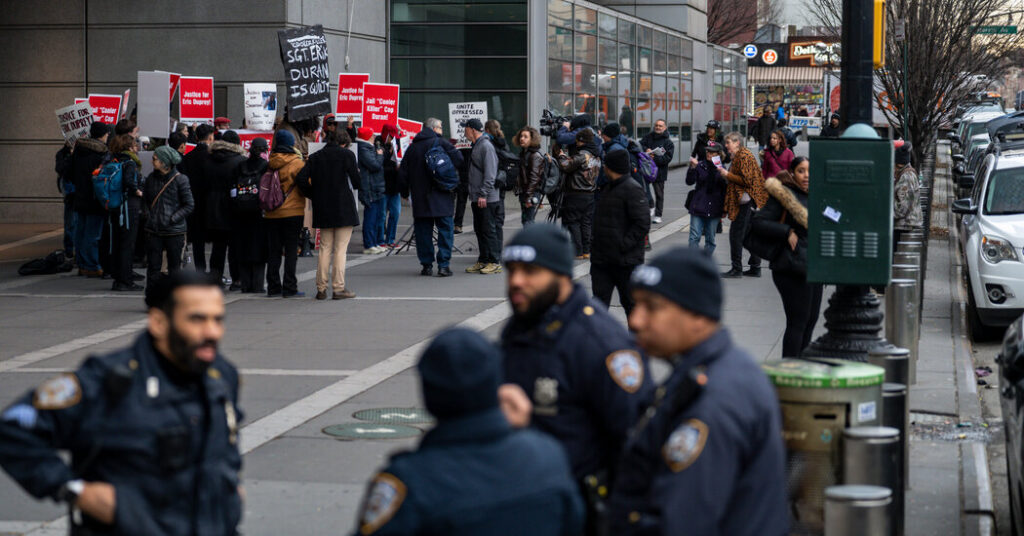
It had been a successful afternoon in the Bronx for about a dozen New York City narcotics officers. They had made at least five arrests in three hours when they decided to make one last, unplanned stop on a long stretch of grass wedged between blocks of apartment buildings where children often play soccer and families picnic.
The small park in the West Bronx was also notorious for drug dealing — “almost like an open-air market for drugs,” a detective would later testify.
Within 30 minutes on that warm day in August 2023, the operation, one that most of the officers there had done hundreds of times, would lead to bloodshed and a sergeant on trial for manslaughter.
“It was going to plan until it didn’t,” Detective Leva Gevargiz, who was part of the drug busts, said in court last month. Testimony in the trial has pried open the inner workings of a covert unit within the New York Police Department and examined whether an officer’s actions that day were reckless or a desperate attempt to save lives. A verdict is expected on Friday.
At about 5 p.m. on Aug. 23, 2023, the officers, many dressed in T-shirts and jeans, spread out near the park on Aqueduct Avenue between 190th and 192nd Streets. An undercover detective went to buy drugs while another detective known as the “ghost” stood nearby, keeping an eye on her.
The ghost, Detective Nelson Nin, stood on the sidewalk about 30 feet away from the undercover officer. The plan was straightforward. The team would wait for the undercover officer to signal that she had bought the drugs, and then the police would drive up to apprehend the dealer.
A prisoner van filled with people the team had arrested was parked nearby. The officers prepared to add one more man: Eric Duprey, a 30-year-old Uber delivery man.
Not far from them, three women in their 40s — two sisters, Maria and Marlene Lasso Aguirre, and their friend, Violeta Soralba Tirrano — were relaxing by a table of tacos and a red plastic cooler loaded with ice, soda, juice and water.
Detective Nin saw Mr. Duprey hand the undercover officer vials with $20 worth of cocaine.
“Move in,” Detective Nin recalled saying.
As the officers drove their cars to Aqueduct Avenue, Mr. Duprey waved over to a man on a motorbike, another dealer. Mr. Duprey tossed a black fanny pack full of cash inside a trash can, got on the bike and headed toward 192nd Street while the other man walked away in the opposite direction.
Sergeant Erik Duran, 38, and two other detectives, Leva Gevargiz and Jose Cintron, who had been in one of the cars, began walking toward the man who had walked away and started to place him in handcuffs. Lieutenant Lamont Gibson was not far behind.
“That’s not him, that’s not him,” Lieutenant Gibson heard Detective Nin said, referring to Mr. Duprey. “He’s on the scooter.”
Two other detectives on Aqueduct Avenue near 192nd Street moved to cut off Mr. Duprey, who steered the motorbike onto the sidewalk, this time toward 190th Street, and began speeding — going between 24 and 30 miles an hour toward the women, Sergeant Duran and the other officers.
Detective Cintron pointed in the bike’s direction and Sergeant Duran stepped toward the picnic table. He grabbed the cooler.
Marlene Lasso Aguirre yelled at her sister to get out of the way. Maria, who was standing on the sidewalk, went to step over the railing toward the safety of the park just as Mr. Duprey zoomed past her and Sergeant Duran hoisted the cooler with both hands over his shoulder.
In what another officer would later describe as a “shot-put motion,” he threw the cooler at Mr. Duprey, striking his arm. Mr. Duprey lost control of the bike, careened off the sidewalk and flew off the motorbike. He then slammed against a tree and into the front of a parked Jeep with such force that it shook. The officers rushed toward Mr. Duprey, who lay motionless under the car.
“You killed him,” Ms. Soralba Tirrano told Sergeant Duran, according to her testimony.
“It was an accident,” Sergeant Duran responded in Spanish.
“You grabbed it and threw it,” she said in Spanish. “How was it an accident?”
Around the same time, Pearl Velez’s phone was blowing up. Come to the park, the texts read. Eric is hurt.
She and Mr. Duprey had been together for nine and a half years and had a 3-year-old boy and a 5-year-old girl.
Shortly before the crash, Ms. Velez had received a text from Mr. Duprey asking her to bring him a bacon cheeseburger from Wendy’s and their son so he could take him for a haircut.
Life had been a struggle for the couple. They had been in and out of homeless shelters since they met and steady work was hard to find.
Mr. Duprey had moved from Puerto Rico when he was 18. He had been a bright student there and had hoped to become a paramedic, according to his mother, Gretchen Soto. But in New York, he felt self-conscious about his poor English and never pursued his dream.
The couple had been making plans to move to Florida, where Ms. Soto had been living at the time.
“He was tired of life in New York,” Ms. Soto said. “It was too fast-paced.”
When her phone began ringing, Ms. Velez thought Mr. Duprey, who had ridden motorbikes since he was a boy, had fallen and broken an arm or a leg.
Then, Mr. Duprey’s best friend, Gordo, called her, crying.
Later that night, back at the precinct, Sergeant Duran and the rest of the officers were gathered in a meeting room. Lieutenant Gibson approached Sergeant Duran, who was quiet and staring blankly.
“He seemed in a daze,” Lieutenant Gibson testified in court. He suggested they get some fresh air.
“‘I just wanted to stop him,’” Lieutenant Gibson recalled him saying. “He just kept repeating, ‘I was just trying to stop him.’”
The details have emerged during a bench trial in Bronx Supreme Court, where for more than two weeks prosecutors in the state attorney general’s office have laid out their case against Sergeant Duran, trying to convince Judge Guy Mitchell that he should be convicted of manslaughter and criminally negligent homicide.
A lesser charge of assault was dismissed on Thursday after Judge Mitchell said that prosecutors had failed to show Sergeant Duran intended to hurt Mr. Duprey.
But he said there was reason to continue considering the two more serious charges against Sergeant Duran, who could spend up to 25 years in prison if Judge Mitchell convicts him of manslaughter.
Prosecutors said that the motorbike was not a deadly threat and that Sergeant Duran threw the cooler in a moment of frustration and fury to stop Mr. Duprey from escaping.
Mr. Duran’s lawyers argued that Sergeant Duran had acted to save lives, trying to stop Mr. Duprey from plowing the motorbike into the other officers.
“It was coming right at me,” Lieutenant Gibson testified.
Sergeant Duran, the son of Ecuadorean immigrants, testified that he believed Mr. Duprey was intent on driving the motorbike into the officers, calling it an “ambush.”
“I thought he was going to kill my guys, he was going so fast,” Sergeant Duran said during the trial. “You don’t come at cops when you’re trying to get away from them.”
Union leaders, officers in the narcotics unit and Sergeant Duran’s family have sat behind him in court, including his wife, who he met while growing up in the Bronx and began dating when they were 13.
Ms. Velez, Ms. Soto and other family members have sat across the aisle from them, joined by the siblings Hawk and Chivona Newsome, the co-founders of the Greater New York chapter of Black Lives Matter. They have supported Ms. Velez since the crash, buying her and her children food and Christmas gifts, and going to court hearings.
Ms. Soto, who has been in the courtroom nearly every day, has avoided watching the videos showing her son’s final moments.
Instead, she often looks at a photo she took of him, beaming, on his 25th birthday. She had come from Florida that day to surprise him with a tres leches cake. It had been decorated in frosting with his name and a tiny motorbike.
Maria Cramer is a Times reporter covering the New York Police Department and crime in the city and surrounding areas.
The post How a Routine Drug Bust Turned Deadly appeared first on New York Times.