For years, Saudi Arabia and the United Arab Emirates opted to resolve their disagreements and border disputes quietly, behind the scenes. Now it appears as if a dam has burst, with the consequences rippling across the region and beyond.
The rupture between the two powerful and oil-rich neighbors, both of which have cultivated vast global influence, has the potential to move markets and exacerbate wars.
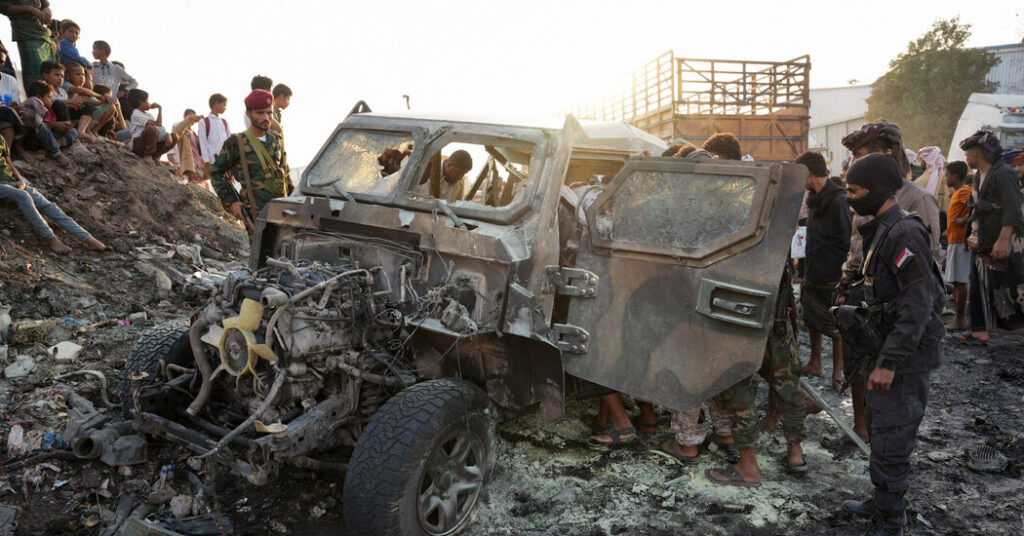
Nowhere is that clearer than in Yemen, where an Emirati-backed separatist group led a failed offensive in December to seize control of the country’s south, a region located along crucial global trade routes. Saudi officials have pushed back forcefully, wresting influence from the Emirates and declaring that the kingdom alone will take responsibility for Yemen’s future.
“This isn’t a tactical disagreement,” said H.A. Hellyer, a senior associate fellow at the Royal United Services Institute in London. “It’s a strategic split over what stability means in the Middle East.”
Analysts say the tensions are spreading to other countries in the region, where the rift could worsen raging conflicts and fracture fragile alliances.
Crown Prince Mohammed bin Salman, the de facto ruler of Saudi Arabia, and Sheikh Mohammed bin Zayed, the ruler of the United Arab Emirates, have long been viewed as natural partners by their allies in Washington. In 2015, their countries teamed up in Yemen, mounting a disastrous military intervention to beat back rebels who had taken over the capital.
In recent years, they have diverged, supporting opposing groups in Sudan’s civil war, pursuing differing oil policies and entering into a heated economic rivalry.
Before the confrontation in Yemen, the Emirati and Saudi governments had publicly maintained a facade of brotherhood and cordiality, built on cultural and tribal ties. Over the span of a few weeks, those niceties have descended into an ugly war of words.
Saudi commentators and state-owned media platforms now display open contempt for the Emirates, accusing decision makers in the capital, Abu Dhabi, of seeding chaos around the region by supporting armed militias in Yemen and Sudan. They say that Emirati ambitions have become grandiose, and that it is time to cut the tiny country down to size.
In turn, Emirati elites grumble that Saudi Arabia is behaving like a domineering “big brother.”
In January, the war of narratives escalated as Saudi Arabia sought to draw attention to past evidence of Emirati human rights violations, bringing journalists to Yemen to view abandoned facilities that local officials said were once Emirati-run secret prisons.
The officials running the tour — representatives of Yemen’s internationally recognized and Saudi-backed government — said the Emirates had held and tortured Yemenis in those facilities.
None of the accusations were new: A United Nations panel of experts determined several years ago that Emirati forces in Yemen were responsible for extrajudicial detentions, enforced disappearance and torture.
The Emirati Defense Ministry nevertheless issued a firm denial of the accusations made in the recent tour, saying in a statement that they were “not based on any evidence” and were part of an “organized campaign to damage the reputation of the Emirati state.”
In the past, the Emirates paid the salaries of some Yemeni fighters, but Saudi Arabia has now pledged to cover salary payments for all Yemeni government employees, civilian and military, for the foreseeable future. That is a financial commitment of more than $1 billion per year, according to two Yemeni officials briefed on the plan, who spoke on the condition of anonymity to discuss details that have not been made public.
Emirati officials have consistently denied financing or arming regional militias, including in Sudan, despite extensive evidence to the contrary. They have only spoken of the split with the Saudis in oblique terms.
“The Emirates has been the target of an unprecedented media campaign,” Anwar Gargash, a senior Emirati official, said at a conference last week. “Differing opinions are normal. What’s not normal is wickedness in a dispute.”
In a news briefing on Jan. 26, Saudi Arabia’s foreign minister said the kingdom’s relationship with the Emirates was “critically important,” but highlighted a “difference of view” in Yemen, noting that the Emirates had “decided to leave” the country.
“If that indeed is the case, and the U.A.E. has completely left the issue of Yemen,” said the minister, Prince Faisal bin Farhan, then that would be a “building block” to keeping the Saudi-Emirati relationship strong. He put emphasis on the word “if,” appearing to underscore the level of distrust between their two governments.
The Emirati and Saudi governments did not respond to requests for comment.
So far, the Trump administration has shown reluctance to take sides. Both countries are key players from which Mr. Trump hopes to win support for his Middle East policies, and both have nurtured business ties with the president’s family.
As the crisis deepens, Saudi Arabia is moving aggressively to counter Emirati interests, analysts say.
“As Riyadh sees it, trust with Abu Dhabi has been exhausted,” said Salman al-Ansari, a Saudi political analyst. “Words and reassurances no longer matter.”
Analysts say the conflict will most likely play out next in the Horn of Africa, the war-torn region located across the Red Sea from the Arabian Peninsula.
In Sudan, the two countries have backed opposing sides in a brutal civil war, with the Emirates supporting a paramilitary group called the Rapid Support Forces and Saudi Arabia backing the Sudanese military. In November, the Saudi crown prince urged the Trump administration to broker a peace deal in Sudan, intensifying an international spotlight on the Emirates’ conduct there.
And in Somalia, where Saudi Arabia has been a firm backer of the central government, the Emirates has cultivated deep ties to a breakaway region called Somaliland. On Jan. 12, Somalia announced that it was ending “all agreements” it had with the Emirates, citing “hostile and destabilizing actions” by the Emirati government.
Wherever the two Gulf powers stand behind opposing sides, tensions are likely to rise, analysts say.
“We are bracing for the impact,” said Alan Boswell, Horn of Africa project director for the International Crisis Group, a research organization focused on resolving global conflicts. “We expect this to escalate the war in Sudan and further divide Somalia.”
Farther afield, Saudi Arabia is reportedly seeking to seal a trilateral mutual defense deal with Pakistan and Turkey. As news of that pact spread, Sheikh Mohammed, the Emirati ruler, made a whirlwind trip to India — Pakistan’s nuclear-armed rival — and signaled his intent to secure his own mutual defense deal there.
The last time the Gulf was split by a crisis of this magnitude was in 2017, when Saudi Arabia and the Emirates joined forces to isolate Qatar, presenting a list of demands to the Qatari government.
“In this case, there is no list of demands,” said Mohammed Baharoon, head of B’huth, a research center in the Emirati city Dubai. There is a dangerous ambiguity to the current rift, he said.
The split with Qatar eventually ended with a diplomatic summit in 2021.
The Saudi-Emirati rift could be mended too, Mr. Baharoon said. But it might leave a scar, he said.
“How bad is the scar — what does it remind you of when you look in the mirror?” he asked. “That is something else that we will have to think about in the future.”
Vivian Nereim is the lead reporter for The Times covering the countries of the Arabian Peninsula. She is based in Riyadh, Saudi Arabia.
The post Gloves Come Off in Gulf as Trump’s Closest Arab Allies Clash appeared first on New York Times.