For years, Lee Kyong Min’s life revolved around shuttling her two daughters from school to cram schools to home.
It was a routine followed by nearly every other parent she knew, all sharing the same goal: making sure their children got into South Korea’s best universities. The decisive element was their choice of hagwons, or private cram schools where students take extracurricular classes in math, Korean and English to prepare for the country’s infamously competitive college admissions exam.
Ms. Lee, a former advertising professional, and her husband, who works in finance, had enrolled their children in the best they could find. Seven days a week, she waited for them late into the night at cafes packed with other parents doing the same. Sometimes, she saw little children with schedules so packed that they juggled homework and dinner in those cafes before hurrying off to their next class.
Extracurricular education, which expanded alongside the demand for university degrees as the country shifted to a white-collar economy in the 1990s, is now omnipresent in South Korea. It is also at the center of long-running debates about the consequences of unchecked academic competition. Many parents wonder what alternatives, if any, exist.
When Ms. Lee’s daughters questioned why they had to spend so much time studying outside school, she told them it was necessary because academic achievement equaled opportunity, which meant a happy life.
But her belief in this idea began to fracture when her eldest, then around 8, asked: “Mom, were you a bad student?”
“I realized she saw me as unhappy,” said Ms. Lee, 46. “I felt like I’d been hit in the head.”
Now she wondered: What vision of life and happiness was she presenting to her daughters? It is a question more parents in South Korea are confronting.
Eighty percent of South Korean school-aged students now receive some form of private extracurricular education, according to government data. While the schooling-age population has been shrinking for decades, this market grew to a record $20.3 billion in 2024.
Children are entering cram schools at younger ages. In some districts in Seoul, the capital, children as young as 4 take entrance exams for English-language preschools. Others enter medical school prep tracks in elementary school.
Even in a country long inured to intense academic competition, these developments have provoked alarm. South Korea’s human rights commission has said that subjecting preschoolers to such high-stakes testing is a violation of their rights. Lawmakers, blaming hagwons for an adolescent mental health crisis, have vowed to intervene.
But the system that created them, as Ms. Lee would discover, is not so easy to change.
‘Level Tests’
For Ms. Lee, entering her children into the grind of hagwon education came with conflicted feelings. She and her husband both attended mid-tier universities, a fact that, in their well-credentialed world, was a source of both defiant pride and smoldering insecurity. Part of her wanted their daughters to have an enriching humanities education, and not be beholden to the college race. Another wanted them to be among its winners.
So in 2013, she enrolled her girls, then around 4 and 5 years old, in an English-language preschool. She declined to give specifics about her children, like their names, for privacy reasons.
But she said they attended numerous hagwons in Daechi, a wealthy neighborhood in the Gangnam district of Seoul regarded as the pacesetter of educational achievement in the country. Daechi is home to 1,200 hagwons spread across an area roughly the size of Central Park.
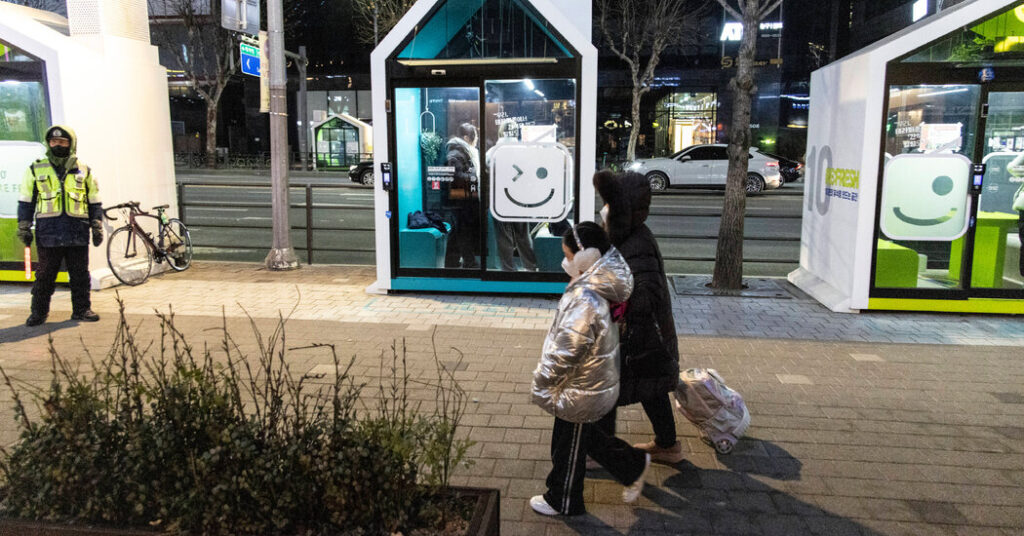
Surrounding them are the other trappings of its hyper-optimized path to academic success: “study cafes” that confiscate students’ phones to promote focus and traditional medicine clinics that advertise brain-boosting treatments. There are even soundproofed enclosures on the street, called “Therapy Zone” boxes, where stressed-out students can study — or scream.
Ms. Lee grew up in Daechi and was no stranger to its reputation. Even so, she was struck by the endless loop of testing that awaited her daughters.
The most important were the “level tests,” or entrance exams held by hagwons for children as young as 4 years old. Some, like those taken by third graders to enter Daechi’s most prestigious math hagwon, are so competitive that parents often send their children to another hagwon to study for it.
“The saying goes, if you want to send your child to medical school, you need to have them do six passes of the entire math curriculum to the high school level,” Ms. Lee said. Her eldest took the test but did not make the cut.
40 Hours After School
Recently, the authorities have urged hagwons to refrain from such competitive admissions for young children.
But little has changed. Anxiety persists around the college admissions exam, the Suneung, a do-or-die test whose scope and difficulty has far exceeded standard school curriculums.
“Students today are all essentially juggling two separate workloads: their school grades and preparation for the Suneung,” said Gu Bon-chang, a former hagwon teacher and now policy director for World Without Worries about Shadow Education, a nonprofit.
One teacher at a leading English hagwon franchise estimated that his elementary school-aged students spent at least 40 hours a week just on extracurricular classes. He asked not to be named for fear of retaliation from his employer.
He was struck by one essay he had recently graded. A 6-year-old, he said, wrote of her fear that her whole family would be unhappy if she did not excel academically.
Parents are also increasingly grappling with the consequences of the system.
Park Euna, a mother of three, said she got a wake-up call a few years ago, when a classmate of her eldest daughter, who was then in elementary school, died by suicide.
Ms. Park recalled the classmate as a savvy and charismatic child who loved to dance, but lacked a head for academics. She had been trying to get in to the elite math hagwon in Daechi but had fallen short.
The episode prompted her to reconsider her children’s priorities.
“If they end up deciding they don’t want to go to college, I am fine with that,” she said.
Bad at Math
Peter Na, a psychiatrist at Yale University, cautioned against drawing a straight line from pressurized academic environments to suicide, which can have complex causes.
Even so, he is troubled by the rise of depression symptoms in South Korean children under 10, as is evident in government data.
“Depression under 10 years old is not something that’s common” he said.
I don’t think it’s isolated from what’s going on in the private sector,” he said, referring to hagwons.
As Ms. Lee’s daughters neared the end of middle school, her own concerns were growing because her eldest, whose gifts were in words but not numbers, was struggling.
“In the South Korean education system, if you aren’t good at math, you are seen as an idiot,” Ms. Lee said.
“The focus is always on what you’re bad at,” she added.
Fearful for her girls’ self-esteem, she and her husband pulled them from their multiple hagwons in 2024.
Ms. Lee herself also made a career change. Now a qualified psychologist, she works as a therapist near Daechi.
Many of her clients are mothers from the same competitive hagwon pipeline, with children reporting symptoms like self-harm.
Their intent, she said, is “to make their parents see them, to show them ‘look, I’m suffering.’”
But the mothers, she said, are no less unhappy.
In South Korea, mothers are primarily responsible for their children’s education, said Ms. Lee, whose doctoral thesis explored the effects this had on their mental health. Many women find themselves corralled into this role after discovering their careers are effectively over after they have children.
They are expected to be the taskmasters who crack the whip, often with fathers watching at arm’s length. Many of the spousal conflicts Ms. Lee sees emerge from this tension, she said, as fathers of underperforming students question why their money is not producing results while mothers spiral in a constant state of anxiety.
A Rip Cord
The roots of such ratcheting competition run much deeper than merely overambitious parents.
South Korea has one of the highest rates — 76 percent — of college enrollment in the world. But the economic insecurities that spurred this mass pursuit in the first place still persist: a weak national pension system, a shortage of high-quality blue collar jobs, limited upward mobility and yawning income disparity.
“There are no second chances in South Korea,” said Soo-yong Byun, a Penn State University professor who studies the hagwon industry. “Not just where you go to college, but also the first job you get after that — all of these have huge impacts on your mobility as an adult.”
Arim So, a 39-year-old mother in Seoul, said she constantly teetered between anxiety and guilt toward her 11-year-old daughter, who recently asked her why her path always seemed to be decided for her.
“But I always realize there is just no other alternative in South Korea,” Ms. So said.
Those who can afford it have a rip cord: leaving the country. This was the path Ms. Lee ultimately settled on, enrolling her daughters in a private boarding school in the United States in 2024.
She was rueful, recognizing it was a privilege that few others have. “It feels like I no longer have the right to talk about the problems of this system,” she said.
Now her daughters are thriving at their new school. Her eldest is no longer seen as a slouch in math.
“Go to the U.S. after studying math in Daechi to the 8th grade level or so,” she said, with a bittersweet laugh. “People will call you a genius.”
The post In South Korea, Questions About Cram Schools, Success and Happiness appeared first on New York Times.