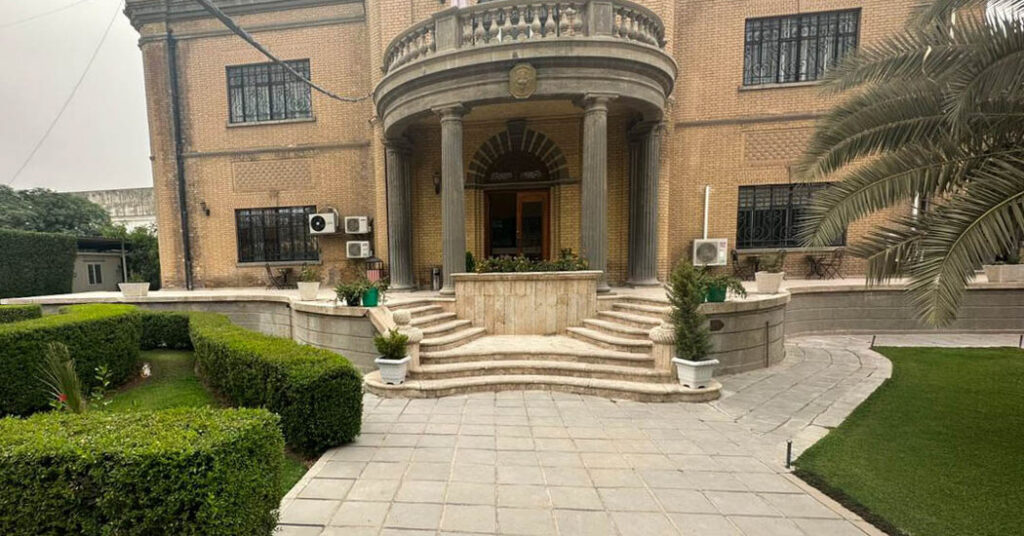
The French Embassy in Baghdad has been in the same location for more than 60 years: in the home of a Jewish family that had fled antisemitism in Iraq and rented the property to the government of France.
But France has not paid that family rent for more than 50 years, and it will not be paying anytime soon, after a Paris court’s ruling.
On Monday, the court rejected the family’s $22 million lawsuit accusing the French government of unjustly profiting from cheap deals with Iraqi officials who claimed control of the home under antisemitic laws. In a written decision, the Paris court concluded that it was “not competent to hear the claims presented” and suggested that Iraq would be the proper place to resolve the dispute.
The ruling dealt a blow to a multigenerational effort by the descendants of Ezra and Khedouri Lawee, brothers who built the home by the Tigris River in the 1930s, to seek compensation for France’s longtime occupation of their home. They say they leased it to France in 1964 expecting the government tenant would protect their rights.
The case drew attention to the plight of about 130,000 Iraqi Jews who from 1941 to 1951 fled or were forced from Iraq during a campaign of discrimination, resulting in billions of dollars in losses. Iraq is an overwhelmingly Muslim nation, with Islam as its official religion.
Philip Khazzam, 66, a grandson of Ezra Lawee, said in an email to The New York Times on Tuesday that the court’s suggestion that the dispute be resolved in Iraq was “preposterous,” noting that “Iraq basically ran us out of our country, and then stole our home.”
The court’s decision sidestepped the difficult questions raised by the case, including whether France had violated its own laws and principles by benefiting from a seizure based on discriminatory policies. Instead, the court noted that the original lease did not specify that claims would be resolved in France, among other technical issues.
The family’s lawyers, Jean-Pierre Mignard and Imrane Ghermi, argued that France had violated its own laws, commitments to human rights and pledges to right past wrongs by refusing to compensate the family and relying on discriminatory Iraqi policy to justify its actions. They likened the case to restitution claims made in cases seeking compensation or a return of goods seized or stolen by the Nazis from Jews during World War II.
The ruling followed a hearing in Paris last month. The French Foreign Ministry, which has declined to comment on the case, did not send a representative to court. But it argued in its defense that the damages claimed by the family “are directly caused by decisions adopted by the Iraqi authorities,” and so France could not be held culpable. The Paris court echoed the ministry’s argument that the dispute was not a matter of French law.
The family’s lawyers said in a statement on Tuesday that the court’s suggestion that the family seek help in Iraq was “surreal” and “amounts to depriving our clients of their right to justice.”
“We dispute the legal basis of this decision,” they added.
The case presented a novel blend of contracts and human rights claims, and some experts in cultural restitution anticipated an uphill battle for the family, particularly given that the property is in Iraq and French law tightly circumscribes what objects qualify for restitution.
But some lawyers who have worked on claims involving art looted during the Nazi era say that the embassy case bears similarities to more traditional cultural restitution cases and that the analogy presented by the family’s lawyers is appropriate.
“The cases are first cousins,” said Kenneth R. Feinberg, the lawyer who administered compensation for the victims of the Sept. 11 attacks in the United States and has been involved in multiple resolutions in Nazi looting cases, including a Marc Chagall painting the Museum of Modern Art in New York returned to the heirs of a gallery owner who fled Germany in 1933.
To prove a traditional cultural restitution case, the claimants have to show that they are the owners and that their goods were stolen pursuant to discriminatory laws, like a Nazi edict. Mr. Feinberg said the property in Baghdad — which no one, including France’s government, disputes is the Lawee family’s property — was similar.
“France took advantage of Iraqi law that was adverse to the interests of the owners,” Mr. Feinberg said. The French court is “hairsplitting” and relying on technical arguments while ignoring the party that was harmed, he said.
The descendants of the homeowners said they planned to appeal the ruling. “We will continue our fight for justice in France,” Mr. Khazzam said. “We have just begun.”
Ephrat Livni is a Times reporter covering breaking news around the world. She is based in Washington.
The post Paris Court Deals Family Blow in Battle for Rent From the French Embassy in Iraq appeared first on New York Times.