As Minneapolis continues to reel from the fatal shooting of 37-year-old intensive care nurse Alex Pretti by federal agents on the morning of January 24, the international spotlight is firmly fixed on the heavily armed and masked operatives who have spearheaded the Trump administration’s violent immigration sweeps.
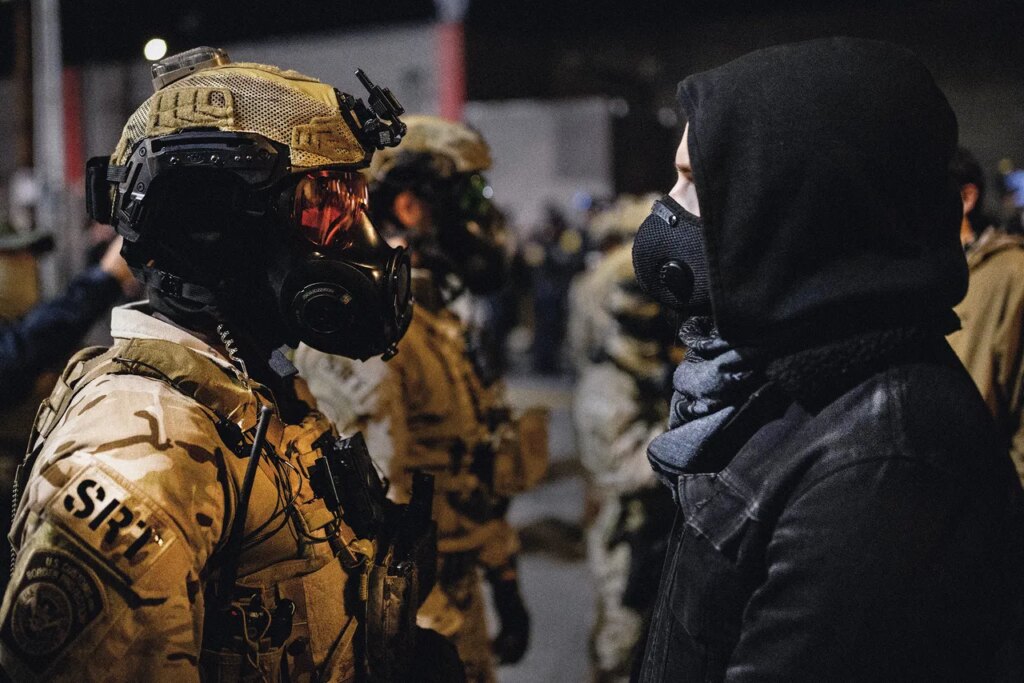
At the heart of the deployment in Minnesota, as well as the chaotic clashes with communities in Southern California and Illinois, are hundreds of agents that operate within Immigration and Customs Enforcement (ICE) and Customs and Border Protection: ICE’s two Special Response Teams (SRT), CBP’s one SRT, and the Border Patrol Tactical Unit (BORTAC). These paramilitary tactical units behave not like local police, but instead like special forces in Iraq, Afghanistan, or other far-flung battlefields from the Forever Wars of the past quarter century.
Amid the widespread, hostile confrontations with concerned citizens in Minneapolis, the unusually aggressive conduct of the Department of Homeland Security’s tactical teams have led to two killings: ICE SRT agent Jonathan Ross shot and killed Renee Good on January 7, while CBP SRT agent Raymundo Gutierrez was identified by ProPublica as one of the two masked feds who shot and killed Pretti.
The brutal tactics of SRT and BORTAC units seem to have spread into ICE and CBP as a whole. Over the last year, these DHS agencies have morphed into a masked, seemingly unaccountable force that detains children, separates families, blows open doors, snatches teachers and parents from schools and day care centers, and kills unarmed protesters who were simply voicing dissent or recording the mayhem. In 16 shootings involving Department of Homeland Security personnel since July, none have faced state or federal charges, according to The Washington Post.
Now, following Good and Pretti’s killings, the future of Operation Metro Surge in Minnesota is now in flux. Gregory Bovino, who led Border Patrol sweeping operations in Minnesota, Los Angeles, Chicago, and other Democratic-run cities and claimed Pretti intended to “massacre law enforcement,” has been sent back to his previous post in California. Tom Homan, the Trump administration’s “border czar,” took the reins from Bovino in Minnesota, vowing to conduct “targeted enforcement operations” while continuing to pressure the state’s law enforcement agencies to cooperate with federal immigration authorities despite laws preventing this support.
“I didn’t ask them to be immigration officers,” Homan said late last month, referring to Minnesota police. “I’m asking them to be cops working with cops to help us take criminal aliens off the street.”
If ICE and CBP’s SRT and BORTAC units continue to be involved, however, it is unlikely they’ll operate like most regular “cops” at all.
The tactics used by SRT and BORTAC vastly differ from those of local police or sheriffs. They use explosives to breach the doors of homes. Team members are equipped with full tactical gear, military-style helmets, assault rifles, and heavy-duty crowd-control weapons like pepper balls, foam launchers, and flash-bang grenades. They have deployed less lethal munitions and chemical dispersants with little or no warning. Federal agents have charged into crowds without dispersal orders, dogpiling people who often are doing nothing more than observing or yelling their disapproval at the feds. And like in overseas battlefields or counter-narcotics missions abroad, DHS agents appear to have been told that they no longer need judicial warrants before breaking into private homes or making arrests, per an ICE memo released in a whistleblower report and guidance reportedly issued by the Department of Justice.
Moreover, the teams are currently being deployed in situations they were previously restricted from taking part in, such as routine warrant service, per a set of SRT operations guidelines leaked to Unicorn Riot in 2019.
SRT’s and BORTAC’s roles in putting down protests in 2020 and since President Donald Trump retook power last January have been referenced in several civil suits alleging wanton abuses and civil rights violations by the tactical units. No individual agents are named in the complaints, a common practice, and their faces are typically blurred in official unit photos. As such, the identities of BORTAC and SRT agents are difficult to verify, although some independent researchers have begun posting photographs, units, and alleged full names to social media since the teams started deploying in Southern California last spring.
“These teams are our equivalent of special operations command,” says Gil Kerlikowske, a former CBP commissioner from 2014 through 2017. “BORTAC in particular is used to operating in the desert. They are not trained for urban policing,” Kerlikowske said. They’re absolutely the wrong tool for the job. It’s like using a chain saw to mow your lawn”
Both SRT and BORTAC are “operator” or SWAT-type units that are patterned off the US military’s special forces teams, not police. As of 2020, 554 agents comprised ICE’s 38 SRT teams around the US, according to a Government Accountability Office report. The same year, BORTAC had a contingent of 259 agents stationed along the Mexican and Canadian borders. CBP’s Office of Field Operations also has a 143-member SRT established in 2006 following Hurricane Katrina.
SRT and BORTAC draw heavily on veterans and US Special Operations Command for their ranks, including bodyguards for Gregory Bovino, the Border Patrol sector chief assigned last summer to head the immigration sweeps. Jonathan Ross, the ICE SRT agent who killed Renee Nicole Good on January 7, was hired by the Border Patrol in 2007 and served as an agent in the El Paso sector until 2015, according to court records reviewed by WIRED. Gutierrez, reportedly one of the two agents who shot Alex Pretti, has worked for CBP since 2014 and works in the agency’s Office of Field Operations, according to ProPublica.
The DHS operatives’ military worldview also extends to minor—if ominous—details of its deportation operations. The Colorado Sun reported that ICE agents were suspected of leaving custom playing cards with the ace of spades in the cars of people they’d detained for deportation proceedings, complete with the address of ICE’s field office in Aurora. During the Vietnam War, ace of spades cards were left by some American soldiers on the bodies of dead Vietnamese fighters and civilians. When the US invaded Iraq, a deck of playing cards featuring the photographs of Saddam Hussein’s key ministers and generals was distributed to American soldiers, with Hussein as the ace of spades.
Aside from a wartime mindset, ICE and the Border Patrol’s tactical agents appear to have disregarded their own use of force guidelines, which mandate that the feds deescalate when possible, instructs them not to use lethal force unless there are no other options, and to obtain medical assistance for people who they wound with either less-lethals or firearms.
Formed in 1984 to put down uprisings in immigration detention facilities, BORTAC is an offensive tactical team used for drug raids, counterterrorism missions, human smuggling and counter-narcotics operations on the northern and southern borders, at special events including the Super Bowl and, at least historically, overseas operations carried out in tandem with the Drug Enforcement Administration (DEA). In 1992, BORTAC deployed to Los Angeles in response to the Rodney King riots. Brian Terry, a BORTAC member, was killed in 2010 during a fierce 10-minute shootout with a drug rip-off gang using high-powered rifles smuggled from the US into Mexico as part of Operation Fast & Furious, a botched Obama-era Bureau of Alcohol, Tobacco, Firearms and Explosives operation that triggered congressional hearings and years of damaging headlines.
From 2015 to 2019, BORTAC teams deployed 683 times, mostly along the southern border for manhunts, security details, and to serve warrants.
In 2022, BORTAC led the entry team that engaged and killed the perpetrator of the massacre at Robb Elementary School in Uvalde, Texas. Though local and state police have been excoriated and sued in civil court by students’ families for their muddled response to the Uvalde shooting, BORTAC and other Border Patrol agents exhibited similar failings during the incident, per ABC News reporting.
During his first term, President Donald Trump sent BORTAC into “sanctuary cities” for immigration enforcement alongside ICE shortly before the outbreak of the Covid-19 pandemic, a move that Kerlikowske, a CBP chief under former president Barack Obama, called a “significant mistake” given the specialized team’s usual high-risk assignments and aggressive posture. In retrospect, that episode six years ago, along with BORTAC’s role in suppressing protests in Portland, Oregon, and guarding federal facilities in Seattle, Buffalo, and San Diego, during the George Floyd uprising in summer 2020, prefigured the violent deployments of BORTAC and SRT to Minneapolis, Chicago, and Los Angeles over the past year.
BORTAC’s tactics have drawn countless lawsuits. Civil rights lawsuits filed by protesters in 2020 accuse masked, unidentified BORTAC agents of abducting them from the streets, roughing them up, illegally detaining, and releasing them without charge.
A civil suit filed by Carmina Guerrero outlines the “night raid”-style tactics employed by the unit, including warrantless entry into private homes. According to the lawsuit, dozens of BORTAC, ICE, and DEA agents burst into their Arizona home shortly before 5 am on November 4, 2009. Six children were present along with Guerrero, her three sisters, and her 60-year-old mother, who was thrown to the ground at gunpoint and cursed out by BORTAC members, the suit claimed. Carmina asked to put clothes on and was allegedly told, “You fucking whore, you don’t deserve any respect.”
According to the complaint, the family was taken outside half-clothed, photographed, and held at gunpoint in 37 degree weather while the house was searched. Another federal agent later told the photographer to erase the photos, according to the complaint. Two of the adult women in the Guerrero family claim they were physically assaulted and subjected to degrading sexual remarks by the Border Patrol agents. No contraband was found during the raid. No arrests were made. The house was torn apart. A warrant was finally presented at 1:30 pm that afternoon.
A WIRED review of more than 110 federal cases that mention BORTAC at least once reveal that while regular Border Patrol agents are often referred to by their names, file affidavits, and testify in open court, BORTAC agents are consistently kept anonymous—most notably in federal civil proceedings and declarations related to weeks of violent protest during summer 2020. Recent statements by Homeland Security secretary Kristi Noem and social media posts that blur the faces of ICE agents and feature them only with their backs to the camera or masked indicate that DHS appears to have expanded the practice of anonymity to all Border Patrol and ICE agents.
ICE’s and CBP’s Special Response Teams have a far shorter history than BORTAC, but its agents train in some of the same techniques as their older Border Patrol counterpart, including sniping and breaching.
Established in 2004, ICE’s SRT units, split almost evenly between Enforcement and Removal Operations and Homeland Security Investigations, were designed to participate in high-risk suspect apprehensions. Enforcement and Removal Operations’ SRT, the unit Jonathan Ross belonged to, primarily targeted people with a prior criminal history or a high likelihood of being armed. The unit also escorts transports of large numbers of immigration detainees by air or ground. Between 2015 and 2019, ERO’s SRT deployed 636 times, almost two-thirds of which were to secure detainee transports and almost a third of which were arresting deportation targets. HSI’s Special Response Teams are far more active, going into operation 1,723 times from 2015 to 2019 and serving active warrants for criminal suspects in about three-quarters of such instances.
Besides Jonathan Ross, who was identified in court records in part because he was previously the victim of an alleged crime, a search of federal court records shows no instance of an ERO or HSI SRT officer swearing out an affidavit in a criminal case, giving testimony, or even being identified by name. The lion’s share of cases WIRED reviewed involving ICE SRT are civil rights claims filed in the past few years over the tactical team’s involvement in either the 2020 George Floyd demonstrations or the mayhem in Chicago, Los Angeles, and Minnesota since last summer.
CBP’s SRT for the agency’s Field Operations Bureau was established following 2005’s Hurricane Katrina, and it is distributed among 18 field offices along the southern border and across the country. Aside from securing large-scale sporting events, CBP’s SRT also engages in “foreign border security operations,” surveillance missions, drug interdiction, and the executing of high-risk warrants. From 2015 through 2019, the unit deployed 3,936 times, more than a third of which was devoted to training other federal agencies.
ICE’s and CBP’s SRT teams have even less of a footprint in the federal court system outside of civil suits filed in response to the Trump administration’s handling of protests. The names of agents assigned to these units are also kept confidential by government lawyers, court records show.
In an apparent response to growing calls for “accountability,” Noem, the DHS secretary, has promised to equip the department’s agents with body cameras “across the US.” If the practice of shielding certain agents’ identities in court continues, however, all the body-cam footage in the world may severely limit the public’s ability to hold agents accountable at all.
The post The Paramilitary ICE and CBP Units at the Center of Minnesota’s Killings appeared first on Wired.