Last year was a tough one for electric vehicles in the United States. The Trump administration and Republicans in Congress tossed out a $7,500 tax credit for E.V. purchases, giving buyers just a few months’ notice. They also challenged California’s plan to phase out sales of new gas-powered cars by 2035.
Amid it all, Ford took a $19.5 billion hit to its profits to cover a major strategic shift as it reconsidered its E.V. strategy. Tesla lost its place as the top seller of E.V.s worldwide, and its domestic and European car sales slumped.
The E.V. pullback has left a nascent U.S. battery industry with a shrinking market to sell its products. Now, some companies are eyeing a new line of business that could play a critical role in helping renewable energy power the grid — if they can beat Chinese manufacturers on cost.
Ford is now attempting to pivot, repurposing car battery production lines to make bigger batteries for data centers and utilities. Tesla is expanding efforts in the same space. Neither company responded to an interview request.
Today, we look at car companies’ big battery dreams, and why a complicated snarl of tariffs, trade wars and tax credits that have slowed their E.V. plans just might end up boosting grid-scale battery production.
Batteries everywhere
Batteries power electric cars, eliminating the need for a gas tank. But they can also be mounted on the wall of a home with rooftop solar panels, storing energy when the sun is shining and releasing it at night.
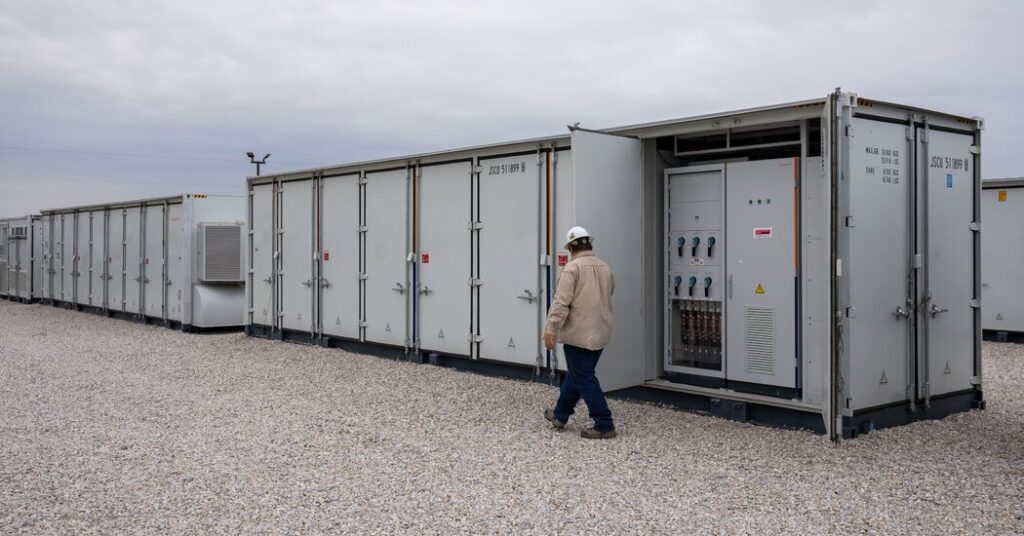
At a larger scale, shipping-container-sized batteries do something similar for power companies, which charge batteries during the day when electricity is cheap and discharge them onto the grid when prices spike in the evening.
When Democrats passed the Inflation Reduction Act in 2022, the legislation included generous incentives aimed at fostering a domestic battery-making supply chain to compete in the global market, which is currently dominated by China. Companies hatched plans to open battery factories in the United States.
At the time, many of these investments were focused on making E.V. batteries. But then Republicans reversed many Biden-era tax incentives in last summer’s sweeping domestic policy bill, including for renewable energy, and the market for domestically produced car batteries looked a lot less promising.
This made battery makers in the United States rethink their plans, said Isshu Kikuma, senior associate on the energy storage team at BloombergNEF, a research firm.
The swap
All of a sudden, there were more E.V. batteries in the U.S. manufacturing pipeline than automakers could really use. So factories began looking for something else to make.
The shipping-container-sized grid-scale batteries made a lot of sense, Kikuma said. Manufacturers could repurpose E.V. battery production lines to build them without starting from scratch. And last summer’s rollback of the Biden-era tax breaks left incentives for these bigger batteries intact, at least in the short term.
It’ll take time and money to make the necessary changes. But “compared to not being able to use the plant because the E.V. demand isn’t there, it’s looking worthwhile to these companies,” said Allison Weis, global head of storage at Wood Mackenzie, an energy research firm.
In December, Ford announced plans to repurpose existing E.V. battery plants to build grid-scale batteries for data centers and utilities.
At Tesla, batteries are already a big business: In a recent financial disclosure the company revealed that its energy storage business, which includes batteries for homes and businesses as well as solar panel installations, is its most profitable and fastest-growing category. Tesla plans to begin production of large-scale batteries at a new factory in Houston later this year.
Taking on China
Right now, there’s room for growth in the domestic grid-scale battery industry, Weis said, though the market is competitive. By 2030, demand for grid-scale batteries is projected to be more than six times what domestic manufacturers produced last year, according to Wood Mackenzie.
The question is whether companies like Ford and Tesla will be able to move fast enough and efficiently enough to compete with makers like Korea’s LG Energy Solution, which is already producing grid-scale batteries at a factory in Michigan.
Lawmakers in the House have begun to scrutinize Ford’s plan to use technology licensed from the Chinese battery company CATL. The Trump administration has sought to limit U.S. companies’ business relationships with Chinese firms by tightening tax credit rules, curtailing sourcing and licensing relationships with firms owned by certain foreign countries. Tesla has purchased equipment from CATL as well.
Qualifying for tax breaks could be make-or-break for U.S. battery hopefuls. It’s still more expensive to produce batteries domestically, but the combination of domestic tax credits and tariffs on Chinese imports make it easier for U.S. factories to compete.
Still, there’s no guarantee that even this combination of carrots and sticks will be enough to help U.S. factories compete with Chinese imports on grid-scale batteries. “They may still come in and beat domestic systems,” Weis said.
Journey to Antarctica
Deep inside an Antarctic glacier, a mission collapses at its final step
A daring attempt to study Antarctica’s fast-melting Thwaites Glacier collapsed over the weekend after the scientists’ instruments became entombed within the half-mile-thick ice.
A team of British and South Korean researchers was trying to install instruments beneath the immense glacier, where they would collect data, the first of its kind, on the warm ocean waters that are melting away the ice at a rate of hundreds of feet per year.
The team of 10 scientists, engineers and guides camped for more than a week on Thwaites to set up their complex operation. They used a jet of water heated to 80 degrees Celsius, or 176 degrees Fahrenheit, to melt a hole through the glacier, one foot in diameter and roughly 3,300 feet deep. They then lowered instruments to gather data in the water beneath the ice.
The clock was ticking: The tiny hole would refreeze in about 48 hours unless the team kept shooting hot water into it. And bad weather was on the way. — Raymond Zhong
More from our voyage
Kids sent us Antarctica questions. Here are the answers.
Do snowy owls live in Antarctica? What’s the most alarming measurement scientists are watching for? What do you eat and drink? Raymond Zhong answers some questions from students around the world.
Quote of the day
“We are headed for a reliability crisis, except now the crisis is not over the horizon, but across the street.”
That’s from Mark Christie, a former U.S. federal grid regulator, who was responding to a new report that predicts problems with the future reliability of the electric grids in the United States and Canada. Tens of millions of people face a growing risk of blackouts over the next five years, according to the report from the North American Electric Reliability Corporation, a nonprofit organization that works closely with federal regulators.
As Brad Plumer reports, demand for electricity is rising quickly, led by a boom in data centers. At the same time, utilities are retiring older coal- and gas-burning plants and aren’t adding enough generation to dependably meet growing demand.
Numbers of the day
0 for 5
The Trump administration is now 0-5 in its effort to stop wind farms under construction along the East Coast, Maxine Joselow reports. A federal judge on Monday struck down the Interior Department’s order to halt work on Sunrise Wind, a multibillion wind farm off the coast of New York State.
In December, the Interior Department ordered all work to halt on Sunrise Wind and four other wind farms off the East Coast. To justify the sweeping move, officials cited a classified report by the Defense Department that they said found the projects to be a national security threat.
The judge issued a preliminary injunction that would allow the project’s developer to restart construction while the broader legal battle unfolds. “Purportedly new classified information does not constitute a sufficient explanation for the bureau’s decision to entirely stop work on the Sunrise Wind project,” the judge said.
More climate news from around the web:
-
Bloomberg reports that the Trump administration’s vows to take over Greenland have halted some research projects on the Arctic Island.
-
The Associated Press looks at the growing number of communities across the U.S. who have found evidence that their drinking water is contaminated with “forever chemicals,” which research has linked to increased risk of cancer and other health issues.
Read past editions of the newsletter here.
If you’re enjoying what you’re reading, please consider recommending it to others. They can sign up here.
Follow The New York Times on Instagram, Threads, Facebook and TikTok at @nytimes.
Reach us at [email protected]. We read every message, and reply to many!
Claire Brown covers climate change for The Times and writes for the Climate Forward newsletter.
The post Why U.S. Car Companies Want to Make Giant Batteries appeared first on New York Times.