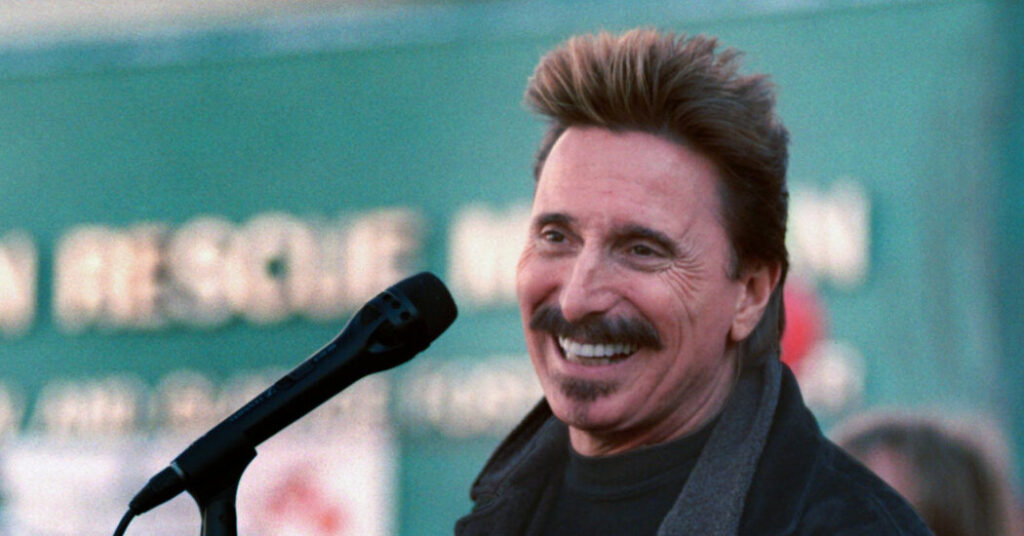
Chuck Negron, one of the most recognizable rockers of the 1970s and a founding member of the band Three Dog Night, died on Monday at his home in Los Angeles. He was 83.
The death was announced in a statement from his publicist that was shared by Mr. Negron’s official social media accounts. It said that he had long suffered from chronic cognitive obstructive pulmonary disease, and that he had been diagnosed with heart failure in his final months.
Mustachioed, sex-charged and often high, Mr. Negron embodied the 1970s rocker aesthetic — and suffered the requisite professional and personal trials. After a particularly dazzling rise and subsequent fall from grace in the ’70s and ’80s, he would go on to get clean, make amends and fashion a relatively successful solo career from the ashes.
Mr. Negron formed Three Dog Night with Cory Wells and Danny Hutton in 1967, adopting the band’s unusual name from a habit attributed to Indigenous Australians of sleeping with dogs for warmth. (A three-dog night is an especially cold one.)
The band, a partnership of three singers, did not write much of its own material, but Mr. Negron’s unmistakable tenor anchored hits like “Joy to the World,” written by Hoyt Axton (a song popularly known by its opening lyric, “Jeremiah was a bullfrog”), and “One,” by Harry Nilsson.
The band proved to be a sensation, producing several albums and household hits. But the pace and pressures of the 1970s rock scene eventually ripped the band apart and, in some cases, nearly killed them.
“When we’d come off the road, they’d lock us in the studio with guards at the door not letting us out, masseuses coming in, etc. What a life, right? But this worked us to death,” Mr. Negron told Forbes in 2022. “It was terrible,” he added. “We were doing cocaine, then downers to sleep.”
The band would break up and fall out, an ending spurred largely by Mr. Negron’s and Mr. Hutton’s unbridled drug use, Mr. Negron once said. Mr. Negron spiraled into addiction, landing on L.A.’s notorious Skid Row.
“I saw all of these people as very attractive and very successful and I just made a left turn, and went from being a guy who never did anything to getting high with them, and then I just liked it so much I never stopped,” Mr. Negron told Rock Cellar magazine in 2018. “I was spending thousands of dollars a day on drugs.”
Charles Negron II was born on June 8, 1942, to Charles Negron, a Puerto Rican nightclub performer, and Elizabeth Rooke, and spent much of his childhood in a Bronx orphanage after his mother could no longer care for him. It was there that he first dabbled in performance, trying out for choirs and, eventually, finding his voice with street groups in the South Bronx.
“When the doo-wop groups would sing on the corner, I’d join in from a distance,” Mr. Negron told Forbes. “Finally, they asked me to come over and sing with them. So I knew others liked what I did.”
After being recruited to play basketball at California State University, Mr. Negron traveled to Los Angeles, where he met Mr. Hutton at a party.
Mr. Negron is survived by his wife, Ami Albea Negron, and his children Shaunti Negron Levick, Berry Oakley, Charles Negron III, Charlotte Negron and Annabelle Negron, and nine grandchildren
After several attempts, Mr. Negron got clean in 1991, and embarked on a solo career. He and Mr. Hutton, the only surviving founding member of Three Dog Night, reconciled last year after decades of estrangement, according to the statement from his publicist. (Mr. Wells died in 2015.)
In later years, as heart issues made singing more difficult, Mr. Negron performed with glasses that fed oxygen into his nose through small tubes designed to look like guitar cables.
“People aren’t going to pay to see someone singing with an oxygen mask on, so I had to do something or it was all going to be over,” Mr. Negron told Rock Cellar, describing the device. “The audience can’t even tell. It changed my entire career.”
Ali Watkins covers international news for The Times and is based in Belfast.
The post Chuck Negron, Singer With Three Dog Night, Is Dead at 83 appeared first on New York Times.