The U.S. military has deployed dozens of aircraft to bases operating near Iran and assembled about 12 warships in or near the Middle East in the past month, according to U.S. defense officials, satellite imagery and available tracking data, setting the stage for — but not assuring — possible U.S. strikes against the Iranian regime in coming weeks.
The buildup falls short of what the Pentagon deployed in the region ahead of strikes against the Iranian nuclear program last year, said current and former U.S. officials, speaking on condition of anonymity because of the sensitivity of the issue. But it provides President Donald Trump with a credible military threat as he seeks to negotiate a peace deal with Iranian officials, and is likely to be expanded in coming days.
“What they’re doing is setting the theater to provide an expanded set of offensive options should the president direct military strikes,” said Dana Stroul, a former deputy assistant secretary of defense for the Middle East who is now a research director with the Washington Institute.
The Trump administration appears to be readying forces that could support more expansive operations than the targeted U.S. strikes on Iran’s nuclear program in June, according to Stroul and other analysts. This time, she said, the administration does not appear to have such a “discrete objective.”
While aspects of the deployments have been previously reported and, in some cases, disclosed by the Pentagon, this examination provides a comprehensive accounting of the mobilization as it stands today, as well as analysts’ view of what it means. U.S. Central Command, which oversees operations in the region, declined to comment.
Early last month, when the buildup was in its beginning stages, Trump promised to help massive anti-government protests that had erupted in Tehran and beyond, statements that suggested support for regime change in Iran. But with significant military resources deployed to the Caribbean, some U.S. officials raised concerns at the time that there was less U.S. firepower in the Middle East than would be ideal to fight back against a major Iranian counterstrike.
Meanwhile the death toll from the violent government crackdown on protests continues to rise, activists and rights groups say more than 6,000 people have been killed.
Now with dozens of additional assets in place, Trump has said the “armada” aims to pressure Tehran to return to negotiations over its nuclear program. Trump told Fox News on Saturday that Iran is “talking to us, and we’ll see if we can do something, otherwise we’ll see what happens.”
On Friday, Iranian Foreign Minister Abbas Araghchi said in a news conference, “Just as [Iran] is ready for negotiations, it is also ready for war.”
“Structural arrangements for #negotiations are progressing,” said senior Iranian security official Ali Larijani in a social media post Saturday.
The aircraft carrier USS Abraham Lincoln, accompanied by three guided missile destroyers, entered Central Command’s area of responsibility on Jan. 26 and is now in the north Arabian Sea, defense officials said. Each destroyer carries air defenses and dozens of missiles, including Tomahawks, a type of munition that U.S. forces used to strike Iranian nuclear targets in June.
The U.S. historically has kept an aircraft carrier in the Middle East, but none had been in the region since October. Trump administration officials redirected the Lincoln last month from the South China Sea.
At least eight other warships are in the area, according to defense officials and satellite imagery reviewed by The Washington Post, including at least two guided-missile destroyers — the USS McFaul and USS Mitscher — near the Strait of Hormuz. Iran has deployed drones over this same area in recent days, according to flight tracking data. Satellite imagery taken on Friday showed what analysts said was an Iranian drone carrier, the Shahid Bagheri.
U.S. Central Command said in a statement on Friday that while Iran has the right to “operate professionally in international airspace and waters … Any unsafe and unprofessional behavior near U.S. forces, regional partners or commercial vessels increases risks of collision, escalation, and destabilization.”
In addition to the warships, more than three dozen American aircraft, including fighter jets, drones and planes used for refueling, reconnaissance and transport, have traveled to U.S. bases or flown in the region since Trump encouraged Iranians to continue protesting on Jan. 13, according to flight tracking and satellite data reviewed by The Post. Most landed at al-Udeid Air Base in Qatar.
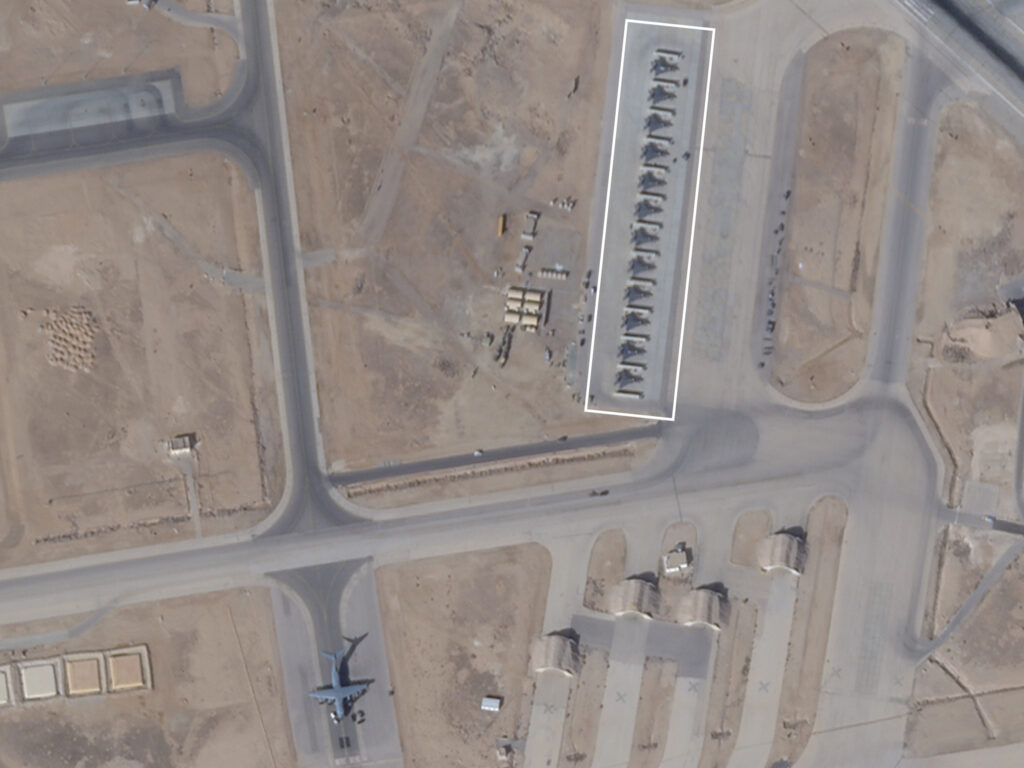
At least a dozen F-15E fighter jets along with nine A-10C Thunderbolt IIs, which are used to protect troops on the ground from enemy forces, were at Muwaffaq Salti Air Base in Jordan on Jan. 25. The F-15E aircraft are from the same squadron that fought in the 12-day war between Israel and Iran in June, according to Nicole Grajewski, an assistant professor at the Paris university Sciences Po who specializes in Iranian military developments.
Two HC-130J Combat King aircraft, which often fly at flight at night and are used for search and rescue operations in contested environments, left the Greek island of Chania last week and flew toward the Jordanian base, according to flight tracking data. Both flights turned off flight tracking signals as they descended.
The addition of search and rescue aircraft is one sign among others the Pentagon may be anticipating operations where aviators and special operators would need to be retrieved inside enemy territory, experts said. Such aircraft, including helicopters optimal for retrieving personnel, were rushed into the Caribbean region about three weeks before the raid to capture Venezuelan President Nicolás Maduro. Satellite imagery taken on Monday shows at least one MQ-9 Reaper drone and several multiple-utility helicopters, which appear to have newly arrived, at the Jordanian base.
Additional assets include F-35 fighter jets and EA-18G Growlers, an electronic warfare aircraft that jams radars and disrupts communications, both of which are on board the USS Abraham Lincoln according to publicly available photos.
The Growlers would be useful if the United States intends to enter Iranian airspace and hit targets further in the interior, said Gregory Brew, a senior Iran analyst at Eurasia Group, adding if the U.S. brings in more F-35s, that would suggest that it plans on “operating inside Iranian airspace in a more considerable way.” The stealthy aircraft are often used to take out an adversary’s air defenses, creating a safer environment for other jets.
In addition to those near the Strait of Hormuz, a destroyer, the USS Delbert D. Black, visited Israel and left port there Sunday; it has since moved further out into the Red Sea. There are two more destroyers in the eastern Mediterranean, U.S. defense officials said Monday, the USS Bulkeley and the USS Roosevelt.
These movements indicates that “both the U.S. and Israel are very concerned about an Iranian retaliation against Israel, even if Israel is not directly involved,” Brew said. Iran has threatened fierce retaliation in the event of a U.S. attack, saying U.S. interests in the region and Israel would be targeted.
Additional defensive weaponry is expected to flow into the region, officials have said, to bolster defense against any potential Iranian retaliation for the U.S. and allied forces.
Nearly every ballistic missile in the Iranian arsenal was designed to target Israel or U.S. bases in the region, said Fabian Hinz, an expert in the Iranian missile program at the International Institute of Strategic Studies.
“All of these systems have the range to hit bases in the region,” he added. “This [short range] arsenal is very likely still pretty much intact, and as it was before the 12-day war.”
Alex Horton in Washington contributed to this report.
The post Satellite imagery shows where the U.S. military is positioned near Iran appeared first on Washington Post.