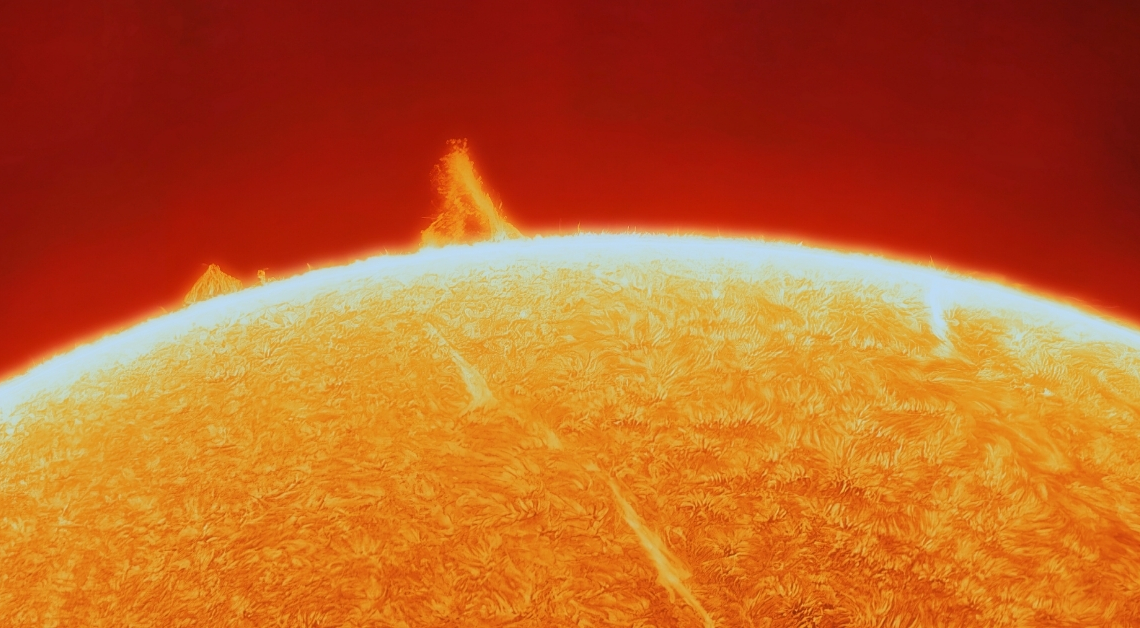
Over a 20-hour window in early February, the Sun released four major solar flares. The burst of activity immediately caught the attention of space weather forecasters.
The activity kicked off at 12:33 UTC on February 1, when an X1.0 flare burst from the Sun’s surface. About 11 hours later, things escalated fast. At 23:37 UTC, the Sun released an X8.1 flare, one of the strongest eruptions seen in years. Two more followed soon after, with an X2.8 flare at 00:36 UTC and an X1.6 flare at 08:14 UTC on February 2, according to data from NOAA’s Space Weather Prediction Center.
X-class flares sit at the top of the solar flare scale. The X8.1 event stands out even among them. NOAA reports it was the most powerful flare observed since October 2024 and ranks among the strongest solar flares ever recorded. All four eruptions came from the same active sunspot region, labeled RGN 4366, which has only recently rotated into a position where it faces Earth directly.
The Sun Unleashed Four Powerful Solar Flares in Less Than a Day
Earth now sits directly in front of the active region. When active regions like RGN 4366 face our planet, outbursts have a higher chance of interacting with Earth’s magnetic field. In an update, NOAA’s Space Weather Prediction Center warned that if the region “continues to evolve, remains complex, and erupts with any powerful solar flares, there could be increased chances of energetic particle events and possible coronal mass ejections (CMEs).”
CMEs are large clouds of magnetized plasma blasted into space by the Sun. When aimed toward Earth, they can cause geomagnetic storms. Sometimes that means impressive auroras stretching far from the poles. Other times, it means interference with satellites, GPS signals, radio communications, and, in extreme cases, power systems on the ground. The same event can produce beautiful photos and very unglamorous technical headaches.
This activity follows close behind the Sun’s most intense phase. The peak of its 11-year cycle brought frequent eruptions and dramatic auroras in 2024. Although activity usually eases after that point, forecasters warn the decline can arrive in uneven bursts.
“Forecasters expect more exciting activity,” the Space Weather Prediction Center noted in its weekly outlook. In practical terms, that means scientists will keep watching RGN 4366 closely as it continues its journey across the Sun’s visible surface.
For most people on Earth, this burst of solar activity won’t affect daily life. The Sun operates on its own schedule, and even from 93 million miles away, its effects can arrive quickly and without notice.
The post The Sun Just Released Four Powerful Solar Flares in One Day, Scientists Confirm appeared first on VICE.