GOOD PEOPLE, by Patmeena Sabit
I didn’t want to start this review talking about “The Office,” or mockumentaries, but there is a reason things are popular. And I believe Patmeena Sabit’s gorgeous and powerful debut novel, “Good People,” will and should be popular for the reason good things are paid attention to, spent time with, talked about.
It’s also true that the structure of new forms of art are influenced by the time they exist within. “Good People” borrows freely from the language of cinema and television and even social media, in which interviewees essentially talk directly to the reader, as if into a camera. In an era where fiction must compete with all these mediums, the short chapters and terse, rhythmic pacing here feel urgent.
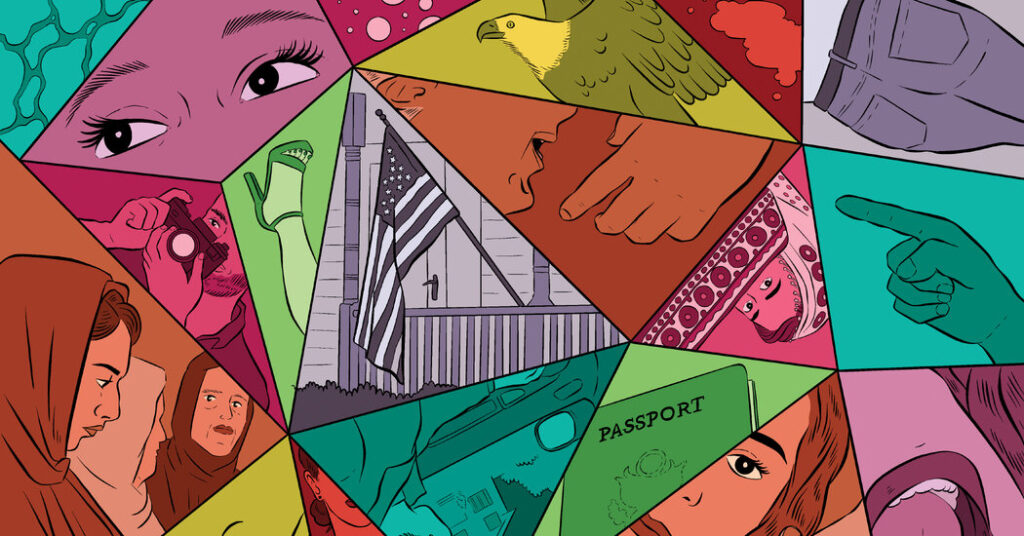
The story in “Good People” concerns the Sharafs, an Afghan family who have, through no lack of persistence and effort by their patriarch, Rahmat, performed the minor miracle of the American immigrant success story.
The Sharafs have moved from the visceral instability of Kabul to the suburban stability of Northern Virginia, a landscape defined by its manicured lawns; its good, polite, well-intentioned neighbors. Rahmat has built a commercial real estate empire, a physical manifestation of his desire to ground his family in something permanent.
But permanence, as Sabit suggests with a cold, clear eye, is an illusion when one’s belonging in a country such as this one is conditional. In the quiet, devastating machinery of her novel, the tragedy is not merely the sudden death of the Sharafs’ 18-year-old daughter, Zorah, but the relentless, suffocating weight of the communal gaze.
Writing with the austere precision of a master of the domestic interior, Sabit has constructed a narrative that functions as a trial where the defendants — the Sharaf family — are never allowed to take the stand in their own defense.
Early on, we understand that a body has been found in a canal. It is a moment of immense, quiet violence that sets the plot in motion. Sabit, however, makes the radical choice to keep the Sharafs at a distance. The story is told through a polyphony of outsiders — neighbors, business associates, schoolteachers, reporters. It is a chorus of “good people” whose observations, colored by their own smallness and prejudices, slowly assemble a portrait of a family they never truly knew.
The novel occasionally clings to its structural conceit with a heavy hand. Sabit prefaces the book with a claim that feels decidedly flawed: “These accounts are presented here in their entirety. They have not been edited in the interests of brevity, grammar or clarity.” This does a disservice to the very tight composition of the chapters, full of specific voice and word choice that the author clearly and painstakingly arrived at through revision.
Similarly, section titles like “The Hour” and “Judgment Day” feel unnecessary. They point toward a framing that isn’t really present enough otherwise in the novel. Sabit should have trusted the reader, and let the conceit of the documentary format move into the background.
Throughout, though, she captures the specific, exhausting labor of being “good” in a culture that is waiting for you to fail. Rahmat Sharaf is not merely a father; he is a man performing the role of the Good Immigrant. His success is his armor.
Yet the moment the tragedy occurs, that armor is stripped away by his neighbors. Their affection for him is revealed to be a thin veneer, easily discarded for the more comfortable, more familiar tropes of “honor killings” and “cultural incompatibility.” Sabit possesses a remarkable ability to have her characters tell on themselves. She does not judge them, but allows the reader a full, unvarnished view of the community’s interior logic.
As one friend of the family says, reflecting on the dead girl, “We give our daughters freedom, but within a frame. All the good families, all their daughters, even if they don’t cover their heads and wear the hijab, they still dress modestly. … Wearing jeans and blouses so tight it was like she’d been sewn into them. … Were those the doings of a good girl from a good family?” Here, the speaker believes she is describing parenting, but she is actually describing a cage; equating morality with the length of a hemline.
At the heart of this storm of voices is Zorah. By keeping her silent and her motivations filtered through the memories of others, Sabit elevates her to a tragic figure of immense proportions. We see her through a prismatic view, from the gas station attendant who meets her for a moment to the family attorney. One is reminded of the way a house is viewed from a moving car — vividly clear yet entirely unreachable. This is a mystery that isn’t meant to be solved in the way of true crime. In our not so brave and not so new world, everyone knows everything and says nothing.
Sabit also speaks voluminously about the impossible burden and loneliness of the second-generation experience. There is a profound sadness in the way the “good people” here settle on a version of truth that satisfies their own worldview.
Near the end, another family friend offers a particularly powerful observation on how America alters the soul, regardless of the culture one attempts to preserve:
But that’s the way of this country. Change is in its soil. In the air and water. In the very blood of the babies born here. In the milk they suckle from their mothers’ breasts. How many of us came here swearing a hundred qasams that we would keep all our ways? That we would be exactly as our fathers were. That only the weak and corrupted ones give way. But we all found out, soon enough, that those were just big big words. In the end the stubborn ones break the hardest of all.
“Good People” is a work of significant moral heft. Sabit has written a book that is as much about the act of seeing as it is about the person being seen. It is a haunting, beautifully controlled exploration of what happens when the life you have built is dismantled by the very people you hoped would call you a friend. And in its final pages, the story leaves us with a silence that is far more devastating than anything a documentary or a thriller or another kind of oral history might have included.
We are living through a particularly intense, brutal time of not seeming to agree or even understand collectively as a country what it means to be an American, what it means to belong to a people who weren’t born here, or whose ancestors weren’t born here.
I believe we need literature to help give language to the many nuances lost in headlines, in social media posts and in political rhetoric that always seems to miss how we all belong to one another, to this experience of being human. We all feel loss, and don’t know what to do or whom to blame, or even how to proceed.
Whenever I finish a novel I love, I feel a little sad to be finished, a little jealous at having not written anything better, but mostly a kind of complete fullness, with no small dose of hope. They say reading is dying, and maybe it is. But works like this one will ensure there will always be a place for what novels alone can achieve.
GOOD PEOPLE | By Patmeena Sabit | Crown | 400 pp. | $29
The post A Girl Is Dead, and a Community Mourns. Or Does It? appeared first on New York Times.