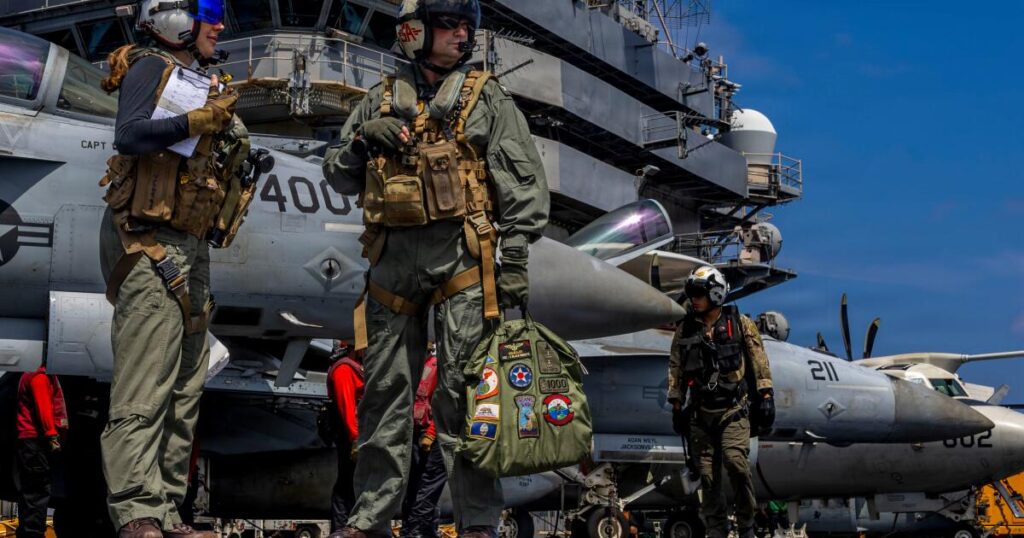
As the United States assembles a “massive armada” off the coast of Iran — an aircraft carrier, accompanying destroyers, strike aircraft positioned across the region — the choreography is instantly recognizable. Forces move into place. Officials speak of “options.” The president’s social media account warns of “far worse” attacks than those launched against Iran last summer. What remains conspicuously absent is any explanation of what the use of that force is meant to accomplish.
If this sequence sounds familiar, it should. In late 2002 and early 2003, the U.S. followed a similar path. Military power accumulated faster than political clarity. The administration cited shifting rationales for invading Iraq — first terrorism, then weapons of mass destruction, even regional stability — while promising that speed and overwhelming force would secure American interests. The opening phase of the Iraq war was fast and tactically overwhelming. Our failure was never seriously articulating how force was meant to shape what came next politically.
Two decades later, the circumstances are different, but the failure is unmistakable.
A serious approach to using the military to shape political outcomes begins with clarity of purpose: what result is sought and how force is meant to achieve it. Strategy requires prioritizing the distinct challenges an adversary like Iran presents and reckoning in advance with consequences — how escalation might unfold, how adversaries and allies would respond, and what must be in place if force succeeds or fails. These questions do not weaken resolve. They are critical to it.
Beyond vague calls for Tehran to “come to the table,” the administration has not yet explained what actions would reduce pressure, halt strikes or be rewarded with restraint. In the absence of that clarity, military power is being asked to do the work that policy has not done. Forces are readied without a defined political end state or a clear explanation of how they will advance U.S. interests rather than simply imposing punitive military and economic costs.
By the administration’s own intelligence assessments, Iran’s nuclear program remains damaged and constrained. There is no evidence of an imminent sprint toward a weapon and no sign of renewed high-level enrichment. The protests by the Iranian people that briefly animated Washington’s rhetoric have been put down through force and repression. Yet the posture toward escalation remains, without a clear explanation of the urgency now being asserted.
Despite no material change in the facts on the ground, the administration’s rationale to strike Iran keeps changing. First came the language of moral urgency tied to protests against the Iranian government. Then attention shifted to another attempt to set back their nuclear weapons program, despite no evidence of an immediate threat. More recently, the focus has drifted toward limiting Iran’s ballistic missile capability and range, reducing their actions through regional proxies, and the suggestion that sufficient pressure might even destabilize the regime itself.
None of these concerns are trivial. But protecting protesters in Iran, halting nuclear enrichment, degrading missile capabilities and forcing political change are each fundamentally different missions, requiring different approaches, tools and tolerances for risk. Treating them as interchangeable — and solvable by the same application of force — avoids the harder work of strategy.
Military force shapes behavior only when it is tied to clear conditions. An adversary must understand what actions will reduce pressure and what outcomes will follow restraint or compliance. Strikes impose costs, but they do not communicate a path forward. Absent defined objectives and conditions, punishment becomes policy. Force stops being a means to an end; it is the end itself.
That failure of the early 2000s has hardened into an American habit. Over time, the mechanisms that once forced leaders to articulate purpose — strategic planning, congressional scrutiny, and sustained public explanation — have weakened. In their place, the use of force has come to stand in for policy. The show has become the strategy.
The broader consequences of using force as the default tool of statecraft extend well beyond any single strike. Repeated military action taken without clearly articulated objectives erodes U.S. credibility and weakens the connection between American demands and American restraint. It unsettles allies and adversaries alike, signaling that American power is increasingly reactive and disconnected from any coherent vision of long-term success. Yet these effects are rarely acknowledged when decisions to use force are made.
Recent history has made this all seem deceptively easy. Limited strikes in Iran, Venezuela and Nigeria did not escalate quickly or widely, giving the impression that military action can be used repeatedly at low cost. That impression is less a reflection of strategic success, and more a function of the relative weakness or restraint of those targeted. It has been misread as proof that this approach is sustainable. It is not.
This is not an argument for passivity. It is an argument for seriousness and accountability. If the administration believes military force is necessary, it owes the American public more than movement and threats. It owes a clear explanation of what it is trying to achieve, why military force is appropriate and how success will be measured. That is not an unreasonable demand. Two decades of experience should have made this non-negotiable.
Jon Duffy is a retired Navy captain. He writes about leadership and democracy.
The post The U.S. military strategy in Iran feels eerily familiar appeared first on Los Angeles Times.