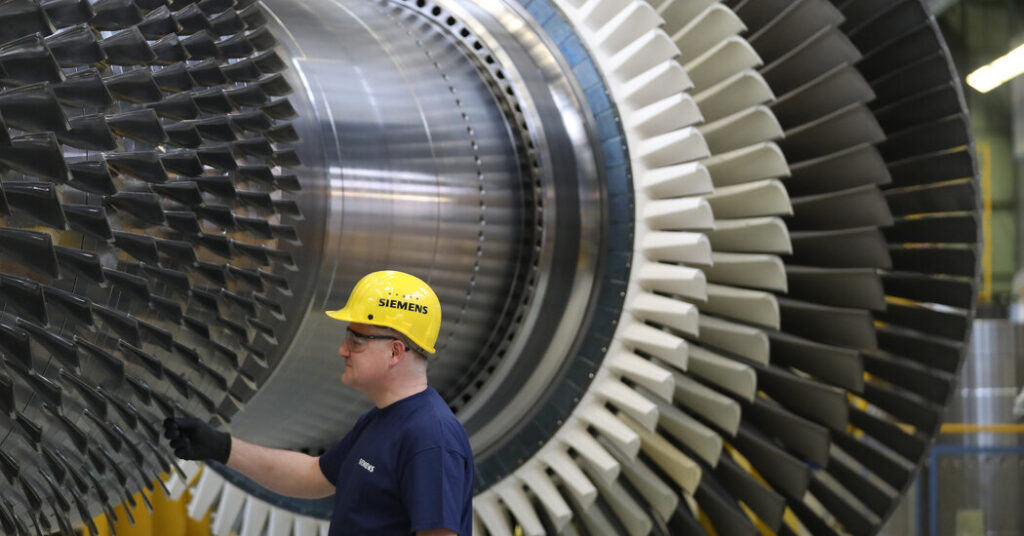
Siemens Energy, the German company, plans to invest $1 billion to make more electrical equipment in the United States, a welcome development for utilities and data center developers.
The manufacturing expansion announced Tuesday amounts to a bet that the artificial intelligence boom, which is propelling plans for new energy-hungry data centers, will drive U.S. electricity demand higher well into the future.
“The models” — the A.I. computer programs — “need to be trained,” Christian Bruch, the chief executive of Siemens Energy, said in an interview in New York. “The electricity need is going to be there.”
Siemens Energy’s spending will be distributed across several states, including Florida and North Carolina. Much of it will go toward expanding existing plants, though Siemens Energy also plans to build a factory in Mississippi to make electrical switchgear, equipment that manages power flows. In all, the expansion is expected to create around 1,500 jobs.
From the power transformers used to increase or decrease voltage, to the giant turbines that help turn natural gas into electricity, many of the components needed to generate electricity and move it have been in such high demand that prices have soared and waits have stretched to many years.
That has been good for companies like Siemens Energy, whose shares are up more than 160 percent in the past year, surpassing the gains of many businesses more commonly associated with the A.I. boom, such as Nvidia, the chip maker.
But supply-chain constraints have made it much harder and more expensive for electric utilities and others to expand the electrical system.
“The scale and speed of new data center energy demand is outpacing the ability to develop new utility generation and grid infrastructure,” a Barclays analyst wrote last fall.
A big question for Siemens Energy and other manufacturers, like GE Vernova and Mitsubishi Heavy Industries, has been whether to invest in new manufacturing capacity or make do with what they have.
“The whole industry was very sensitive to the fact that there was a time when there was a big overcapacity in the market,” Mr. Bruch said. “Everybody got burned.”
The way he sees it, demand for electrical equipment “is there to stay on this elevated level.”
The demand for natural gas power plants is another matter.
Wind and solar energy have been the fastest-growing sources of power in the United States and much of the world. But many utilities and technology companies have been gravitating toward natural gas recently because they believe data centers will use much more electricity than they previously thought, and much sooner. The Trump administration and Republicans in Congress also have been making it a lot harder to develop renewable energy projects by slowing down federal permitting and winding down federal tax incentives.
At the end of 2025, the United States had more natural gas power capacity in development than any other country, according to the Global Energy Monitor, a nonprofit organization.
“We’re confident until the end of the decade,” Mr. Bruch said of demand for natural gas turbines. “Beyond that is speculation.”
Siemens Energy, which currently makes large gas turbines in Germany, is planning to start producing them again in Charlotte, N.C. — but at an existing plant. Higher tariffs on imports were a factor, but not the most important one, Mr. Bruch said.
“If you just would have tariffs and no market, you would not localize,” he said. “The main driver is really market, market, market.”
Rebecca F. Elliott covers energy for The Times.
The post Siemens Energy Bets $1 Billion That A.I. Power Demand Will Last appeared first on New York Times.