It happened in a remote area near Laredo, Texas, not far from the Rio Grande in May 2018. Claudia Patricia Gomez Gonzalez, 20, of Guatemala, was walking with a group of other migrants when a Border Patrol agent spotted them in the brush. Most of the others ran, but Ms. Gomez, unarmed, took a step forward. The agent shot her in the head.
Customs and Border Protection, Border Patrol’s parent agency, initially said that she and others were throwing blunt objects at the agent, but later changed its description, no longer describing her as an assailant. The F.B.I. reviewed the case and declined to pursue criminal charges, according to a lawsuit filed by her family.
The incident was one of many brutal and violent episodes in the 100-year history of the Border Patrol, which has typically operated on the furthest edges of the country, outside of the view of many Americans.
The fatal killing of protester Alex Pretti in Minneapolis last month reflects what critics say is a longstanding ethos of aggressiveness that permeates the agency and was imported into U.S. cities through President Trump’s immigration crackdown.
Despite multiple efforts over the years to provide greater oversight of the agency, there is still not data available about how the use of force by Border Patrol agents compares to that of other federal law enforcement officers. But local communities and civil rights groups have documented a long pattern of aggressive tactics that raises questions about how frequently the Border Patrol uses excessive force.
“There have been concerns over use of force policies within C.B.P. for many years,” said Dan Herman, a former adviser on accountability and transparency at the agency during part of the Biden administration.
Former officials say the Border Patrol’s insular culture and often a lack of consequences for its actions have stymied efforts to bring more transparency and discipline, even as new policies on training and use of force were put in place.
Then Mr. Trump made the Border Patrol a central player in immigration enforcement, deploying agents to cities across the country last year. At the helm was Greg Bovino, an outspoken sector chief who joined in 1996 and rose through the ranks of the agency into leadership positions.
“Arrest as many people that touch you as you want to,” Mr. Bovino told agents in Los Angeles in August. “It’s all about us now.”
That confrontational approach quickly led to tension, fear and violence. In Chicago, snipers rappelled from helicopters to the top of an apartment complex. Agents deployed chemicals on protesters in Minneapolis.
Tim Quinn, a senior C.B.P. official between 2014 and 2025, said Border Patrol agents have historically operated under immense pressure in some of the country’s harshest and most isolated environments, noting that they have not been trained to operate in protest settings.
Responsibility for the excessive tactics on display in Minneapolis lies with top officials at Homeland Security and the White House, which have set “reckless deportation quotas,” he said.
“Unfortunately, what was sacrificed was good law enforcement professional standards in pursuit of those numbers,” Mr. Quinn added.
Tricia McLaughlin, a spokeswoman for the Department of Homeland Security, which includes the Border Patrol, defended its agents as “highly trained and required to meet the highest standards of professionalism and law enforcement capability.”
For his part, Mr. Bovino — who was recalled from his post in Minnesota in the aftermath of Mr. Pretti’s killing — has defended the tactics of his agents as “legal, ethical and moral.”
A dark beginning
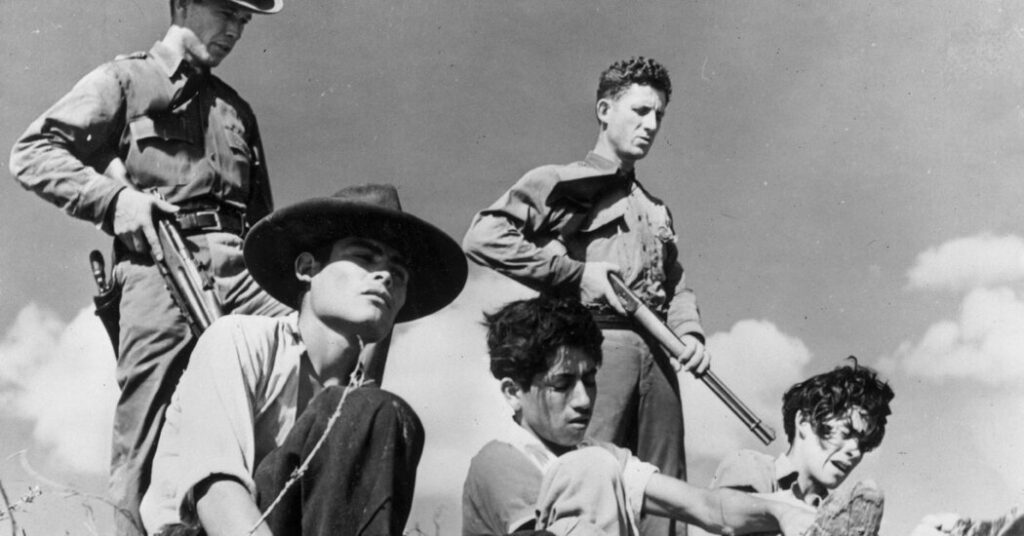
The Border Patrol was formed in 1924, at a time when a wave of national nativist movements drove support for one of the nation’s earliest and most expansive immigration laws. That measure limited immigration based on racial and ethnic quotas, giving preference to those from western European countries.
With a force of mostly white working-class men, the Border Patrol focused on enforcing a racial and social order, mostly through regulating the migration of Mexican laborers. Recruits came from the Ku Klux Klan and the Texas Rangers, infamous for lynching Black people, Native Americans and Mexicans, according to multiple historians.
Before long, the Border Patrol became known for its brutal roadside interrogations of Mexican laborers about their immigration status.
In one case from the early 1930s, two agents tied the feet of migrants and dragged them in and out of a river until they answered questions about their citizenship, said Greg Grandin, a history professor at Yale University and author of “The End of the Myth: From the Frontier to the Border Wall in the Mind of America.”
In the ensuing decades the Border Patrol grew in size and gained more authority to stop, search and detain immigrants as far as 100 miles from the border.
In 1976, Border Patrol agents were chasing three Mexican men who were walking on a path in a remote part of Pima County, Ariz. When one of the men fled toward the border, an agent chased him and shouted for him to stop, then fired three shots into his back, according to a 1997 report to the United States Commission on Civil Rights.
In the 1980s, Border Patrol agents were involved in series of violent incidents against Mexican boys, some as young as 11 and 12, according to a 1989 memorandum by members of Congress to a House subcommittee on human rights and international organizations.
The agents themselves have faced significant threats and violence on the job. In the 1960s, two agents were kidnapped and executed by suspected drug dealers. In 2023, an agent was shot twice in the torso by a man he pulled over on a rural section of highway in New Mexico.
In an interview with The New York Times last year, Mr. Bovino said that as a young man, he was impressed by the bravery required to work for the Border Patrol.
“The extreme amount of violence those Border Patrol agents, or they were called inspectors back then, were up against, it struck me, wow, that was a pretty tough organization to be out there alone with no backup,” he said.
A growing presence
Over the years, Congress continued to bolster the agency’s budget, pointing to the dangerous nature of its work.
As the Border Patrol was drawn into the war on drugs, the agency began getting military-grade equipment.
In 1992, a Border Patrol agent fired his semiautomatic weapon 12 times at an unarmed man in Nogales, Ariz., as he fled back to Mexico. Two shots hit the man in the back, and the agent dragged him to a nearby crevice where he died, the 1997 report said.
Between 2004 and 2011, the agency added nearly 11,000 agents, bringing it to a total of 21,400. The number of employees accused of misconduct or arrested off-duty increased, as well, the Government Accountability Office found in a 2013 report. That was, in part, because the agency could not keep up with background checks, the G.A.O. found.
In 2010 Border Patrol agents hogtied, beat and used a stun gun to shock a 42-year-old unarmed Mexican father of five who was in custody after crossing the border illegally near San Diego. The man, Anastasio Hernández Rojas, died. The official cause of death was identified as a heart attack, and the Justice Department declined to criminally investigate the agents involved.
Last spring, the Inter-American Commission on Human Rights concluded that U.S. law enforcement violated Mr. Rojas’s human rights, pointing to the “application of tactics that threaten life and integrity.” It called for the U.S. to reopen the investigation and hold the agents involved responsible.
“We’ve been having these conversations from the southern border for a long, long time,” said Andrea Guerrero, the executive director of Alliance San Diego, a community organization and part of a coalition that promotes human rights along the southern border. “But it is the first time that we’re seeing different communities experiencing the intensity of what we have lived.”
Daniel Altman, who led investigations for C.B.P.’s Office of Professional Responsibility between November 2019 and April 2025, said that he observed that some of the most violent incidents involving Border Patrol agents took place when they were thrown into an unfamiliar situation.
“Situations can spin out of control and lead to bad outcomes when agents are forced to work in extremely chaotic circumstances, like what we’ve recently seen and, for example, what happened in Del Rio,” Mr. Altman said, referring to the mass crossing of Haitians into Del Rio, Texas in September 2021.
The jarring scenes of agents on horseback charging at Haitians and trying to force them back into a river where they had crossed led to an internal investigation. In the review, C.B.P. found that the Border Patrol agents used excessive force and were deployed without clear orders.
In recent years, Mr. Bovino has been at the forefront of some of the Border Patrol’s most provocative tactics.
Last January, in the waning days of the Biden administration, Mr. Bovino led raids 300 miles from the southern border in Kern County, Calif. Agents arrested farm workers on their way to work and targeted businesses in Latino neighborhoods.
Some farm workers said the agents they encountered did not identify themselves or provide warrants, and they ignored requests to call lawyers, according to a lawsuit filed by some of the farmer workers last year. C.B.P. said the raids were targeting people involved in smuggling and led to 78 arrests.
The Biden administration had banned such operations. But Mr. Bovino said he viewed it as a success.
“It certainly opened our eyes to the need for interior enforcement,” Mr. Bovino told The Times last year.
An entrenched culture
Even as the agency has expanded its ranks, the federal government has provided uneven oversight over the conduct- of its agents, independent reviews have found.
A 1992 Government Accountability Office report determined that inefficient management and understaffing at Immigration and Naturalization Service, which included the Border Patrol at the time, made it difficult to file internal complaints against agents and hold them accountable.
A 2013 independent report by the Police Executive Research Forum offered several recommendations, including that Customs and Border Protection officials investigate every time an officer or agent uses deadly force. Since 2014, a national review board has examined incidents involving serious physical injury or death, but former officials say the review process is slow.
Josiah Heyman, an anthropologist and border researcher who has studied the agency for more than three decades, said that in that year there was one of the only significant updates to the C.B.P.’s use of force guidelines, which required agents not to reach inside of cars or stand in front of moving vehicles.
“What’s happening in Minneapolis and other places is the product of that culture that is developed over years,” said Chris Magnus, who President Joseph R. Biden Jr. tapped to run C.B.P., lauding his reputation for changing entrenched police culture.
By the time the Senate confirmed Mr. Magnus in December 2021, the historic number of illegal crossings at the southern border took precedence — operationally and politically — over any change in culture.
Less than a year later, Mr. Magnus said the homeland security secretary, Alejandro N. Mayorkas, asked him to resign, in part because he was making things difficult for the Border Patrol.
In a social media post at the time, the agency’s union quickly said “good riddance,” and said Mr. Magnus was spending too much time “chasing imaginary ‘culture’ problems in B.P.”
“Leadership within these agencies were allowed to operate largely with impunity and do what they wanted with little to no consequences,” Mr. Magnus said last week. “That sets a tone.”
Kitty Bennett, Dylan Freedman and Georgia Gee contributed research.
Eileen Sullivan is a Times reporter covering the changes to the federal work force under the Trump administration.
The post Pretti Shooting Thrusts Border Patrol’s History of Aggressive Tactics Into View appeared first on New York Times.