TEL AVIV — By the time the Israeli start-up Kela opened its doors in 2024, its employees had already been serving as reservists on Israel’s battlefields.
Once in the office, the team at the military tech firm began experimenting with solutions for overcoming the kinds of problems they’d personally seen drones encounter in war zones like Lebanon, including electronic jamming and signal loss. The employees configured fiber-optic drone prototypes that were then rapidly dispatched to troops on the front lines and pitched to foreign militaries looking for battle-tested technology.
“It was iteration under fire,” said Hamutal Meridor, Kela’s president, referring to the process of testing and ironing out kinks in tech products. Such technology, she said, can help armies keep apace with a “battlefield which is moving at the speed of software.” Last year, the firm, which is also developing a platform to integrate military and commercial products, entered a partnership with the California-based drone company Neros, a supplier to Ukraine that also has a $17 million deal with the U.S. Marines.
Kela is among a cohort of Israeli military tech firms that were born out of, or scaled up during, the war against Hamas in Gaza and as Israel’s military campaign spread to Lebanon, Iran and elsewhere in the region.
The founders of some start-ups say that international condemnation of Israel human rights violations in Gaza, including alleged war crimes, have tarnished the Israeli brand, as have investigations into accusations that Israel committed genocide there. Some clients have sought to maintain a low profile, especially those from European countries that have halted arms shipments to Israel or expressed concern that it has engaged in atrocities.
But Israeli start-up executives say that foreign requests to purchase their weapons and related systems are up sharply. Israel’s success in carrying out devastating pager attacks in 2024 against the Hezbollah militant group in Lebanon, intelligence operations in Iran during the 12-day war last year and commando raids to rescue hostages in Gaza have stoked foreign demand for the weapons and other technology used by Israeli troops.
Israeli start-ups brought in a record $15.6 billion in investments in 2025, up from $12 billion in 2024, according to Startup Nation Central, an organization that tracks the country’s start-up industry. Industry experts predict that the trend will continue to rise as the United States and other NATO countries surge defense budgets and Israel’s state-owned arms manufacturers and private sector start-ups announce more partnerships with militaries around the world.
Hagai Balshai, chief executive and founder of Robotican, a start-up developing remote-controlled robots, said that the Hamas-led attacks on Israel on Oct. 7, 2023, prompted an awakening by Israel’s military, which quickly turned to the private tech sector for help on the increasingly digital battlefield. Overnight, systems such as drones, robotics and advanced sensors were rushed into use. These became essential as the Israeli army searched for 251 hostages being held in Gaza and responded to Hezbollah drones flown across the border into Israel.
During these conflicts, about 1,200 people were killed in the Hamas attacks, and Israeli communities near Gaza and close to the Lebanese border were evacuated. More than 71,000 Palestinians have been killed in the Israel Defense Forces’ invasion of Gaza, according to local health officials, who do not distinguish between combatants and civilians, and much of Gaza’s population has been repeatedly displaced in the devastated enclave.
“If our technology was once boutique, once relegated to specific development departments of the IDF, now every commander needed a drone to go in, or robotic cameras on which to base military simulations,” Balshai said.
The Israeli tech industry has long drawn on the expertise of engineers, coders and entrepreneurs who graduated from Israel’s elite intelligence units and are fluent in the culture of Silicon Valley. Dozens of Balshai’s employees, including some from Gaza border communities where family or friends were taken hostage, have repeatedly swapped their army fatigues for jeans and T-shirts and back again.
While on military duty, he said they used the robots they’d developed to scan booby-trapped buildings, detect noxious gases and shoot at drones or militants. When an Iranian missile hit the nearby Soroka Medical Center during the June war, Balshai outfitted his robots with thermal sensors to search for survivors in the devastated medical wards. Those sensors were then adopted by Israeli special forces for missions, “in Gaza, Lebanon, Syria and beyond,” he said.
“This is a war that I wish had never happened, but it gave us a capability that means we’re now part of something global,” he said.
At the height of the war in Gaza, with top international courts pursuing genocide charges against Israel and issuing arrest warrants for Israeli Prime Minister Benjamin Netanyahu and his then-defense minister Yoav Gallant, several European governments announced embargoes on Israeli military exports and imports. In September, Britain blocked an Israeli Defense Ministry delegation from attending an arms trade fair. A month earlier, Germany partially suspended transfers of weapons that it said Israel could use in its war in Gaza, but lifted the ban in November, after a Gaza ceasefire agreement was reached.
Balshai said the Spanish government last year paused its contract with his company, and other Western European countries have requested discretion as part of their orders. But representatives of foreign militaries have been visiting his offices on a regular basis, and deals have been spiking, he added.
“There are governments that are publicly virtue-signaling about Gaza, to placate the street while also sending their defense leaderships to talk with Israeli companies to protect that same street,” said Aaron Kaplowitz, founder of 1948 Ventures, a Miami-based venture capital firm that launched after the start of the war and invests in Israeli military tech.
Eran Toch, an engineering professor at Tel Aviv University, said the development of military systems based on artificial intelligence has allowed Israel to produce target lists at an unprecedented speed and scale, giving the IDF the ability to strike Hamas militants in Gaza as never before. But he added that these systems have shown the limits of AI-powered warfare by failing to adequately calculate the risk to civilians or take the broader impact of the military campaign into account.
“The bottleneck today isn’t the technical problem of delivering bombs or the firepower, since making hundreds of thousands of decisions simultaneously was what AI was created for,” he said. But Toch said the civilian deaths and the wider humanitarian crisis are “not necessarily stuff you can put into the algorithm.”
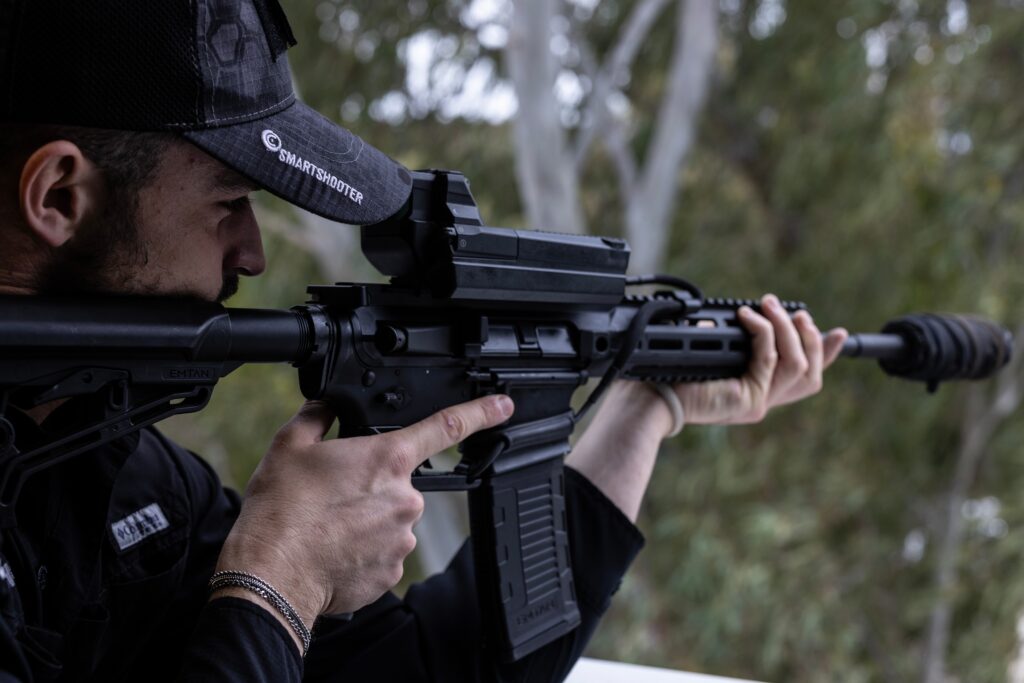
Michal Mor is the chief executive of SmartShooter, an Israeli start-up that developed an AI-powered attachment for rifles that she said helps soldiers detect and fire at targets, whether they be a sniper running across a rooftop or a tiny drone zipping through the sky. She said her company’s technology saves lives of soldiers and uninvolved civilians by increasing the accuracy of gunfire.
Mor said the technology was crucial when Israeli reservists rushed into battle early in the Israel-Gaza war, including some who hadn’t been trained in years and “don’t really know how to plan or what they will see once the first shot is fired and all hell breaks loose.”
The company signed a $13 million contract with the U.S. Army last year and operates sister offices in Virginia, Germany and Australia, she said.
While some Israeli tech firms have seen foreign investments pulled in recent years, she said that many Israeli companies have found work-arounds to foreign bans and restrictions, for instance incorporating in the United States or sending delegations from their American or European offices to arms trade fairs or to negotiate deals. After France banned Israeli companies from attending defense exhibitions in 2024 and 2025, Mor said her company has increasingly scheduled client meetings that do not overlap with international arms fairs.
She said that while there may be international pressure on Israeli defense tech firms, her company has conducted business as usual.
“In the end,” she said, “the war is the only reality.”
The post Israeli military tech start-ups cash in on two years of war appeared first on Washington Post.