Ever since President Trump took office last year for a second term, he has worked to transform the John F. Kennedy Center for the Performing Arts in Washington, D.C., into his own.
He purged the board of its Biden appointees; ousted the center’s longtime president; appointed a political ally as the top executive; named himself chairman; hosted the Kennedy Center Honors; and added his name to the building’s facade, which now reads, “The Donald J. Trump and John F. Kennedy Memorial Center for the Performing Arts.” On Feb. 1, he announced his intention to shut the venue down for two years starting this summer, aiming to turn what he called “a tired, broken, and dilapidated Center” into “the finest Performing Arts Facility of its kind.”
All the while, the center has been hit by more than two dozen cancellations and boycotts. Some performers have characterized their withdrawal as a direct rebuke of the president’s overhaul. Others have simply said that they hoped to work with the Kennedy Center again one day.
The number of cancellations is especially stark for the 2026 season.
Here is a list of cancellations at the Kennedy Center since Mr. Trump re-entered the White House:
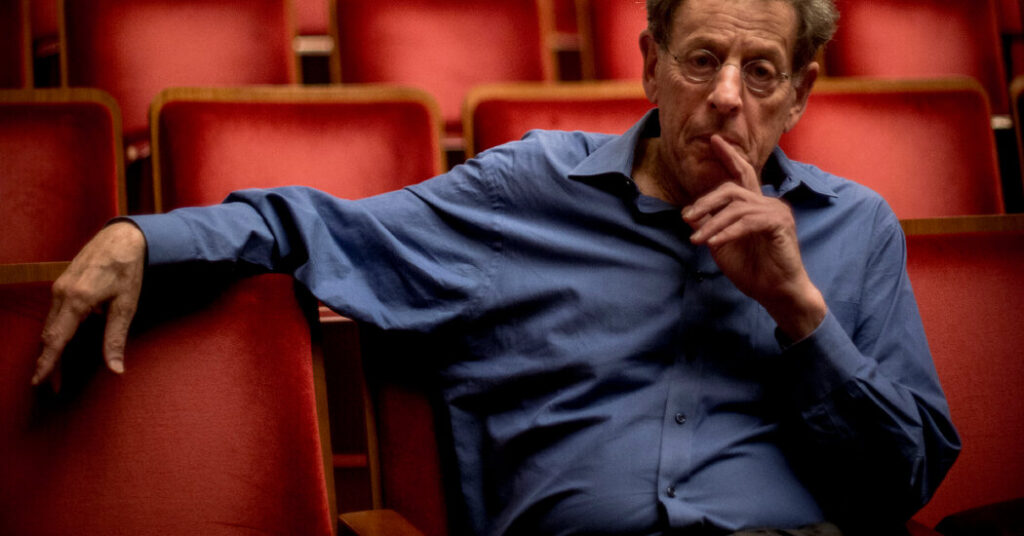
Philip Glass
When the renowned composer pulled his Symphony No. 15 from the Kennedy Center, he said the institution’s current values were “in direct conflict with the message of the symphony,” which is based on Abraham Lincoln’s Lyceum Address of 1838. Mr. Glass had been commissioned to write the symphony to honor Lincoln for the 50th anniversary of the Kennedy Center in 2022.
The Washington National Opera
The Washington National Opera relocated its spring season to George Washington University after 70 years at the Kennedy Center. Like the Kennedy Center, the opera faced a tumultuous year of cancellations, empty seats and the retrenchment of donors protesting Mr. Trump.
In a statement announcing the relocation, Timothy O’Leary, the opera’s general director, said, “Thanks to our community of support, W.N.O. will continue to be a source of beauty, connection and free expression for another 70 years and beyond.”
Béla Fleck
The Kennedy Center was “less and less a musically and artistically based situation and more of a highly politicized and divisive one,” the Grammy-winning banjo player said when he withdrew from a performance with the National Symphony Orchestra.
Mr. Fleck said his decision had been difficult, in part because skipping the performance “punishes the symphony for something they have nothing to do with.”
Stephen Schwartz
The composer of “Wicked” backed out of hosting an upcoming gala at the center for the Washington National Opera, saying he would no longer participate in the venue’s events despite a history of collaboration.
“It is no longer apolitical, and appearing there has now become an ideological statement,” Mr. Schwartz said in a statement to The New York Times. “As long as that remains the case, I will not appear there.”
Renée Fleming
The soprano’s cancellation of two performances with the National Symphony Orchestra was not her first rejection of Mr. Trump’s takeover of the Kennedy Center. Last year, she stepped down as an artistic adviser to the center after David M. Rubenstein was ousted as chairman.
“Out of respect, I think that it is right to depart as well,” she said at the time.
The Martha Graham Dance Company
The nation’s oldest dance troupe was set to celebrate its centennial with performances at the Kennedy Center before it canceled the four shows it had planned for this spring.
The company did not give a reason, saying in a statement only that “we hope to perform at the center in the future.”
‘Hamilton’
The hugely popular musical about the nation’s founding was set to be staged at the Kennedy Center to honor the 250th anniversary of the Declaration of Independence. But after Mr. Trump was appointed chairman of the board last year, Lin Manuel Miranda, the show’s creator, said the show would not engage with the institution “while it is the Trump Kennedy Center.”
“It became untenable for us to participate in an organization that had become so deeply politicized,” Jeffrey Seller, the lead producer, said in an interview with The Times. “The Kennedy Center is for all of us, and it pains me deeply that they took it over and changed that.”
Brentano Quartet With Hsin-Yun Huang
A performance by the string quartet, which has served as artists-in-residence at the Yale School of Music for a decade, would have featured the violist Hsin-Yun Huang.
A brief statement on the group’s website attributed the cancellation merely to “the recent changes at the John F. Kennedy Center.”
‘Let Freedom Ring!’
For the first time in over 20 years, “Let Freedom Ring!,” an annual concert that celebrates the life of the Rev. Dr. Martin Luther King Jr. and has featured artists like Aretha Franklin and Leslie Odom Jr., was held not at the Kennedy Center but at the Howard Theater, a few miles away.
“You celebrate the time that was and the impact that has been and can never be erased,” Nolan Williams Jr., the music producer for the show since 2003, told NPR. “And then you move forward to the next thing.”
Magpie
The American folk duo started what it called the “Traveling John F. Kennedy Center for the Performing Arts Restoration Roadshow” after canceling a concert at the center.
Trump Administration: Live Updates
Updated
- Pirro threatens jail time for lawful gun owners who travel to Washington with a firearm.
- The Justice Department failed to alert a judge to a press law in its application to search a reporter’s home.
- Federal judge blocks end of protection for Haitians in the U.S.
In a post on Facebook, the band members, Terry Leonino and Greg Artzner, said that they had initially been intrigued to put on a show at the center that would be “an evening of hard-hitting songs decrying the entire debacle of the fascist regime now running what’s left of the US Government,” but that they had ultimately decided “to publicly and vocally join the boycott.”
Sonia De Los Santos
The children’s musician said on social media that although it had “long been a dream” of hers to perform at the Kennedy Center, the current climate did not represent “a welcoming space for myself, my band, or our audience.”
Ms. De Los Santos, a Mexican American immigrant, said that she used her music to “uplift the stories of immigrants in this country” and that she hoped the decision would be an example for younger generations.
The Cookers
The jazz septet canceled New Year’s Eve performances, saying in a statement that it hoped “this moment will leave space for reflection, not resentment.” The band’s drummer, Billy Hart, told The Times that the name change at the Kennedy Center “evidently” played a role.
“Jazz was born from struggle and from a relentless insistence on freedom: freedom of thought, of expression, and of the full human voice,” the statement said.
Doug Varone and Dancers
The dance company wrote on social media that after Mr. Trump renamed the building, the group could “no longer permit ourselves nor ask our audiences to step inside this once great institution.”
“We hope in three-year’s time, that the Center and its reputation will return to that glory,” the company added.
Chuck Redd
After Mr. Trump added his name to the Kennedy Center’s facade, Mr. Redd, the American jazz musician, canceled the institution’s annual Christmas jazz show, ending a two-decade tradition.
Richard Grenell, the center’s president, later threatened legal action against Mr. Redd in a letter, writing that the institution would seek $1 million in damages “for this political stunt.”
Vocal Arts DC
After low ticket sales, refund requests and a decline in donations, Vocal Arts DC, an ensemble of singers, canceled its spring recitals at the Kennedy Center.
“This was not a decision we made lightly, but the financial realities have made it unfeasible to continue responsibly at this time,” the group wrote on social media.
Seattle Children’s Theater
After the company canceled a production of “Young Dragon: A Bruce Lee Story” at the Kennedy Center in April, Keiko Green, who wrote the play, admitted that the decision had not been easy.
The play follows a young Bruce Lee before he made a career out of martial arts on the big screen. “Are we silencing ourselves to make a larger point?” Ms. Green said in an interview with a local Seattle radio station. “That’s been a big piece of baggage.”
Kristy Lee
The folk singer from Alabama cited “concerns for institutional integrity” when she canceled her one-night performance at the Kennedy Center.
Ms. Lee said that the decision was not directed at the Kennedy Center’s staff, artists or patrons, but that it was intended to honor her belief that “publicly funded cultural spaces must remain free from political capture, self-promotion or ideological pressure.”
Rhiannon Giddens
The folk singer opted to move a show last year from the Kennedy Center to the Anthem in Washington. Ms. Giddens wrote on social media that the show had been booked “long before the current administration decided to take over this previously bipartisan institution” and that she could not “in good conscience” continue to perform there.
“I will say here that I don’t judge anyone for choosing to go on with their shows,” Ms. Giddens added. “It’s a highly difficult situation for artists right now, and everyone has to do what makes the most sense for them in the moment.”
Balún
The Brooklyn-based, Puerto Rican electronic dance band said on social media that the decision to cancel was “not easy” but that the center no longer aligned with its values.
“While we initially hoped to use this opportunity to engage meaningfully and challenge the prevailing systems, recent events have led us to realize that the Kennedy Center no longer provides the space we envisioned for this kind of work,” the band added.
Issa Rae
The award-winning comedian and actress canceled a sold-out show, “An Evening With Issa Rae,” last year.
She attributed her decision to “an infringement on the values of an institution that has faithfully celebrated artists of all backgrounds through all mediums.”
Low Cut Connie
Adam Weiner, the frontman of the American rock band Low Cut Connie, wrote on social media that the band would not perform at the Kennedy Center until the institution returned “to a non-partisan community-building model of arts programming.”
Amanda Rheaume
When the Canadian singer decided to cancel a performance at the center, she said she was “horrified by everything that’s happening” there.
“When I saw that he had appointed himself chairman, I was like, There’s no way I can do this,” Ms. Rheaume told The Ottawa Citizen. “I’m a queer woman and I just don’t feel good about it.”
Peter Wolf
The former frontman of the J. Geils Band canceled an event promoting his memoir, “Waiting on the Moon: Artists, Poets, Drifters, Grifters and Goddesses.” In a post on X, Mr. Wolf wrote that his decision had been prompted by “the egregious firing of staff by the new administration.”
Wayne Tucker
The jazz trumpeter and composer said that performing at the Kennedy Center with his band, the Bad Mothas, would contravene his only goal as a musician: “to uplift as many human beings as possible.”
“The controversy of performing there right now may do the opposite of that,” Mr. Tucker wrote in a statement to Newsday. “It may uplift some, but it also may cause more friction and tension, and that is why we are canceling our show.”
‘Eureka Day’
Producers for this play about left-leaning parents who are hesitant about vaccines canceled a two-week run at the Kennedy Center. The Manhattan Theater Club, a New York-based nonprofit, told The Times that the cancellation was because of “financial circumstances.”
Michaela Towfighi is a Times arts and culture reporter and a member of the 2025-26 Times Fellowship class, a program for early career journalists.
The post From ‘Hamilton’ to Issa Rae to Philip Glass: Here’s a List of Kennedy Center Cancellations appeared first on New York Times.