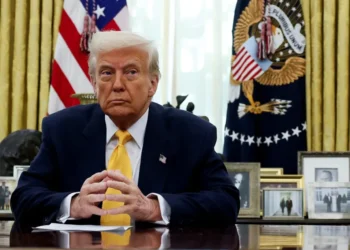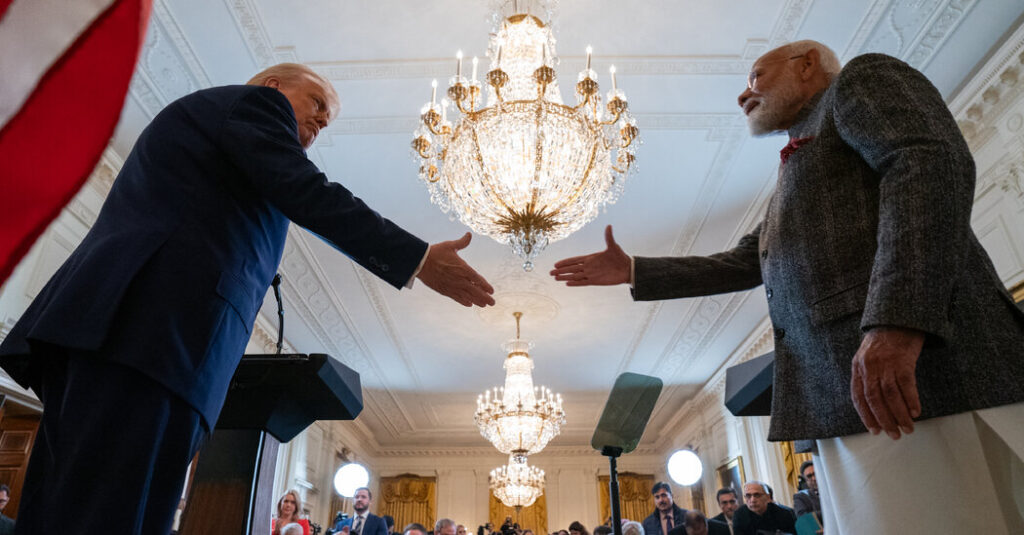
The economic war the Trump administration unleashed against India last summer came to an abrupt end on Monday with a pair of social media posts from President Trump and then India’s prime minister, Narendra Modi. What had begun as a dispute about trade and tariffs, and then escalated to include the Ukraine war, visas and more, was declared over.
Mr. Trump was first to share the news: “Our amazing relationship with India will be even stronger” and “the United States will charge a reduced Reciprocal Tariff, lowering it from 25 percent to 18 percent.”
In fact, most Indian goods have faced a 50 percent tariff — not 25 percent — since Aug. 6, when Mr. Trump said the country should be punished for buying oil from Russia. That doubled a tariff that was already set higher than those burdening India’s competitors in Asia.
Mr. Modi posted soon after, confirming that the two leaders had spoken, praising Mr. Trump personally as a peacemaker and saying the deal “unlocks immense opportunities” for both sides.
But aside from the new 18 percent tariff rate, all other aspects of the deal, as laid out in Mr. Trump’s post, leave enormous questions to be answered. Mr. Trump wrote that the new rate would be “effective immediately,” without much elaboration. Key terms remained murky, including Mr. Trump’s claim that India agreed to spend $500 billion in the United States, something the Indian side did not immediately mention.
The announcements were greeted, initially at least, with a collective sigh of relief. Stocks in Asia jumped on Tuesday with shares in India rising nearly 3 percent.
“This removes an enormous irritant on the U.S.-India side and opens the path for perhaps more cooperation and convergence,” said Nisha Biswal, a partner at the Asia Group who formerly worked for the U.S. International Development Finance Corporation.
Throughout much of last year, the impasse between the countries over trade drew in other grievances, leaving it difficult for businesses and investors to make plans. An especially pointy irritant for Mr. Modi was Mr. Trump’s repeated claim that he helped de-escalate India’s military conflict with Pakistan in May.
Questions about the new terms of trade might be the most urgent for businesses affected, especially those in India. Many of the Indian companies that sold goods to the United States, their biggest export market, worth in total about $40 billion a year, were facing an existential crisis. Mr. Trump wrote that the Indians would “move forward to reduce their Tariffs and Non Tariff Barriers against the United States, to ZERO,” in exchange for the 18 percent rate their goods will now face.
India levies relatively high tariffs against American goods, charging a trade-weighted average of about 12 percent, while also using an expanding class of other barriers to protect local industries from foreign competition.
Experts were skeptical that India could eliminate every barrier to imports from the United States, as Mr. Trump suggested. To use one charged example, American dairy products, produced by cows with nonvegetarian diets, would send India’s consumers into an uproar, not to mention what it would do to the 70 million Indians who depend on dairy production for earnings.
Similar constraints are expected to keep most American agricultural goods at bay.
“Corn and ethanol were areas that we had heard the Indians might be ready to make some accommodation on,” Ms. Biswal said, but these are the kind of details that have yet to emerge.
Apart from trade itself, Mr. Trump claimed that India has “agreed to stop buying Russian Oil, and to buy much more from the United States and, potentially, Venezuela.” That creates important pressure on Russia to end the war in Ukraine, according to Mr. Trump.
It would be difficult for India to explicitly renounce Russia and its imports, and Mr. Modi’s post gave no sign that it would. India remains neutral in the Ukraine war, bridles at taking direction concerning its military alignments and buys weapons from Russia still.
India has reduced its purchases of Russia’s crude oil since the Mr. Trump applied sanctions against companies that trade with its biggest oil firms, Rosneft and Lukoil. Kpler, an analytics firm, noted that India’s imports of Russian oil were down to 1.1 million barrels a day in January, the smallest amount since November 2022.
It remains to be seen if Mr. Trump considers such level of purchases good enough. In November, when India was buying 1.8 million barrels a day, he told reporters that “India has largely stopped buying Russian oil.”
India’s imports of American crude have been growing, though they are less than a quarter as much as India buys from Russia. That might be part of what Mr. Trump had in mind when he wrote that Mr. Modi had committed to “BUY AMERICAN” and would spend more than $500 billion on goods including energy.
Mark Linscott, senior adviser to the U.S.-India Strategic Partnership Forum and a former assistant U.S. trade representative, said a $500 billion commitment over, say, a decade could be feasible and meaningful. But $500 billion at a go, or in one year, is not realistic.
One factor that might have propelled the Trump-Modi détente was the installation of Sergio Gor, a close associate of Mr. Trump’s, as the ambassador in New Delhi last month.
And last week India concluded the negotiation of a giant trade deal with the European Union, which was many years in the making. The two sides felt pressured by their deteriorating trade relations with the United States.
The Europeans’ deal may or may not have helped push Mr. Trump to resolve his differences with Mr. Modi. Officials for the E.U. and India are now deep into the process of sorting the details of their transformative new trade partnership. So far, the United States and India have mainly their leaders’ social media truce.
Ana Swanson contributed reporting.
Alex Travelli is a correspondent based in New Delhi, writing about business and economic developments in India and the rest of South Asia.
The post Trump and India Call Off Their Trade War, but the Terms of Peace Are Murky appeared first on New York Times.