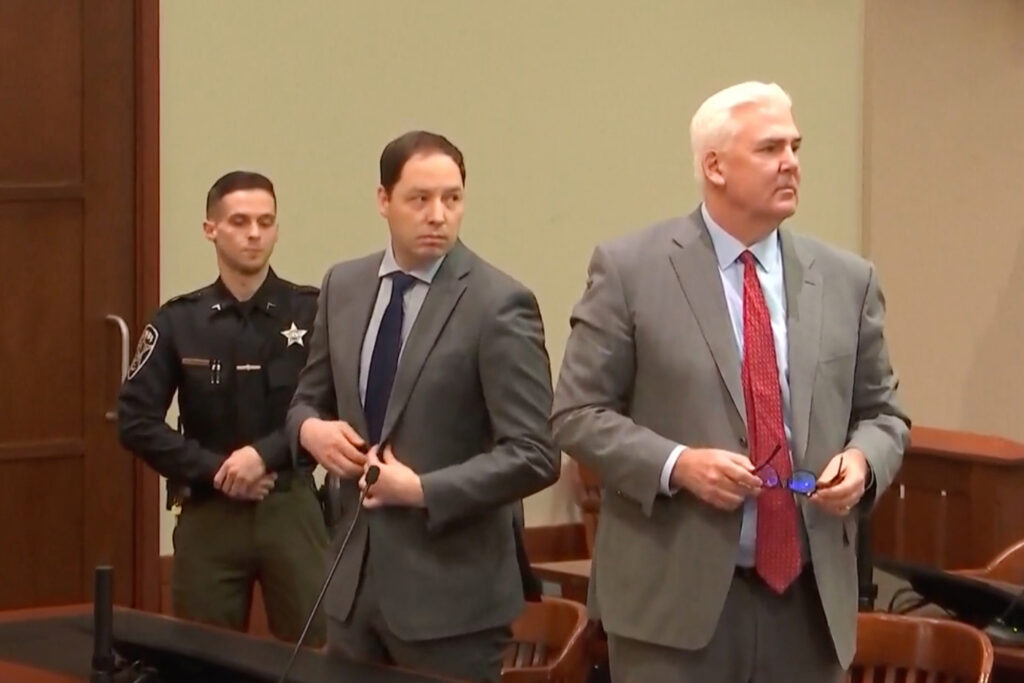
Brendan Banfield, the Virginia man accused of plotting with his family’s au pair to impersonate his wife on a sexual fetish website to frame a stranger as her killer, was found guilty Monday of aggravated murder in the 2023 killings of Christine Banfield and Joseph Ryan.
A jury in Fairfax County deliberated for nearly nine hours before finding Banfield, 40, guilty of both murders as well as two lesser charges. His sentencing is scheduled for May 8. The aggravated murder charges carry a mandatory life sentence without parole.
The conviction came in the trial’s fourth week, after prosecutors painted Banfield as a man so deeply in love with the young Brazilian au pair that he orchestrated an elaborate plot to shoot Ryan, whom he had lured to the family’s Northern Virginia home under the pretense of a rough sex fantasy, then kill his wife with the stranger’s knife.
Prosecutors had testimony from Banfield’s former mistress, au pair Juliana Peres Magalhães, to corroborate their theory. Banfield told jurors that he had interrupted a violent attack on his wife but shot her attacker too late to save her. The trial revolved around circumstantial forensic evidence and the competing accounts from the only surviving witnesses to the killings. In the end, jurors weren’t convinced by Banfield’s story.
Magalhães was initially charged with Ryan’s murder but pleaded guilty to involuntary manslaughter in a deal that set the stage for her testimony. She said Banfield wouldn’t divorce his wife because he feared losing custody of the couple’s then-4-year-old daughter. Instead, Magalhães said, he devised a plan to “get rid of” Christine Banfield by “catfishing” a man online, then framing him for the murder.
Fairfax County Commonwealth’s Attorney Steve Descano called Brendan Banfield “monstrous” during a news conference outside the courthouse after the verdict.
“There were obviously a lot of salacious details in this case that caused it to get a lot of attention,” Descano said. “But at the end of the day, this case is about two people — two neighbors of ours — that were murdered almost three years ago here in Fairfax County. We take that very, very seriously.”
Defense attorney John Carroll did not comment after the verdict Monday.
During his testimony, Banfield emphatically denied any plan to harm his wife and dismissed the idea that he had concocted a catfishing plot as “absolutely crazy.” He told jurors that his relationship with Magalhães was not serious, citing his previous extramarital affairs as proof that he would not kill his wife over a dalliance. When confronted with letters he had written to Magalhães planning what they would name their future children — Chloe for a girl, Robby for a boy — he said he fell in love with her only after the death of his wife. Evidence photos taken of Banfield’s bedroom after the killings show that he had replaced photos of his wife — a pediatric ICU nurse — with photos of Magalhães, who had also moved her clothes into the closet once used by Christine Banfield.
Prosecutor Jenna Sands said outside the courthouse Monday that she believes Brendan Banfield’s testimony helped her case. As a former defense attorney, she said, she would have advised him to remain silent. After Banfield said he woke up early on the day of the killings for an important work meeting, a former IRS colleague came forward as a last-minute witness saying no such meeting was scheduled.
“I think everyone has commented on what was so obvious: that he was not truthful, that he was cold, that he behaved oddly in response to questions that should have elicited emotion,” Sands said, “that he never spoke of himself as Christine’s husband, that he didn’t speak lovingly of his wife, that he showed absolutely no human emotion that we expect to see of someone in his position.”
Carroll spent much of the trial focused on the digital evidence, calling up experts who testified that they could not definitely say who was using Christine Banfield’s devices to send messages on FetLife, the BDSM and kink community website. He also took aim at the investigation, arguing that Fairfax police commanders pressured investigators to agree with the impersonation theory and reassigned two homicide detectives who questioned it.
He tried to discredit Magalhães, using letters and messages she sent while incarcerated to paint her as a young, disillusioned woman who became willing to say anything for a chance at freedom. The plea deal ensured prosecutors would recommend her release, setting up her deportation back to Brazil, as long as she cooperated with investigators and pleaded guilty to involuntary manslaughter.
But Descano and Sands said Monday that they could have convicted Banfield without Magalhães’s testimony. “As a matter of fact, we were planning for it,” Descano said.
He noted that at the time of Banfield’s arrest, Magalhães had been in custody for almost a year and had not turned against her former lover. They had “given up” on her cooperation, Sands said.
The results of a forensic blood spatter analysis, not Magalhães, gave them the evidence needed to arrest Banfield for the murder, Sands said. A blood spatter expert testified that blood patterns observed at the scene indicated that the bodies of Christine Banfield and Ryan were manipulated after their injuries, a conclusion prosecutors pointed to as evidence that Brendan Banfield had staged the crime scene.
“This case was always going to be in the blood,” Descano said.
Outside the courthouse Monday, Descano and Sands both rejected the characterization of Magalhães’s plea deal as a “sweetheart” arrangement. Sands emphasized that a judge can disregard their recommendation and sentence the former au pair to up to 10 years in prison.
Magalhães’s sentencing is scheduled for Feb. 13.
The post Banfield guilty of murdering wife and another man in plot with au pair appeared first on Washington Post.