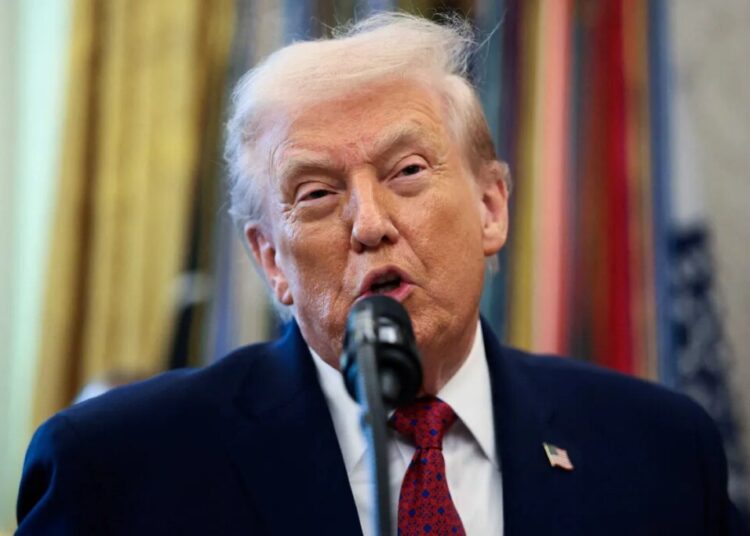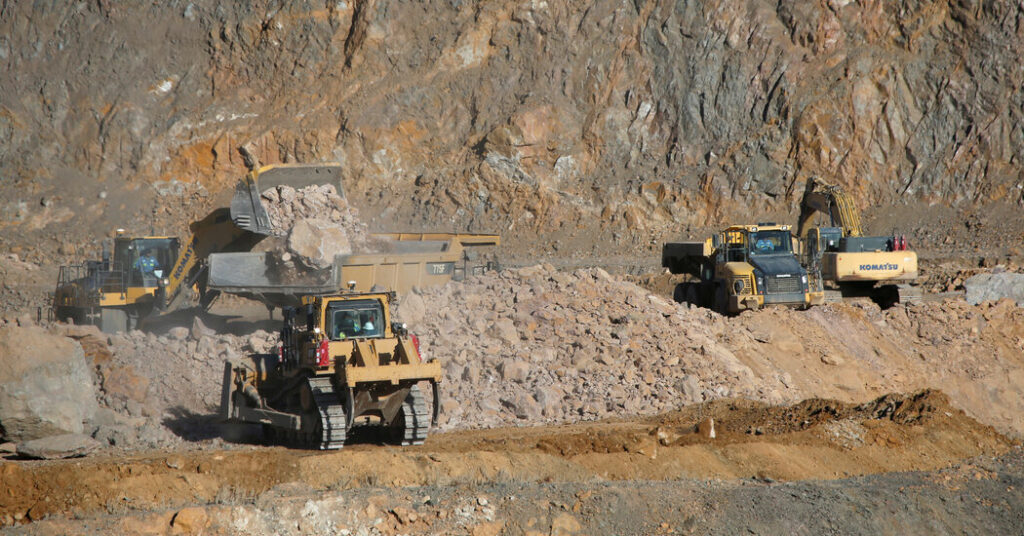
President Trump on Monday rolled out a $12 billion initiative aimed a bolstering domestic stockpiles of strategic critical minerals, as the United States looks to reduce its reliance on China for key components of technology that powers cars, computers and phones.
Known as “Project Vault,” the effort will entail procuring and storing minerals for American manufacturers. In remarks at the White House on Monday, Mr. Trump likened the endeavor to the government’s oil reserves and other emergency caches. The reserve will be financed by $1.67 billion in private funds and a $10 billion loan from the U.S. Export-Import Bank.
The bank’s board of directors approved the loan on Monday.
Speaking in the Oval Office, Mr. Trump framed the announcement as the latest move by the United States to develop its own supply chain for critical minerals, after China curbed exports of its magnets last year, creating shortages for cars, robots, semiconductors, drones and other products.
Details about the structure of the loan, which was reported earlier by Bloomberg News, were not immediately available. On Monday, Mr. Trump said that he expects “the American taxpayer to make a profit from the interest on the loan” used to support the new reserve.
General Motors, Stellantis, Boeing and Google are among the companies that are participating in the project, according to a White House official, who declined to be identified because they were not authorized to publicly discuss the project.
“Over the past year my administration has taken extraordinary steps to make sure the United States has all of the critical minerals and rare earths that we need,” the president said.
The project will establish the U.S. Strategic Critical Minerals Reserve. The Export-Import Bank said in a statement that it will be a public-private partnership that will store essential raw materials in facilities across the U.S.
Mr. Trump has made the global hunt for critical minerals a priority, striking deals with Ukraine and Australia to access their resources and pursuing Greenland, which is rich with natural resources, as the United States looks to secure its stockpiles. The deals include joint projects that would give the United States access to foreign minerals supplies. The United States has also been taking stakes in American rare earths companies as a way to compete more effectively with China.
China mines 70 percent of the world’s rare earths, and does chemical processing for 90 percent of the global supply. When the Trump administration recently imposed high tariffs and more expansive technology controls, the Chinese government responded by rolling out a licensing system that would give it control over rare earths shipments even outside China.
The Trump administration last week extended up to $277 million in direct funding and up to $1.3 billion in loans to USA Rare Earth Inc., a mining and manufacturing group, to help develop its supply chain for rare earth metals and magnets. Last July, the Defense Department agreed to take a $400 million stake in MP Materials, a mining company that has struggled to turn profits amid tough price pressure from China.
The new project is intended to shield companies from price volatility of critical materials by allowing them to make purchase commitments and have access to stockpiles without having to store them independently.
Republicans have long been skeptical of the Export-Import Bank, but Mr. Trump has embraced it as a way to expand his industrial policy efforts and to compete with countries that rely on government subsidies.
“Project Vault is designed to support domestic manufacturers from supply shocks, support U.S. production and processing of critical raw materials, and strength America’s critical minerals sector,” John Jovanovic, Ex-Im’s chairman, said in a statement.
Alan Rappeport is an economic policy reporter for The Times, based in Washington. He covers the Treasury Department and writes about taxes, trade and fiscal matters.
The post Trump Unveils $12 Billion Critical Minerals Stockpile appeared first on New York Times.