1 p]:text-cms-story-body-color-text clearfix”>
I’m hesitant to call “Melania” propaganda because I can’t imagine anyone watching this movie and thinking that Melania Trump comes off well. If this vapid, airless, mindless time-waster had subversive designs of being a satire about the first lady of the United States, there’s not much it would have changed. Yet somehow, “Melania” is exactly the film that the first lady wanted to make — her company was paid $40 million for the rights to this self-greenlit production — and no one around her warned that it was a very expensive bad idea.
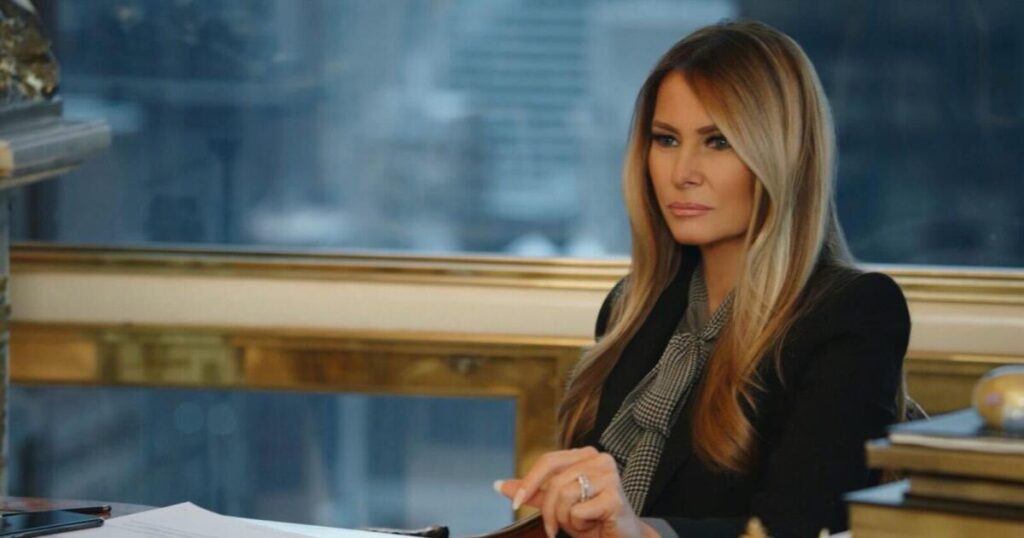
“Melania” didn’t screen for critics and, of the dozen people in my AMC theater on opening day last Friday, half of us were journalists paying to play catch-up. Introducing “Melania” at its Kennedy Center premiere the night before, the lead herself insisted that it is not a documentary but a “very deliberate act of authorship inviting you to witness events and emotions through a window of rich imagery.” Mostly, it’s B-roll of Melania stepping in and out of SUVs. My best guess is her pay rate is a million dollars an hour.
The president is effusive the first time that he greets his wife on an airplane tarmac alongside the film crew. “A movie star!” Trump says with a grin. He has a couple reasons to sound happy. For one, he’s getting to actually make public eye contact with his wife. As a bonus, she even offers up her cheek for a peck, which is as affectionate as things get between them.
With the same queenly beneficence she grants her husband, Melania has allowed the long-out-of-work director Brett Ratner (this is his first film since six women accused him of sexual assault in 2017) access to film her in tightly constrained snippets until the day after her return to the White House. It is 2025 and Trump will be sworn back into office as the 47th president of the U.S. in 20 days — or is it 13? One attempts to measure the passage of time in her outfit changes — a white jacket, shiny black leggings, a tight leather pencil skirt — although the exact numbers blur when Melania attempts to count them.
In terse, precise narration that provides most of our chances to hear her voice, Melania says that this will be a movie about “family, business, philanthropy and becoming first lady of the United States, again.” The latter, yes. Otherwise that proves to be a checklist of several things the movie scarcely touches on at all.
An intimate portrait, this is not. There’s no mention of how she and Trump fell in love and no words are exchanged with her stepchildren Ivanka, Tiffany, Eric and Donald Jr., not even to dispel rumors about their frosty relationship. Melania does gaze fondly at her son Barron on a couple of television screens and predicts he will grow up to have “ultimate success.” The only time I remember them speaking is a goodbye as he turns his back to lope down a hallway.
You become well-acquainted with her stiletto Louboutins and her silent, hunky blond bodyguard. We do witness insider White House events, like the five-hour window used to swap out all of Biden’s furniture for Trump’s, a breakneck turnaround accompanied by a panic of violins. As for witnessing emotions, though, Melania’s inexpressive voice-over assures us that her guarded surface contains deep empathy for humankind.
“Everyone should do what we can to protect our individual rights,” Melania says. “No matter where we come from, we are bound by the same humanity.” Indeed, this isn’t a documentary — a black comedy, perhaps? In another scene, Melania silently watches news footage of the 2025 Los Angeles fires alone on a couch while informing us that it’s “impossible to see these images and not be devastated.” Bless her heart, she tries.
The first lady doesn’t mention politics other than to briefly say that it’s a shame so many people seem to wish her husband harm. Otherwise, she shares her precise opinions on every object she drinks from, sits on or wears. The opening finds her futzing over the neckline of her inauguration day blouse before telling the tailors to slice into the fabric with scissors. This outfit will be in a museum someday, she says. She’s not wrong, although the most compelling thing about that moment is witnessing how exceedingly agreeable everyone is in her orbit. One whispers, “I don’t think we can cut it, though,” once she glides out of the room.
“Melania” plays like a sizzle reel for her post-political (post-spousal?) future career in which she may rouse herself to be a guest judge on a reality competition show. She reminds us of her education in architecture and her Slovenia-to-Rome-to-Manhattan modeling path during which she gained confidence approving or disapproving of various fabrics, as well as the pride she took last term in renovating the Rose Garden (now paved) and decorating the East Wing (now demolished). Her dress designer fashions the closest thing the film has to a metaphor for Melania herself: a gown constructed with no visible seams. “A mystery,” he beams.
On camera, Melania barely talks to anyone besides her employees, a few of whom pick up on the Bravo Channel-style of the film and dutifully recite her opinions on her behalf, like when her event planner David Mann shows her the inauguration invitations and compliments them for being printed in “the color red … which you chose.” I experienced a secondhand childhood shiver of being prompted to write a thank-you note. (In fairness, Melania tells people “thank you” often.)
One of her helpers, who moved to the States from Laos at the age of 2, beams that her proximity to the first lady “really is the American dream.” Both women are immigrants, the film notes, although it doesn’t mention the Trump administration’s feelings about that. It’s worth noting that last year, the United States deported several hundred Laotian refugees back to their homeland, many of whom arrived here as toddlers after the Vietnam War. As for Slovenians, it deported three.
Halfway through “Melania’s” 104-minute running time, it occurred to me that it would feel scandalous if Ratner so much as taped her doing something as human and unguarded as eating a bite of food. Melania does, however, approve of Mann’s suggestion that she serve an appetizer of caviar-topped golden eggs. “White and gold is you,” he assures her, although — drama alert — she later admits that her favorite colors are actually white and black.
The other scintillating confession comes in the back of an SUV when Ratner drags it out of Melania that her favorite musician is Michael Jackson. He follows up that revelation by asking her to name her favorite song. “Billie Jean,” she replies. We’ve already heard that hit on the soundtrack, which also features needle drops by the Rolling Stones, Aretha Franklin and Elvis. (They must have gobbled up a portion of the film’s otherwise confounding price tag.) Someone also selected a piece from the score of “Phantom Thread,” the Paul Thomas Anderson drama about an underdog immigrant wife who poisons her much older spouse. Nevertheless, the unseen chauffeur cues “Billie Jean” again on the stereo. Melania lip syncs. It’s the film’s action spectacular.
Documentary filmmakers are inquisitive and curious; they prefer real facts to alternative ones. Ratner, of course, earned Hollywood over $2 billion with his blockbusters about gunfire and exploding cars. He’s never made a documentary — and I agree with the first lady that he hasn’t made one now.
Still, I enjoyed several scenes exactly as they were: Melania hurrying to get off the phone with Trump when he starts boasting about his electoral college numbers (“It was a big win,” she assures him, smoothly), Melania nudging her husband to profess that his “proudest legacy will be that of a peacemaker and a unifier,” Trump’s pique that his big day must battle for ratings against the college football championships. “We’ve had this date for hundreds of years,” Trump says with a huff. “They probably did it on purpose.”
As a kicker, “Melania” observes its central couple politely nodding goodnight after they come home from three inauguration balls, making it clear that the couple prefers separate bedrooms. Their marriage remains an enigma. Ratner captures lots of hand-holding, little connection. Reacting to the one-year anniversary of Melania’s mother’s death, her husband tells the camera, “This one had a hard time with that.” He sounds like he’s talking about an assistant challenged to bring him an ice-cold Diet Coke.
I cannot recommend “Melania” as a good movie or even an interesting one. It has the feel of a soothingly looped AI screen saver, a trance-inducing spell where nothing matters so long as your high heels aren’t hurting your feet. Yet against all odds, there is a truth in her SUV-to-tarmac-to-SUV-to-tarmac insularity. Future historians will be glad to have “Melania” as a lens into this moment in time. Like everything she touches, it’s a costly artifact.
The post Made of car rides and cold silences, ‘Melania’ is so polished it slips out of the first lady’s hands appeared first on Los Angeles Times.