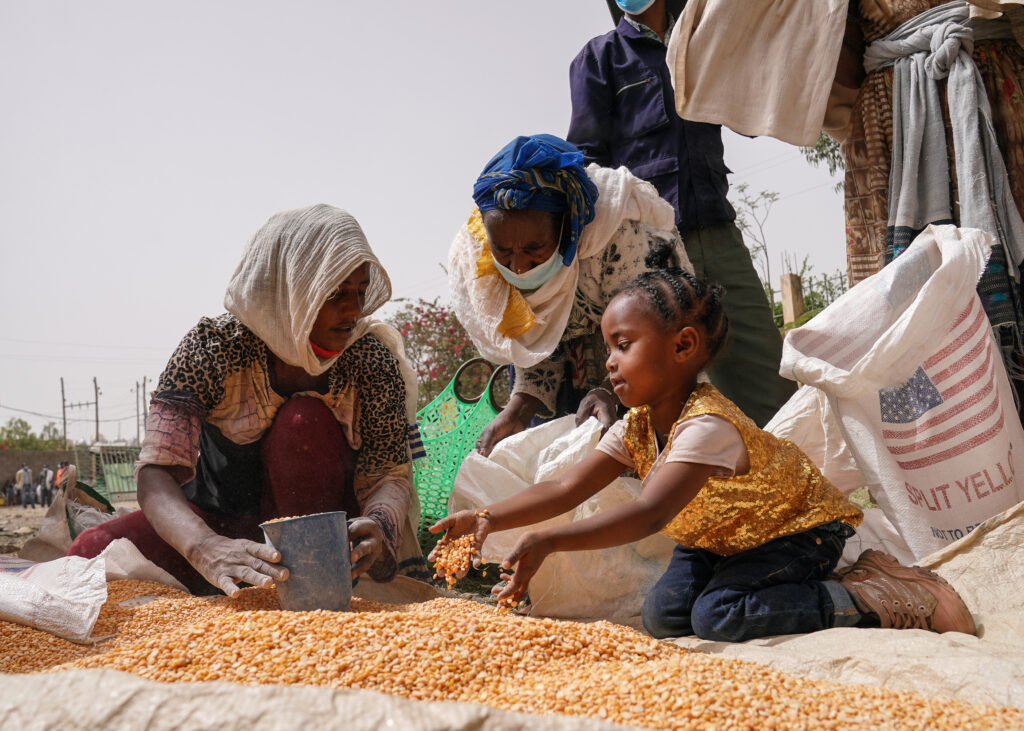
Over the past year, sharp aid cuts have forced the closure of soup kitchens in war-riven Sudan, led to medicine shortages across sub-Saharan Africa, and resulted in reductions in food rations in places such as Somalia and Haiti.
A new study published Monday in the Lancet puts a number on the potential human toll as the global humanitarian system cracks apart, projecting an extra 9.4 million deaths by 2030 if the current trends persist.
The study amounts to an early picture of how funding reductions from the United States and other Western countries could undo decades of health gains, leading to upsurges in HIV/AIDS, malaria and hunger across the developing world.
The projection comes roughly a year after the Trump administration eliminated the U.S. Agency for International Development (USAID). Though that move stood out for its suddenness, other traditional donors — France, Germany and Britain, among them — have also carried out sweeping cuts, prioritizing domestic spending amid economic uncertainty and doubt about whether the donor-led aid model was achieving its goals.
The State Department said in a statement that “some recent ‘studies’ are rooted in outdated thinking, insisting that the old and inefficient global development system is the only solution to human suffering. This is simply not true.”
“Rather than helping recipient countries help themselves,” the statement said, “the old system created a global culture of dependency, compounded by significant inefficiency and waste. This has prompted development donors everywhere — not just the United States — to reconsider their approach to foreign aid.”
Many poor countries say they’d prefer investment and trade to reliance on handouts. But replacing a massive support system built up over decades is also perilous, many development experts say. For now, many poorer nations — particularly those with the most fragile governments — are stuck with getting fewer resources than before.
The Organization for Economic Co-operation and Development (OECD) said global development aid was set to drop between 9 and 17 percent in 2025, following a 9 percent decline in 2024. Countries in sub-Saharan Africa could see decreases of up to 28 percent.
The study by the Barcelona Institute for Global Health, which was funded by the Rockefeller Foundation and the Spanish government, analyzes a scenario in which international aid falls by 10.6 percent per year after 2025. This reflects the average development aid cuts from 2024 and 2025.
The study did not lay out which factors or diseases would lead to the increase in mortality. But health experts are particularly worried about HIV/AIDS, malaria and tuberculosis — diseases whose tolls were curbed after coordinated global efforts.
“It is the dismantling of an architecture that took 80 years to build,” said Rajiv Shah, the president of the Rockefeller Foundation and the leader of USAID for five years under President Barack Obama. “The scale of the cuts and the scale of the reduction far outstrips the scale of philanthropy to step in and solve the problem.”
The study also assesses a more severe scenario of aid budget cuts, in which the world could see 22.6 million additional deaths.
A Barcelona Institute for Global Health study published in July anticipated that the USAID cuts could lead to 14 million deaths in the event of a near-total stoppage of the agency’s former programs.
Ian Mitchell, a senior policy fellow at the Center for Global Development, who was not involved in the new research paper, said he thinks aid cuts over the next few years will be significant — probably “somewhere between the two scenarios modeled in the study.”
Secretary of State Marco Rubio had previously described USAID as a dysfunctional organization.
Last year, in an interview with George Stephanopoulos of “Good Morning America,” Rubio said the U.S. would still “do more foreign aid than any country in the world … but we’re going to do it the right way.” Asked about the potentially deadly consequences of aid cuts, Rubio said that “no one” had died as a result of the American decisions.
“Anybody who tells you that somehow it’s the United States, if we cut a dollar, somehow we’re responsible for some horrific thing that’s going on in the world, it’s just not true,” he said.
In 2024, the last year for which there is official data, the U.S. was responsible for about 30 percent of development aid. It contributed more than twice as much as the next largest donor, Germany, meaning only a free fall in spending could cause it to lose its top place.
Since the elimination of USAID, the U.S. has unveiled a new “America First” global health strategy and reached bilateral health deals with some developing nations. And that kind of work could get a boost if Congress passes a spending bill that would set aside $9.4 billion for international health in fiscal 2026. That sum is more than double what the administration had requested but a step back from budgets of $12.4 billion for both 2024 and 2025.
Heiner Janus, a researcher at the German Institute of Development and Sustainability, said it is difficult to project aid levels for the next few years, given the political volatility.
“It could be the beginning of a longer reversal, what the [study] authors estimate, but it could also be stabilizing,” Janus said.
Davide Rasella, a research professor at the Barcelona Institute for Global Health who was part of the study, said the consequences of aid cuts could be even graver than the decline in funding suggests. He described a conversation with a doctor in sub-Saharan Africa who faced antibiotic shortages because USAID had played a role in transporting them.
“In a complex health care system, even if you take out a part, you collapse the system,” Rasella said.
Shah, of the Rockefeller Foundation, said that he tends “to believe the worst-case scenarios are more likely than not. But to me, it’s also a big signal that in this moment, action saves lives.”
“What is happening out there is a human catastrophe,” he said.
The post Global aid cuts could lead to 9.4 million deaths by 2030, study projects appeared first on Washington Post.