Garland Pollard was 11 in 1976, the year the United States celebrated its 200th birthday, and was living in Virginia Beach with his parents.
“We were a Nixon family,” Mr. Pollard said. “I remember all the dinner party talk about Watergate. There were race riots at that time. It was pretty feisty — there were arguments at the dinner table.”
Yet as Mr. Pollard, 60, wrote in an editorial last summer in Boca Beacon, the Florida newspaper he edits, in that bicentennial year “there was a wave of patriotism that came seemingly out of nowhere.”
This time around, as America commemorates its 250th anniversary, there will be a government-sponsored mixed martial arts bout on the White House lawn and plenty of debate about what it means to celebrate the birth of a nation that finds itself arguably more divided than it was in 1976.
Final plans for the biggest celebrations, including a nationwide block party this summer, are coming together amid protests against federal agents in U.S. cities and international unease over President Trump’s stated desire to take control of Greenland. In short: Are Americans in the mood to celebrate the semiquincentennial?
“In the back of my mind, that question does come up,” said Rosie Rios, the chair of the U.S. Semiquincentennial Commission, a nonpartisan group charged by Congress to plan festivities under the banner America250. “Are we ready?”
The bicentennial year was not always sunny. Trust in the federal government was at a low two years after President Richard Nixon’s resignation. The Vietnam War had come to an end, but scars remained. The economy was so dire that a new word was coined to describe it: stagflation.
In April, a desegregation protest in Boston turned into a riot, during which a photojournalist captured a white man appearing to attack a Black man with an American flag. The photo, titled “The Soiling of Old Glory,” won a Pulitzer.
Marc Stein, a professor of history at San Francisco State University and the author of the forthcoming book “Bicentennial:A Revolutionary History of the 1970s,” said he had been struck by the “eerie parallels” between 1976 and 2026. “In both cases, the celebration takes place in the aftermath of impeachment proceedings,” Mr. Stein said. “In both cases, there’s international conflict. Perceptions of an urban crisis is another parallel.”
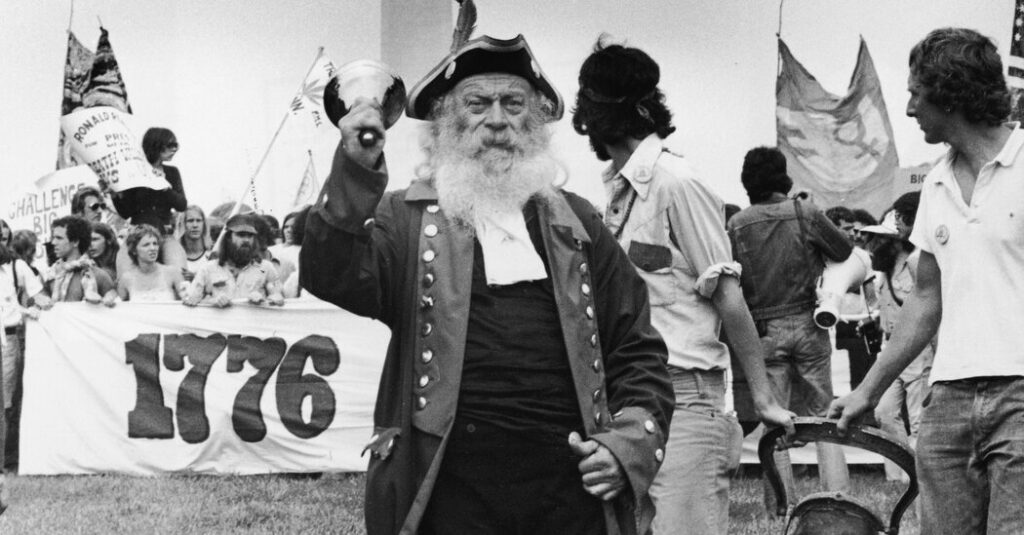
Celebration and protest came together at an anti-big-business demonstration held by the People’s Bicentennial at the Washington Monument on July 4, 1976, with participants dressed in Revolutionary costume. But for the most part, the nation’s 200th anniversary gave Americans the opportunity to look on the bright side of their nation and its history.
All across the country, people painted fire hydrants in stars and stripes or to resemble Betsy Ross and other famed early Americans. Millions of spectators turned out for the “tall ships” that sailed from the Gulf Coast to New York and Boston harbors. Johnny Cash served as the grand marshal of the miles-long Grand Bicentennial Parade in Washington, with President Gerald R. Ford and Queen Elizabeth II looking on.
As part of a school field trip, Ms. Rios, 60, traveled from her home in Hayward, Calif., to Oakland to see a traveling exhibition: the Freedom Train, a steam-powered locomotive pulling cars loaded with American artifacts.
As a 14-year-old in New Jersey, Ronald Rinaldi played a Continental Army soldier in a re-enactment of George Washington’s crossing of the Delaware. “There were thousands of people in attendance,” Mr. Rinaldi, 63, recalled. “The organizers had these bicentennial envelopes they stamped that we carried across the river.”
That moment set Mr. Rinaldi on his life’s path: He majored in American History in college, adopted the founding fathers as personal heroes and became a historical re-enactor. “It was a time to be happy about your country,” he said of the bicentennial year. “To be proud of your country.”
In an act of patriotic cosplay, hundreds of men, women and children crossed the country in 19th-century-style wagon trains as part of the Bicentennial Wagon Train Pilgrimage. The caravan set off from Blaine, Wash., on June 8, 1975. Participants hewed to old pioneer trails and camped along the way. A revue of musicians and actors performed at each stop. The journey ended at Valley Forge, Pa., in time for the fireworks on July 4, 1976.
“These people were farm people, rural people, horse people,” said Earl Reinhalter, 75, one of the wagon train musicians, describing the participants. “This was a once-in-a-lifetime chance. It’s not happening now, 50 years later.”
Trump Administration: Live Updates
Updated
- Trump is set to unveil a $12 billion critical minerals stockpile.
- Trump would have a slim chance in court against Trevor Noah, legal experts say.
- A judge blocked more changes at the President’s House site after the removal of mentions of slavery.
Asked if he felt the country was gearing up for the 250th anniversary as it had for the bicentennial, Mr. Reinhalter said, “I don’t see much excitement, to be honest.”
Part of the reason, he added, might be the mouthful term “semiquincentennial.” “The word you have to use doesn’t roll off the tongue,” he said. “From a marketing standpoint, it’s kind of awkward. The 300th anniversary may be more exciting.”
The U.S. chief of protocol, Monica Crowley, who serves as the Trump administration’s representative for major government-sponsored events, including the semiquincentennial, acknowledged that America today is “riven by very deep divisions.”
Ms. Crowley, 57, recalled celebrating July 4, 1976, at the Jersey Shore. As a young girl, she felt “almost a coziness about American patriotism and pride,” she said. “We are seeking that same kind of feeling for every kind of American.”
A sign of the divisions noted by Ms. Crowley is the continued promotion, by Mr. Trump and many of his aides and supporters, of the debunked claim that he won the 2020 election. In a social media post on Thursday, Ms. Crowley backed the president, writing, “President Trump won 2020 in a landslide.”
Still, she added, “I’m very optimistic about the American people and our capacity to overcome our divisions when we are united by a common goal — or, in this case, a common celebration.”
Whenever the nation throws itself a party, the sitting president plays the host-in-chief. In 1976, the role fell to the unassuming President Ford, who was trying to distance himself from his pardoning of Nixon while running an election campaign.
“This would have been an opportunity to deliver a vision for the country,” said Scott Kaufman, a history professor at Francis Marion University and the author of “Ambition, Pragmatism and Party,” a political biography of the 38th president. “Ford was not a good speechmaker. It may have been a lost opportunity there.”
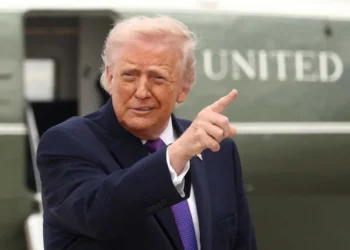
Mr. Trump, who revels in speechmaking and pageantry, has taken the matter into his own hands. He is overseeing a calendar of commemorative happenings under the banner Freedom 250, which is separate from the America250 congressional commission.
The Freedom 250 events include the U.F.C. fight at the White House on Flag Day, which is also the president’s 80th birthday; events on the National Mall, including a prayer gathering; and an athletic competition featuring high school students, dubbed the Patriot Games.
“One young man and one young woman from each state and territory,” Mr. Trump said in a video last month that introduced the games. Then he waded into the politicized debate over transgender athletes: “But I promise there will be no men playing in women’s sports. You’re not going to see that.”
Decades before the internet provided citizens with their own information silos, the media landscape of 1976 helped ensure mass awareness and participation. Three major TV networks dominated the national discourse, helped along by daily newspapers with millions of subscribers and much-read newsmagazines. All went big on the patriotic theme. The long lead time didn’t hurt: Planning for the bicentennial began in 1957.
Corporate America backed the message, with patriotic tie-ins by companies from Campbell’s Soup to Johnnie Walker. Burger King offered what it called a “colorful and fact-filled” calendar to illustrate “historical events in the birth of the U.S.” It came with 12 coupons worth a total of $8.
Even British Airways got in on the act with a new tagline: “You gave us the business 200 years ago, America. Here’s hoping you’ll do it again.” The commercialization was so pervasive that by the fall of 1975, Time magazine had already labeled it overkill. That level of hype is not much in evidence today.
“I don’t think it’s exposed as much as it should be,” said Mr. Rinaldi, the director of special education at a school in Somerset, N.J. “I can remember hearing more about the bicentennial in school as a kid than I see we’re doing now as teachers.”
Before he began talking about the semiquincentennial in class, “most students had absolutely no idea this was coming up,” said Mr. Stein, the college professor.
Mr. Rinaldi also expressed concern about protests this summer, given the heated political climate. “When July 4 comes,” he said, “are there going to be rioters?”
Perhaps more troubling than a fractious 250th anniversary is one that could be met with a shrug. A recent Gallup poll suggested that Americans’ sense of national pride had hit a low. Each generation was less likely to identify as “extremely” or “very” patriotic, with members of Gen Z expressing the least patriotic feelings.
For her part, Ms. Rios, the America250 chair, is aiming for a big-tent celebration that appeals to all Americans. That includes critics.
“You can still love your country and want it to be more perfect as our founding fathers envisioned,” she said. “Why wouldn’t you be patriotic?”
Steven Kurutz covers cultural trends, social media and the world of design for The Times.
The post Will the Spirit of 1976 Come to 2026? appeared first on New York Times.