Until last weekend, few visitors to the Basilica of San Lorenzo in Lucina, in downtown Rome, lingered over the modern decoration of a small chapel. The ancient church’s premier attraction was a Crufixion by the Baroque painter Guido Reni, over the main altar.
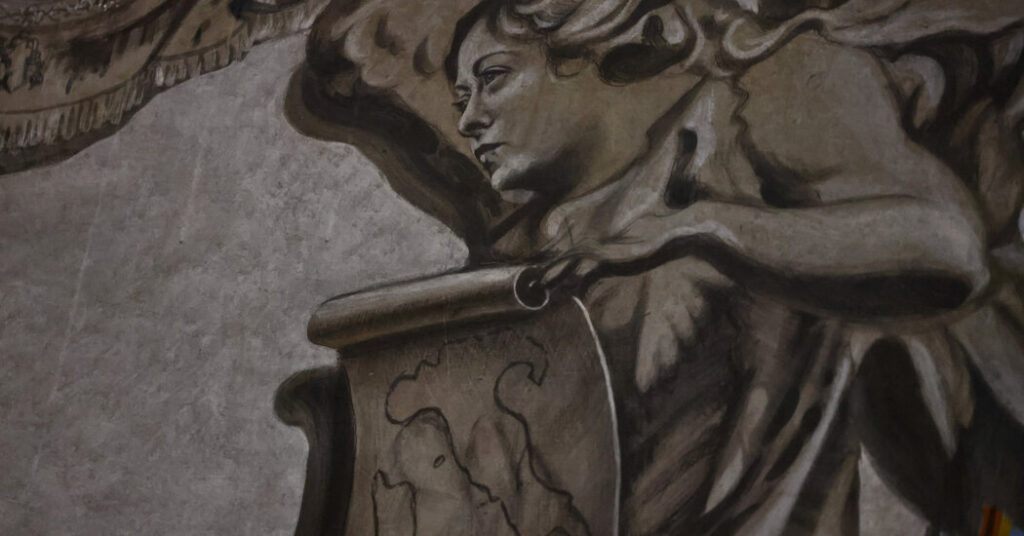
But that changed on Saturday, when a Rome newspaper noted that a recently restored angel painted in that chapel bore a striking resemblance to Prime Minister Giorgia Meloni of Italy. The angel in question is holding a scroll with the outline of Italy.
The report set off a barrage of howls by opposition lawmakers, some hand-wringing by the authorities overseeing the church, and a steady stream of Romans and tourists trekking to the scene, a short walk from Parliament, to see for themselves.
“It is her, yes” said Edoardo Farsi, a government lobbyist whose office is nearby. “It’s crazy. The moment we heard, we had to come,” he said.
The Rev. Daniele Micheletti, the parish’s priest, said he hadn’t noticed the resemblance to Italy’s conservative leader until it made news over the weekend, and now he was vexed that he’d been thrust into a media storm. “It’s just a tempest in a teacup,” he said in an interview in his office on Monday.
Previously, the chapel, near the entrance to the parish offices, had not been a major draw. Around 1985, Father Micheletti recalled, the chapel was allotted to a group of monarchists who installed there a bust of Umberto II, the last king of Italy, who had died in exile in 1983, along with a commemorative plaque. Around 2000, the chapel was frescoed with decorations of sites linked to the Italian royal family as well as two angels flanking the bust.
Over time, water infiltration severely damaged the chapel and church officials had it restored. The restoration was finished last year, just before Christmas.
The chapel remained obscure until the newspaper La Repubblica published a front-page story on Saturday pointing out the likeness to Ms. Meloni. Suddenly it seemed everyone was paying attention, with no shortage of heated opinions.
An opposition lawmaker, Irene Manzi, called the touch-up “unacceptable,” saying that it violated a slew of existing laws meant to safeguard the country’s cultural heritage that prohibit “inappropriate interpretations.”
Italy’s culture ministry said it would look into the matter. Cardinal Baldassare Reina, the second-ranking official of the Rome diocese, after Pope Leo XIV, issued a stern statement pledging to “verify the possible responsibilities of the parties involved.” Images of sacred art and Christian tradition “cannot be misused or exploited, as they are intended exclusively to support liturgical life and personal and communal prayer,” he said.
Ms. Meloni took it in stride. “No, I definitely don’t look like an angel,” she said on Instagram, alongside a laughing emoji. Memes of the prime minister’s likeness being superimposed into other paintings began to spread. Comedians joked that people had started going to pray for taxes to be lowered.
The decorator who painted the original fresco and also carried out the recent restoration is a church volunteer named Bruno Valentinetti. He did not respond to requests for comment.
In videos online, he insisted that the angel did not depict the prime minister and said his restoration faithfully replicated what had been there before. Art experts have been tasked with looking for images of the fresco before the restoration so that they can compare.
Father Micheletti said he was still evaluating what to do. For all the protests, he said he’d gotten some messages from people who thought it was great. “As you know, Italy is always divided on everything,” he said. But if the grumbling gets louder, he said, the angel’s face may have to be repainted.
Riccardo Staglianò, the journalist who broke the story of the likeness in La Repubblica, said Monday that Italians were now racking their brains to figure out who the other angel depicted in the chapel might resemble, with the most disparate names emerging. He spoke of a “collective pareidolia,” the phenomenon of seeing images, particularly faces, in anything from clouds to a grilled cheese sandwich.
He expressed surprise that it appeared no one had controlled or overseen the restoration, especially in such an important church, one of the oldest in Rome. (There has been a church on the site since the 4th century.)
“It’s very improbable,” he said.
After seeing the fresco on Monday, Luciano Bello, a sales agent, described it as “a demonstration of loyalty, an act of adulation,” and a potentially dangerous manifestation of a “personality cult.” He said the fresco should be “chipped away, not just painted over.”
Roberto Meloni (no relation), who is studying management, thought the work was a “satirical act,” but his friend, Cristina Norrito, a law student, countered that this was no place for satire.
A restorer should not be conveying political messages, let alone in a religious context which should remain neutral, she said. “What are we leaving for future generations?” she asked.
Elisabetta Povoledo is a Times reporter based in Rome, covering Italy, the Vatican and the culture of the region. She has been a journalist for 35 years.
The post Does This Angel Look Familiar? A Modern Face Appears in a Rome Fresco. appeared first on New York Times.