For Henry Garnica, a traumatic visit from immigration officials was just the start of the hardest months he’s ever experienced running a business.
On Dec. 11, Mr. Garnica was at a meeting when he saw on his security camera feed several suspicious-looking vehicles idling outside the little grocery store he owns in East St. Paul, Minn. He called his staff and told them to lock the doors. When he arrived, more than a dozen officers surrounded him and demanded to see identification.
Mr. Garnica, a naturalized U.S. citizen born in Colombia, produced his passport. The agents demanded access to the store, where several workers and customers were waiting nervously. They didn’t have a warrant, so he refused, as a helicopter hovered overhead. Neighbors had gathered in support. After about 40 minutes, the officials left.
But in the following weeks, federal officials drove by every day looking for people to detain, Mr. Garnica said, terrifying the owners and workers at immigrant-owned businesses up and down the street. Four of his 10 workers have disappeared, too afraid to come to the store. He keeps the door locked, opening it only for the occasional customer. Sales are down 45 percent, and his savings are dwindling.
“Many small businesses have shut down,” Mr. Garnica said. “It’s not good for the economy, it’s not good for families, it’s not good for anybody.”
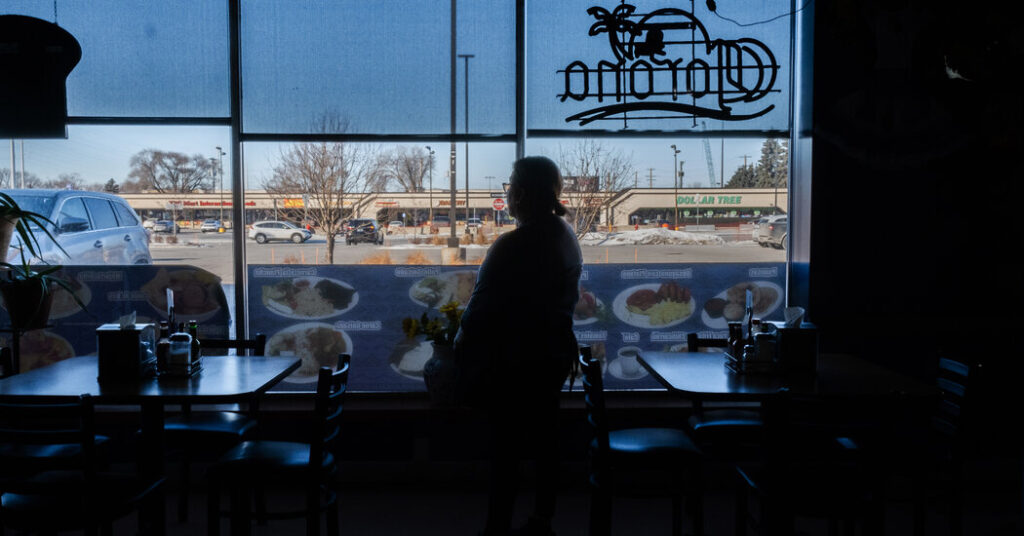
Operation Metro Surge, nearing its third month in Minnesota, has exacted a heavy toll on commercial corridors populated by Latino-owned businesses such as Mr. Garnica’s CentroMex Grocery, as well as Somali and Hmong shops and restaurants.
The damage doesn’t stop there. Although it will take time for official data to arrive, companies across the region have already reported steep declines in revenues. The City of Minneapolis estimates the cost is $20 million each week, and the city’s convention and visitors bureau found that 72 percent of the employers it surveyed — including hotels, retailers and arts organizations — had experienced canceled, postponed or reduced sales.
One investor in a housing development postponed closing the deal out of concern over the city’s prospects, said Erik Hansen, the city’s director of community planning and economic development.
“It’s been brutal,” Mr. Hansen said. “And that is seen not only in free movement in and around the city, but also the business activity that we’re seeing from downtown Minneapolis all the way into the neighborhoods and into the suburban communities.”
The Twin Cities area is experiencing perhaps the most visible economic pain of all the urban centers that have been targeted by Immigration and Customs Enforcement in a year of aggressive deportation efforts. But every one of them — from Chicago to Miami — has sustained some harm.
“If there was any correlation between rampant illegal immigration and a good economy, Biden would have had a booming economy,” a spokesperson for the Department of Homeland Security said in response to a request for comment. “Removing these criminals from the streets makes communities safer for business owners and customers.”
Some business leaders who had remained quiet about the immigration crackdown are calling for a different approach.
A Hurricane or a Recession?
Whenever a region experiences any kind of negative disruption, economists try to understand what the economic impact might look like. Natural disasters like hurricanes are usually thought of as transitory. Economic activity is pushed forward: If you decided against throwing a party or buying a couch while the storm was raging, you’ll likely do it once the sky clears. Also, a bunch of money typically flows from the federal government and insurance companies, seeding a flurry of rebuilding that generates income.
A broader downturn, like the Great Recession of 2008, has longer lasting effects. That’s partly because there’s less money available in the rest of the economy — government budgets are strapped and philanthropy is spread thin.
Some consequences of the ICE disturbance in Minneapolis might lift quickly, like a hurricane. Sarah Enrico owns a catering company that employs about 50 people. As federal agents sowed fear across the region, several clients postponed their events, including one for 280 people worth $30,000. Ms. Enrico had to cancel dozens of shifts and freeze or donate all the food she had already bought.
Nevertheless, Ms. Enrico is hopeful that the events business will come back with a vengeance, like it did after the Covid-19 pandemic eased.
“There’s a very obvious source of the anxiety,” Ms. Enrico said. “Even after the pandemic people were chomping at the bit to have their wedding or do that event or be around people.”
Other damage from the ICE operation will take more time to fix.
Oscar Murcia arrived in St. Paul from El Salvador in 2000, and a few years later started a restaurant and bakery called El Guanaco. He now has four locations, serving mostly Latino customers pupusas and tacos. As ICE activity intensified in December, traffic plunged 80 percent at the Minneapolis location, so he closed it. He has cut hours and staff at the rest of the stores, and asked his landlords and bankers for relief on rent and loans.
Even if customers come back, Mr. Murcia will be missing some of his 64 staff members — four of them were detained, even though he said they had work permits and pending asylum applications.
“It’s going to take a while to grow up again,” he said. “We have to start over with half shift, maybe half employees.”
The Latino Economic Development Center, a nonprofit lender, found that only a fifth of its clients who responded to a survey were operating normally, and half were experiencing “critical” damage. Mercado Central, a hub for Latino businesses, and Karmel Mall, which hosts Somali eateries and shops, have been eerily quiet.
American-born business owners are hurting as well, even if their clientele and workers are less vulnerable to deportation. Lindsey Johnston is the co-owner of Francis Burger Joint, a vegan restaurant with locations on the city’s north and south sides. Every day they hear the whistles and honking horns that follow ICE convoys, and her staff often run out to join the observers. One day her kitchen manager was pepper sprayed and detained for six hours before being released without charges, so the restaurant closed.
“It’s haunting. Everyone is exhausted. Everyone is scared,” Ms. Johnston said. Promotions the restaurant would normally run to draw customers in January feel inappropriate while nobody wants to celebrate, Ms. Johnston said: “There’s lots of people I’ve talked to who are like, ‘yeah, I spent money yesterday and I can’t remember the last time I spent money.’”
One thing common to all crises: The more intense it is and the longer it lasts, the greater the economic damage. Ryan Allen, associate dean for research at the University of Minnesota’s School of Public Affairs, has studied the region’s immigrant communities. He worries about a tipping point that could permanently dim the lights in some commercial corridors if enforcement operations don’t ease.
“For local businesses that have thin profit margins and are not highly capitalized, if this continues much longer it’s hard to see how many of them are going to survive,” Mr. Allen said.
Looking for Help
For some parts of Minneapolis, the crackdown is like salt in an open wound. The civil unrest that erupted after a police officer killed George Floyd in 2020 caused hundreds of millions of dollars in property destruction. A perception of danger depressed activity for years, along with the lingering effects of the pandemic.
During that time, however, the federal government poured resources into communities to keep them afloat — expanded unemployment insurance, forgivable business loans, stimulus checks and direct grants to local governments. None of that appears to be on the way this time.
“The difference there is that the federal government was on our side,” said Alma Flores, executive director of the Latino Economic Development Center. “In this case, I would be shocked if they stepped up and said, ‘We’re going to help you with all of this lost revenue.’”
Minnesota may have more help rebuilding than some places. The Minneapolis Foundation, a nonprofit, has mustered $3.5 million from large companies to help small businesses, and 60 large Minnesota-based companies called for a “de-escalation” of tensions.
Grassroots efforts, such as donated groceries and crowd-funded rent, have been just as powerful. Ingrid Rasmussen is the pastor of Holy Trinity Lutheran Church, a stalwart of Minneapolis’s Longfellow neighborhood for more than a century. She spent her entire discretionary budget in the first two weeks of January helping local businesses pay their bills.
“The need is so astronomical,” she said. “We could be collecting funds for the next five years and never meet what we’re experiencing in terms of economic devastation.”
In Democratic-led states like Illinois and California, officials have also pitched in to address the effects of ICE raids. In Maine, the state chamber of commerce sent a letter to the state’s Congressional delegation pleading for limits on aggressive immigration enforcement tactics.
In contrast, conservative states like Texas and Florida have cooperated enthusiastically with federal immigration officials and enacted their own policies that destabilize immigrant workers and business owners. Tonantzin Carmona, a fellow at the Brookings Institution who has studied the economic impact of immigration enforcement, said that could magnify the damage.
“They’re compounding this issue,” Ms. Carmona said. “So there might be differences in what economic growth looks like in these places a few years from now.”
Lydia DePillis reports on the American economy for The Times. She has been a journalist since 2009, and can be reached at [email protected].
The post ‘It’s Been Brutal’: Twin Cities Economy Suffers Under ICE Crackdown appeared first on New York Times.