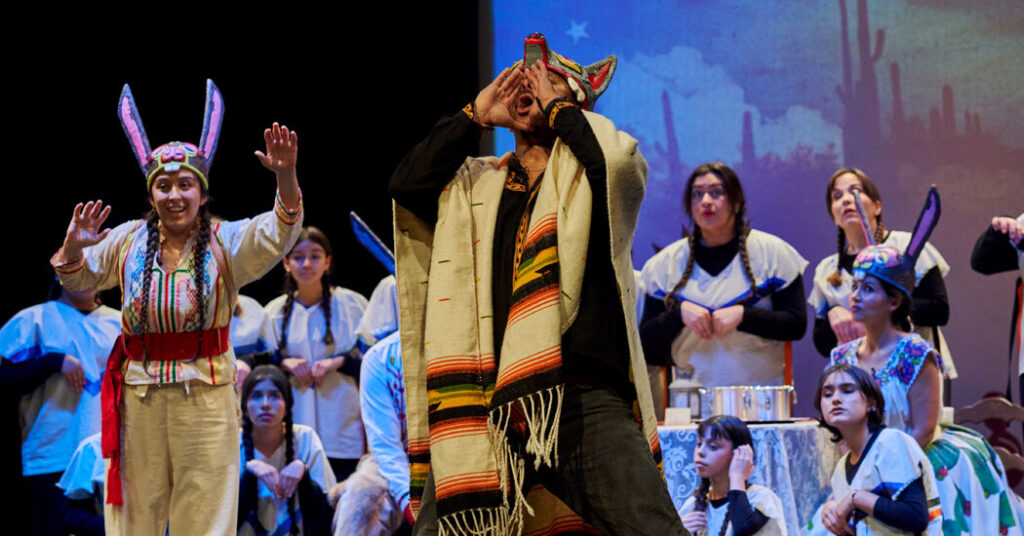
The new children’s opera “Pancho Rabbit and the Coyote” is told with singers dressed up as hopping bunnies, coyotes, snakes and butterflies. In the course of 90 minutes, it chronicles a journey through deserts, a river, an underground tunnel and a wall: a border wall, lorded over by a character known as Orange Snapping Turtle.
Because while “Pancho Rabbit” might present itself as a children’s opera, it tackles some of the most polarizing events gripping the nation today. The opera, based on a children’s picture book and written in Spanish and English, recounts the story of a Mexican farmer (Papa Rabbit), who crosses the border into the United States to work on carrot and lettuce fields. His young son, Pancho Rabbit, embarks on a perilous journey to find his father, escorted by a coyote that later tries to eat him.
Its composer is Anthony Davis, who has a history of tackling politically charged and socially fraught subjects in operas like “The Central Park Five,” about five Black and Latino teenagers wrongfully convicted of raping a jogger, and “X: The Life and Times of Malcolm X.” “Pancho Rabbit” was presented on Saturday night at the Teatro de la Casa de la Cultura in Tijuana, Mexico, a few miles away from the busiest crossing on the U.S.-Mexico border.
The venue, a rambling brick building on a hill with a view over Tijuana, was chosen to underline the urgency of the themes that this opera addresses, albeit cloaked in the guise of a playful story for children.
“I wanted to find a way to capture the imagination of children at the same time having the subtext of what we are dealing with now,” said Davis, who also teaches just across the border at the University of California, San Diego. “With the issue of immigration and that hostility that exists toward migrants and particularly toward the Other.”
In a follow-up email, he said that living in San Diego, he was acutely aware of the border crisis. “I have always felt the need,” he wrote, “to be an activist through my art and reveal through an examination of our history, both recent and in the past, the fractures that persist in our politics and are reflected in our culture.”
Davis created the opera with Allan Havis, the librettist, who is a playwright and professor at the University of California, San Diego. Produced by the nonprofit Bodhi Tree Concerts, the one-night performance of “Pancho Rabbit” in Tijuana came two weeks after its premiere at the Southwestern College Performing Arts Center in Chula Vista, Calif.
“It’s the right message for an opera,” Havis said. “It’s not an escapist story. It’s painfully real. Sometimes we can only accept a dramatic experience as fairy tale. If it works, it’s because it’s artfully indirect.”
The story of Pancho’s undocumented border crossing was topical when the book, “Pancho Rabbit and the Coyote: A Migrant’s Tale,” by Duncan Tonatiuh, a Mexican American author and illustrator, was published in 2013. Barack Obama was president, and Congress was enmeshed in debate over changing immigration laws.
“It’s been an ongoing, unresolved challenge for decades — the whole issue of undocumented aliens,” Tonatiuh said. “But it feels very courageous to put it on now, with everything that is going on.”
Pancho’s tale has fresh urgency at a time when President Trump has targeted illegal immigration on the border with Mexico. Immigration and Customs Enforcement agents patrol San Diego. Several Mexican American members of the opera’s cast, who sang in the premiere, declined to join the performance in Tijuana, concerned that they would have trouble returning to the United States. A $15,000 grant from the National Endowment for the Arts to produce the opera was canceled last year.
“Things have degraded,” said Diana DuMelle, who founded Bodhi Tree Concerts with her husband, Walter DuMelle. They have been developing the opera for nearly a decade. “I’m in San Diego, and there has been a lot of ICE activity and fear.”
The task of producing a bilingual, border-crossing opera with a cast of nine principal singers, a 16-member children’s chorus and a 17-member orchestra, would be daunting at any time. But “Pancho Rabbit,” she said, faced logistical obstacles that reflect both the ambition of the work and the tenor of the times.
“We just have to jump the hurdles,” DuMelle said. “We’re pushing through. It’s been tricky. Our main concern — our goal — is to open the hearts and minds of your traditional opera community.”
Pancho’s journey begins after Papa Rabbit’s family gathers for what was supposed to be a fiesta celebrating his return to Mexico from his visit to “El Norte,” or the North. When he does not show up, Pancho Rabbit, played in Tijuana by the American soprano Maya Goell, sets out to find him. Along the way, he accepts an offer of help to cross the border from a coyote (Victor Ryan Robertson, an American tenor who sang the role of Elijah Muhammad in “X” at the Metropolitan Opera).
The coyote, an animal chosen in a nod to slang that refers to people who escort immigrants across the border, grows hungry after an arduous journey: hopping a speeding train, fording a river, dodging snakes, pushing aside spider webs and bats in an underground tunnel. The coyote, out of food, and finally on U.S. soil, announces that he will now cook and eat Pancho. At that moment, Pancho’s father, hearing his son’s alarmed cries, appears and rescues him.
Davis’s previous operas have included polemical moments, but “Pancho Rabbit” is more allegorical. “We’re not telling the story, we are showing the story,” he said. “I didn’t want it to be in your face: All of a sudden you realize what this is about, without it being as confrontational as I usually am.”
At times, as the opera expands on the book to make it more reflective of contemporary events, its resonance may seem pointed. “It’s a little more explicitly political,” said Tonatiuh, comparing it with his book. ‘Some things are said more explicitly. Some things are sung more explicitly.”
For example, the opera depicts a dream of Pancho’s in which he comes across a child who is locked in a cage then rescued by a flock of butterflies that boast of overcoming ICE. There are descriptions of border patrol officers who wear green night goggles, and carry guns and plastic handcuffs.
There is also a character in the opera that was not in the book: the orange snapping turtle, portrayed by the contralto Sharmay Musacchio, who guards a wall that is meant to keep Pancho out. (The turtle suggests Mr. Trump, but the president is a named role in “The Central Park Five,” which premiered during his first term and won the Pulitzer Prize for music.) The turtle sings:
I can build a wall so high That even birds won’t dare to fly. I’ll have my way I’ll make Mexico pay!
When Pancho returns home with Papa Rabbit, the family bursts into celebration — until Papa Rabbit reminds them that he likely will be forced to make the same trip again when the next growing season arrives:
I don’t want to go. But if the rain doesn’t come this year, if there isn’t food or work, what can I do? I would have to cross the border another time, to El Norte.
That moment, Havis said, captures the despair of migrant farm workers. “The next chapter of this story can be even more dangerous,” he added. “There is something a little ominous. There’s not a happy ending here. We are simply on pause.”
Yet the opera ends with an ecstatic dance to what Davis called a song of liberation. “It’s kind of uplifting and empowering,” he said, “looking forward to a post-Trump world.”
As that music plays, the Orange Snapping Turtle steps out, campy and animated, and seeming to imitate the distinctive off-balance dance style of Mr. Trump. On Saturday, Musacchio bounced down the steps and into the crowd before leaving through a side door. The audience broke into laughter and applause.
Adam Nagourney is the classical music and dance reporter for The Times.
The post At the U.S.-Mexico Border, a Children’s Opera Sings to the Moment appeared first on New York Times.