YANGON, Myanmar — Few complaints can be aired openly in Yangon.
Myanmar’s military generals administer the city watchfully. Informants lurk in teashops and on tuktuks. Chinese-made surveillance cameras scan intersections for unusual activity. Each week, say watchdog groups, prisons grow more congested with people accused of criticizing the regime.
Those who have survived in the city so far know it doesn’t pay to talk. So I was surprised to find while reporting in Yangon last week that there was one grievance so exasperating it seemed impossible to repress: Import restrictions.
To squash the rebel groups that have been fighting it on different fronts, the military has substantially tightened the inflow of foreign goods over the past year. The curbs have suffocated Yangon, the country’s largest city and commercial hub. From shopkeepers and diplomats to taxi drivers and U.N. officials, everyone had a story.
There was a Coca-Cola shortage because factories weren’t able to bring in the company’s trademarked formula from abroad. Some KFC outlets, after running out of sauce packets, started giving out a random assortment of local sauces in plastic baggies.
Increasingly, people said, the only way to get nail polish remover or contact lens solution or cat food or tampons was to have the rare visitor mule it in from elsewhere. A pound of yeast used to cost 2,000 Myanmar kyats, or just under a dollar. On the black market now, it goes for ten times that amount, said a dry goods trader.
Since Myanmar’s military seized power in a violent coup five years ago, the country’s inflation rate, according to the World Bank, has hovered between 20 and 40 percent.
I’ve covered Myanmar’s civil war since 2022, detailing painful and graphic accounts of the military’s repression. Political prisoners executed despite appeals. Children killed in indiscriminate airstrikes. Young men fleeing conscription through jungled hills.
The military has tried to stifle these stories by blocking international journalists from entering the country. But over the past month, it allowed some of us back in on short visas, ostensibly to report on its efforts to stage an election.
Every watchdog group I spoke to said the polls would not be free or fair. Long before any ballots were filled, it was all but assured that the Union Solidarity and Development Party, a military proxy, would win in a landslide — and so it did.
Still, the opportunity to observe military-controlled parts of Myanmar was a rare and valuable one. So on a Thursday night in late January, I found myself disembarking at Yangon airport, the only passenger on my flight — or any other flight, it seemed — to head toward the customs desk that said “FOREIGNER.” The officer on duty, stirred from a supine state on a bench, took my photo with both a desk camera and his phone, then waved me through.
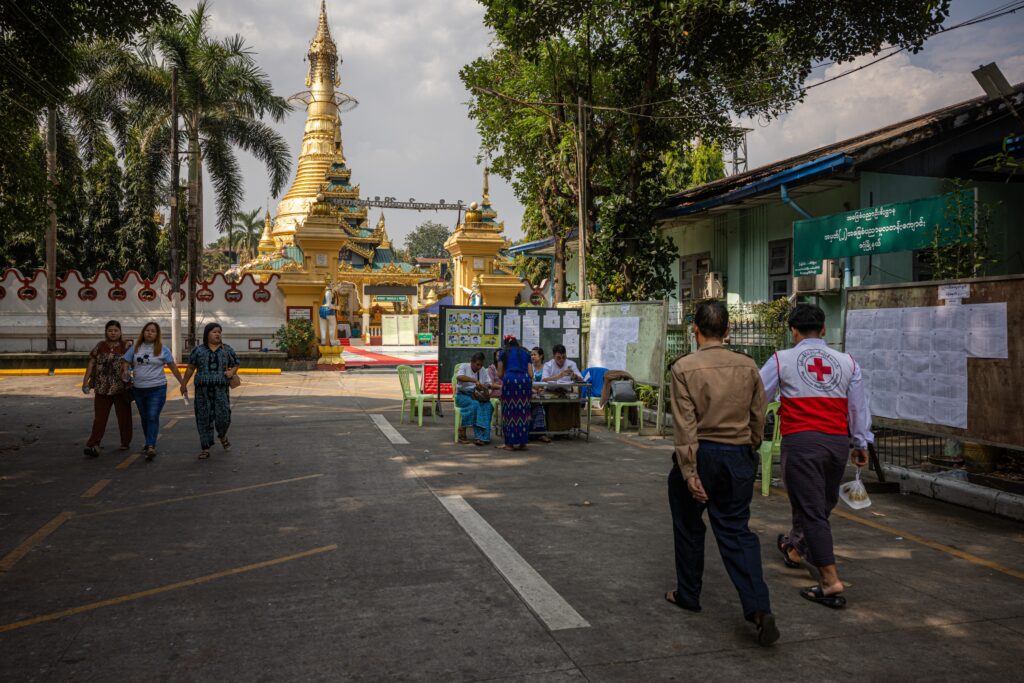
It was the first of many times over the week the regime would log my image. Police and military intelligence officers snapped away openly as I visited polling stations on election day. At a rally held by pro-military, ultranationalist Buddhist monks, I had to stop an interview midway because the monk I was talking to started recording me instead, placing his phone so close to my face, I couldn’t quite see.
Like other journalists, I wasn’t allowed to venture to contested parts of the country like Sagaing or Magway, which the junta continued to bomb through the election. Neither was I allowed to travel to the western state of Rakhine, where more than 100,000 ethnic Rohingya people are living in dilapidated camps that are effectively prisons.
Yangon residents made sure to tell me the city was a “bubble” insulated from the worst of the country’s suffering. Yet, in the same breath, they would also gripe about the price of groceries, medicine, electricity. I came to see this frustration as part of a deeper sentiment settling over Myanmar: Exhaustion.
International support for the country’s pro-democracy movement, including from the United States, is crumbling. In places such as Yangon, the prospect of ousting the generals feels distant. Many people are attempting — or have attempted — to leave the country. And those who can’t are desperate for any change that could ease the pressures of daily life.
“Enough of this,” said a bald, hunched 44-year-old trader, who like many other locals spoke to me on the condition that I omit his name in case of reprisals from the military.
From his office in downtown Yangon, he pointed out on a map the different trading routes that have been shut down by the military, his voice rising in incredulity. He has five containers’ worth of electronic goods in China that can’t enter Myanmar because the regime won’t issue him import licenses, he said.
“Politics is politics. Fix the economy,” he snapped, “People need to live. More than 50 people work for me. They need to eat. They have children who need to eat.”
In the lead-up to the election, security consultants, diplomats and analysts had anticipated a surge of anti-military violence. They thought resistance groups would assassinate pro-junta candidates, fling homemade explosives at polling stations or ambush military convoys transporting ballots.
Over three rounds of voting, however, there were hardly any attacks. The military’s senior general Min Aung Hlaing walked freely around Yangon’s polling stations.
“In how things have unfolded … the military has gathered a lot of information about the resistance. It has reason to be more confident,” said Min Zin, who leads the Institute for Strategy and Policy-Myanmar, a Thailand-based think tank.
Toward the end of my allocated seven days in Myanmar, I met with a trader of bicycle and bicycle parts. Ashen, heavy bags hung under his eyes.
He had been waiting five months for an import license, he said. He’d been trying to bring in cargo over the land border with Thailand but recently almost every consignment had been seized by military authorities. At least, he added with a laugh, there wasn’t pressing demand. Pre-coup, he used to sell ten bicycles a day. Now, there were long stretches of days he didn’t sell even one.
As we finished our coffee, I asked where he was headed next. He sighed. He was going to see brokers who help solicit and process bribes for the military, he said. For every 70 cents he was looking to import, he said, the military wanted $1. “It’s the worst it’s ever been,” he said.
The bicycle seller gathered his things and looked at his watch. Wearily, he headed back into the streets of Yangon.
Cape Diamond contributed to this report.
The post Coca-Cola, cat food, tampons. The missing goods of military-run Myanmar. appeared first on Washington Post.