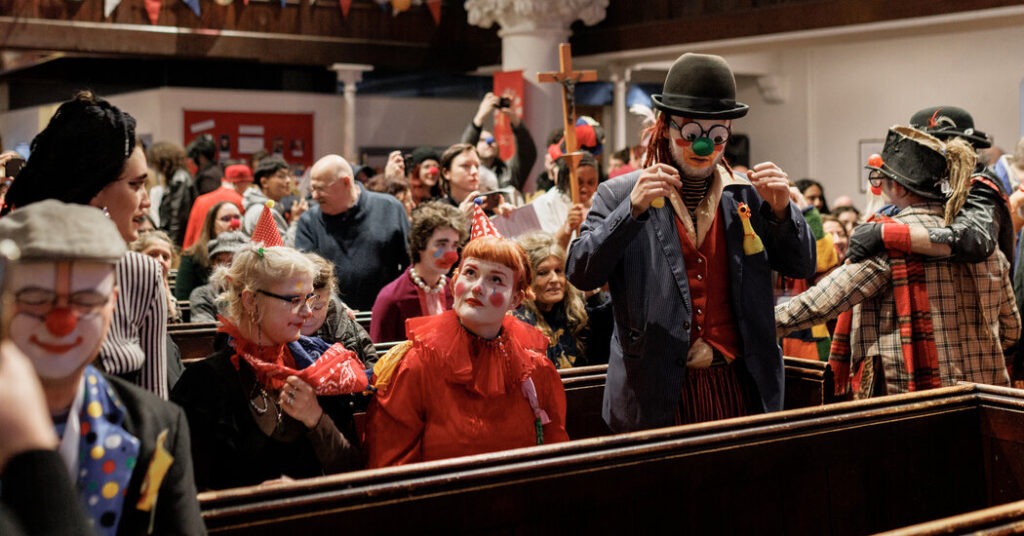
The pews were full at All Saints Church in northeast London on Sunday as the parishioners bowed their heads in prayer, sang hymns enthusiastically and raptly listened to a Bible reading. It could have been any church service except for one thing: Many in the audience were clowns.
This was the 80th annual Grimaldi Service, held each February to honor Joseph Grimaldi, a 19th-century performer known as a father of modern clowning.
If it weren’t for Grimaldi, the white-faced, red-nosed and rosy-cheeked makeup associated with clowns would not exist. And although he’s little known outside clowning circles, the Grimaldi Service draws a vast audience of locals and tourists who want to celebrate the art form he helped shape.
“We can be faithful to God and also have a laugh,” Laura Luz, the church’s vicar, said in an interview, noting that, during her eight years leading the service, one clown had thrown a custard pie in her face and another had encased her in a giant soap bubble. At no other service did people worship with “such a real spirit of joyfulness,” she said.
Sunday’s service began with a procession of about 30 clowns in full makeup along the church’s nave, including one riding a miniature bicycle and another blowing bubbles out of a toy saxophone. They and the 700-strong congregation then read aloud a prayer that asked the Lord to forgive them “for all the times when we have failed to see the joke.” Josie Godfrey, the church’s assistant curate, later delivered a sermon about how laughter was essential, even in times of grief.
As she finished, a clown honked a rubbery horn in approval.
The first Grimaldi Service was held in 1946, a few months after the end of World War II. Mattie Faint of Clowns International, the group that organizes the service, said that clowns had gathered at Grimaldi’s graveside in north London to remember friends who had died in the war — and perhaps also to generate publicity that would get Londoners, still reeling from the conflict, to start coming to circuses again.
In the service’s early years, the clowns wore their Sunday best to worship, but Faint said that in the 1960s they switched to their clown outfits. That created one of London’s more unusual ecclesiastical sights, although Faint, 73, stressed that clowns were “ordinary people” beneath the makeup. “Just because we’re in costume doesn’t mean we don’t have the same feelings as anyone else,” he said.
The service became so well known that the BBC has featured it several times on “Songs of Praise,” a long-running TV show about churchgoing. One broadcast filmed at the service included a segment in which two clowns told the biblical parable of the Pharisee and the tax collector by throwing buckets of slime over each other.
Andrew McConnell Stott, who wrote a biography of Grimaldi, said by phone that there was no evidence that Grimaldi had been religious. His clown act also wasn’t quite like those of the children’s performers who often fill the pews at the Grimaldi Service.
Instead, Stott said, Grimaldi was a star of 19th-century pantomimes, bawdy entertainments that evolved into the holiday-season spectacles of today. One part of his show had a plot involving several villains — one called Clown — trying to break up a budding romance, Stott said. As the story progressed, Clown would perform physical comedy and daredevil stunts to uproarious laughter.
In a typical scene, Grimaldi would fall off a high balcony and crash to the floor, only to leap back up to to the balcony’s ledge, then pratfall back down again. He was a virtuoso of physical performance,” Stott said, “the best to ever do it.”
When Grimaldi was starting out, the clown character dressed like “a country bumpkin,” according to Stott. Then, in 1802, Grimaldi started applying distinctive face paint to make him visible from the back of London’s vast theaters.
That look helped turn him into one of the city’s first celebrity entertainers. He performed to thousands a night, and newspapers wrote about his onstage antics as well as his troubled private life. He suffered from bouts of depression and had a strained relationship with an alcoholic son, who predeceased him.
Stott said that Grimaldi’s legacy wasn’t just that clowns had mimicked his look and performance style; his temperament also helped create the idea of the sad clown who makes others laugh despite their own problems. Stott recalled a quip that Grimaldi used to make based on his own name: “I make you laugh all night, but I’m grim all day.”
At Sunday’s service, there were moments that played into the trope of the melancholic clown. At one point, Brian Kinney, an American clown known as Blotto, read a poem about a performer whose “shoes were too big” and hat “too small,” but “just wasn’t funny at all.” Later, children lit candles in memory of clowns who had died over the past year, including “Juggles” Lee Mullally and “Pattycake” Patsy Garland.
But overall, the mood was upbeat. Mr. Pineapple Head, whose real name is Ben Edmonds, said that although he’d been working as a clown for 30 years, he had avoided the Grimaldi Service until recently because he wasn’t a church goer. But when he came he found it “genuinely moving” and like “a free party.”
Eleni Papachristodoulo, 27, a graphic designer wearing clown makeup, said that she was at the service because she was obsessed with clowns. Plus, she said, her mother had once lived in the house where Grimaldi died, and claimed to have “been haunted by his ghost. ”
At the end of the service, the clowns gave out pieces of cake decorated with Grimaldi’s image. Then they staged a performance on a makeshift stage at the front of the church.
Ollie Inge, 11, the youngest clown in attendance, rode a unicycle while bouncing on a trampoline. Mr. Pineapple Head got stuck in a beach chair. And Tweedy, who runs his own tiny circus, pantomimed a skit about a lost bowler hat.
None of them mentioned Grimaldi. But as children’s laugher filled the church, the clowns certainly invoked his spirit.
Alex Marshall is a Times reporter covering European culture. He is based in London.
The post When the Clowns Went to Church appeared first on New York Times.