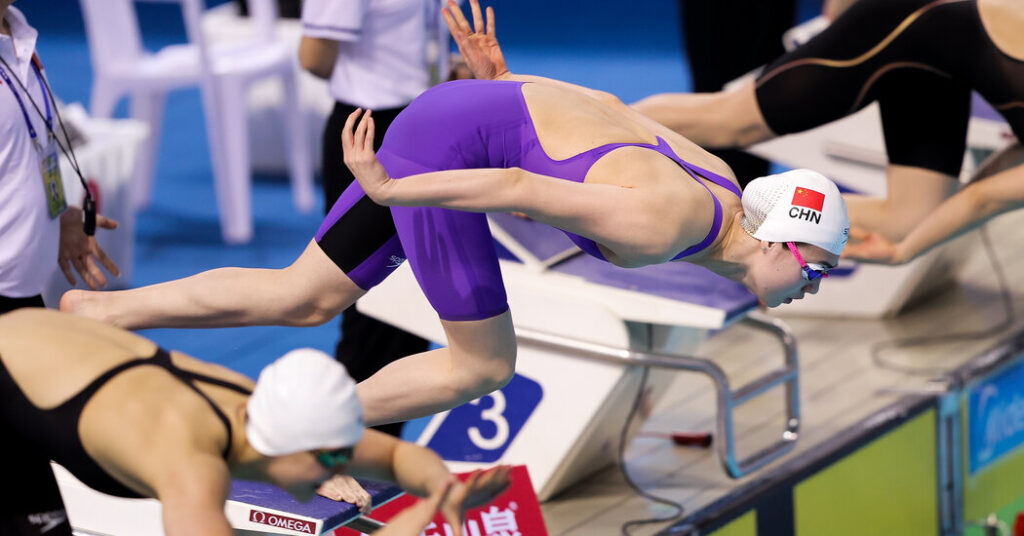
The Chinese swimmers won their Olympic races, stepped onto the podiums and posed for photos with their medals in 2021. Years later, the world learned that they had been cleared to compete despite failing doping tests.
The revelation, first published by The New York Times in 2024, created a crisis for the World Antidoping Agency, the group responsible for ensuring fair competition in elite sport. Chinese officials who had conducted the doping tests did not penalize the swimmers, and the agency knew about the tests but chose not to intervene.
Now, in an effort to restore its credibility, the World Antidoping Agency, better known as WADA, is considering a major change to testing rules before major events like the Olympics. After years of largely relying on the biggest nations to screen their own athletes before major international competitions, the agency is moving closer to recommending a new system in which an independent organization would conduct at least part of the testing.
WADA has commissioned a working group to study the feasibility of such a change. The discussions are occurring too late to affect the Winter Olympics that begin this week in Italy, but they could come into play before Los Angeles hosts the Summer Olympics in 2028.
The global authority has strongly denied that it did anything wrong in the 2021 episode, or that the Chinese swimmers should have been barred from competing in the Tokyo Games after they tested positive for the drug trimetazidine, a banned heart medication. The Chinese antidoping regulator found that the swimmers had ingested the substance inadvertently through food contamination, and although some experts viewed the finding as implausible, WADA agreed with the Chinese account.
When reports of how the tests were handled came to light in 2024, WADA and its longtime director general, Olivier Niggli, faced harsh criticism from some members of the global antidoping community, notably in the United States. Swimming’s global governing body recommended that WADA stop permitting countries to test their own athletes, a change that WADA is now discussing.
In an interview, Mr. Niggli said that the swimming episode “indicated that the testing of athletes before a major event, which could be an Olympic Games and maybe world championships, a portion of it at least should be done by an independent organization, not by the national antidoping body.”
He added: “The risk is, whether true or perceived, that they might have a conflict of interest or they might be biased, because if the national hero tests positive this could be an issue for the country.”
The working group is expected to provide its findings in March. “This is not something that would take ages to be implemented,” Mr. Niggli said.
It was an earlier Winter Olympics that was at the center of the worst doping scandal in sports history. Russia, in a scheme that incorporated operatives of its domestic security agency, swapped out dirty samples from its athletes during the 2014 Winter Olympics for clean ones, allowing cheating athletes to go undetected. An investigation found that Russia had been manipulating the doping records of its athletes for years, corrupting scores of international events, including other Olympic Games and world championships.
A scandal involving a heart drug marred the last Winter Olympics, in 2022 in Beijing, when Kamila Valieva, a 15-year-old figure skating star, competed despite having tested positive for the same banned drug as the Chinese swimmers.
WADA’s biggest critic has been the United States Antidoping Agency. Its chief executive, Travis T. Tygart, suggested that the push to take responsibility away from domestic testers was an overreaction to the conduct of “a couple of bad apples.”
“It’s inaccurate to paint the whole world as favoring their own dirty athletes. Just ask Lance Armstrong, Marion Jones,” said Mr. Tygart, citing two disgraced former American sporting superstars whom his agency’s testing helped expose. “There are many of us out there that put clean athletes first above all else.”
WADA has said the United States’ testing regime isn’t above reproach, criticizing it for breaching the rules over a decade ago by allowing athletes who had failed tests to continue competing. In that case, U.S. officials said, the athletes had been permitted to keep competing so they could work undercover to assist in a criminal investigation into human and drug trafficking, which resulted in convictions.
Before Olympic competitions, most antidoping tests are carried out by national bodies, and by individual federations for some of the biggest sports. The pre-Olympics testing program is devised by the International Testing Agency, a group formed after the scale of Russia’s cheating program was uncovered that is responsible for testing conducted during the Games themselves.
Mr. Niggli said that under a new system, testing before competitions could be put in the hands of private companies, which already carry out antidoping work, or greater responsibility could be given to the I.T.A. Others are skeptical of the independence of that agency, which receives millions of dollars in annual funding from the International Olympic Committee and includes representatives of the committee itself.
“Neutrality is in the eye of beholder,” said David Howman, the chairman of the Athletics Integrity Unit, the independent body responsible for antidoping in track and field, and a former director general of WADA.
Testing before major competitions currently differs by sport and country, and how and when athletes are tested is constantly adjusted as science evolves. Top athletes in sports like swimming, track and cycling are expected to provide a so-called one-hour whereabouts window every day of the year to allow testers to make surprise visits.
That type of testing has proved successful in track and field, which in recent years has caught many high-profile athletes.
The Canadian swimmer Penny Oleksiak, a seven-time Olympic medalist, is currently serving a two-year suspension for three “whereabouts failures.” Ms. Oleksiak has denied taking any banned substances.
On Monday, the Italian news media reported that an Italian biathlete, Rebecca Passler, had tested positive for a banned substance in what was believed to be the first doping case in the run-up to the Winter Games.
Other sports, notably soccer, are less reliant on such methods, and perhaps as a consequence positive tests are relatively rare.
“To run a program that’s exhaustive costs money,” Mr. Howman said.
Tariq Panja is a global sports correspondent, focusing on stories where money, geopolitics and crime intersect with the sports world.
The post Countries Have Long Tested Their Own Athletes for Doping. That Could Soon Change. appeared first on New York Times.